Rajasthan Budget Direct Benefit Transfer For Tribal Families
Source:patrika ↗
Why It Matters
Important for RPSC RAS aspirants to track state budget announcements, welfare policy reforms like direct benefit transfers for Particularly Vulnerable Tribal Groups (PVTGs) like Sahariya and Kathodi, and digital governance initiatives like the Shram Setu app.
Summary
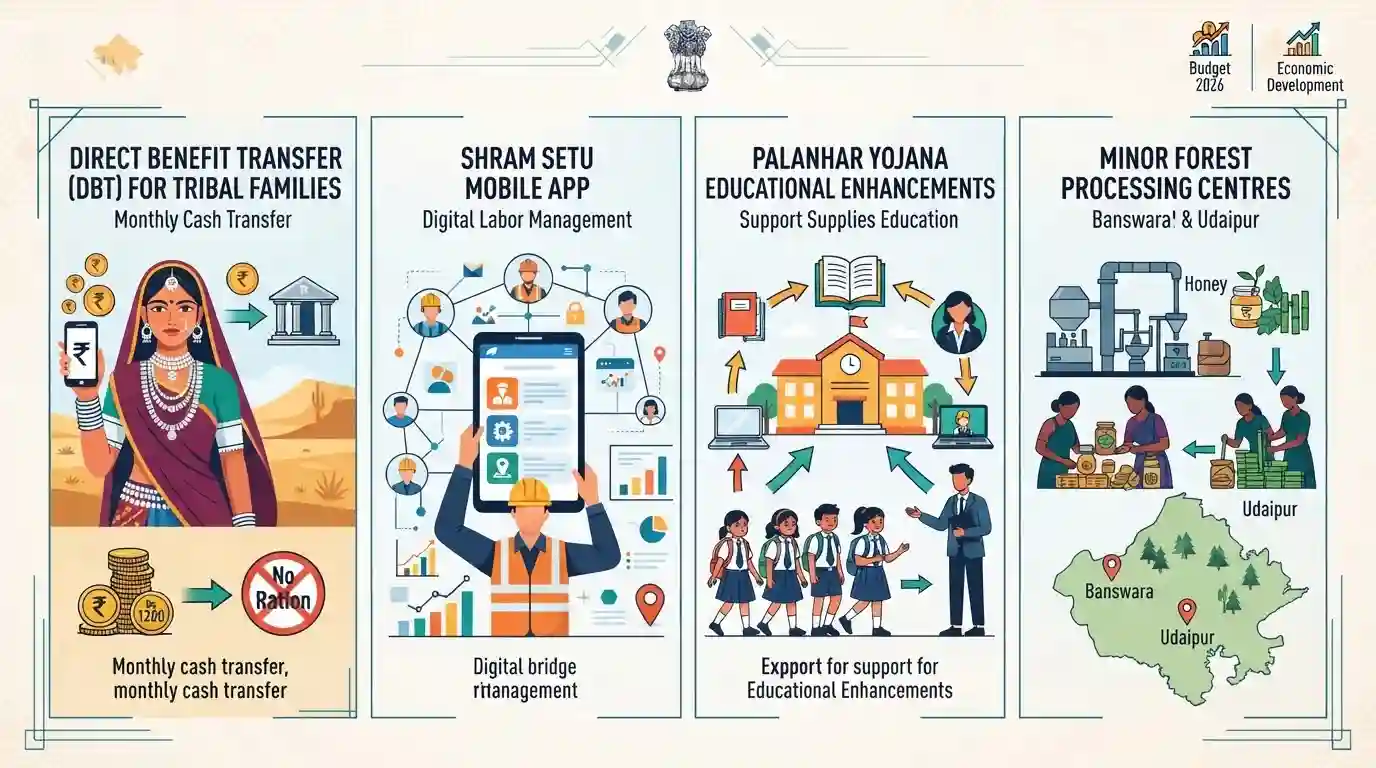
The Rajasthan Budget 2026, presented by Finance Minister Diya Kumari, introduced key welfare measures including a monthly direct benefit transfer of Rs 1,200 to female heads of Sahariya-Kathodi tribal families in lieu of ration distribution. Other major announcements include the launch of the Shram Setu Mobile App for digital labor management, educational enhancements under Palanhar Yojana, and setting up Minor Forest Processing Centres in Banswara and Udaipur.
Key Points
- The Rajasthan Budget 2026 introduced a direct benefit transfer (DBT) of Rs 1,200 monthly to the female head of households for Sahariya-Kathodi tribal families, replacing the earlier ghee and oil ration distribution system, benefiting around 38,000 families.
- The 'Shram Setu Mobile App' was announced as a digital labour chowk facility to help laborers register, obtain ID cards, and manage job demand-supply online.
- Palanhar Yojana beneficiaries will now receive options for higher education and professional training.
- Minor Forest Processing Centres will be established in Banswara and Udaipur districts to promote forest resources and local employment.
Important Terms
Palanhar Yojana

A Rajasthan government welfare scheme providing financial assistance to guardians of vulnerable or orphaned children for their upbringing, education, and nutrition.
UPSC context
Important for RPSC welfare schemes, social security, and child development policies in Rajasthan (Paper II/III).
Shram Setu Mobile App
A digital platform launched by the Rajasthan government to streamline labor management, registration, identity card issuance, and delivery of welfare benefits to workers.
UPSC context
Tests digital governance initiatives and labor welfare administration in Rajasthan for competitive state examinations.
Static Concepts Connected
Which communities in Rajasthan are classified as Particularly Vulnerable Tribal Groups (PVTGs) by the Central Government?
- Sahariya Recognition: Sahariya Tribe is the only tribe in Rajasthan recognized by the Government of India as a Particularly Vulnerable Tribal Group (PVTG), traditionally concentrated in Baran district.
- Kathodi Tribe: Kathodi Tribe is also recognized as a PVTG in Rajasthan, known for their traditional skill in catechu (kath) making, primarily residing in Southern Rajasthan.
- PVTG Count: Total PVTGs nationally stand at 75, with specific central and state interventions like special ration and DBT schemes dedicated solely to their upliftment.
Cross-Topic Patterns
PVTGs + DBT welfare convergence
Sahariya and Kathodi communities are constitutionally classified as Particularly Vulnerable Tribal Groups (PVTGs), linking state budgetary DBT schemes directly with central PM-JANMAN frameworks.
Minor Forest Produce + Van Dhan model
Minor forest processing centres in Banswara and Udaipur connect tribal livelihood schemes with the national Van Dhan Vikas Kendra model under TRIFED.

RPSC frequently tests specific welfare allocations and PVTG target groups in budget questions; expect direct questions on Sahariya-Kathodi DBT.
Linked PYQs · 3
Linked PYQs · 3
- 2024RPSC_PRELIMSGS1
Who among the following are eligible for Amrita Scheme in Rajasthan? (i) Persons with specially abled 40% or more disability. (ii) Specially abled category with more than 40% percent disability. (iii) B.P.L. family persons. (iv) Families where 2 or more people are specially abled. (v) Families with a specially abled transgender.
- 2024RPSC_PRELIMSGS1
Who among the following are eligible for Aastha Scheme in Rajasthan? (i) Persons with specially abled category. (ii) Specially abled category with more than 40 percent disability. (iii) If people are specially abled 2 or more people are specially abled. (iv) Families with 2 or more specially abled persons.
- 2025RPSC_PRELIMSGS1
What is the objective of the Chief Minister Swanidhi Yojana in Rajasthan?
