Rajasthan Budget 2026 introduces monthly financial relief for families
Source:patrika ↗
Why It Matters
Crucial for RPSC RAS aspirants tracking recent state budget allocations, social security frameworks, and direct benefit transfer (DBT) welfare schemes implemented by the Rajasthan government.
Summary
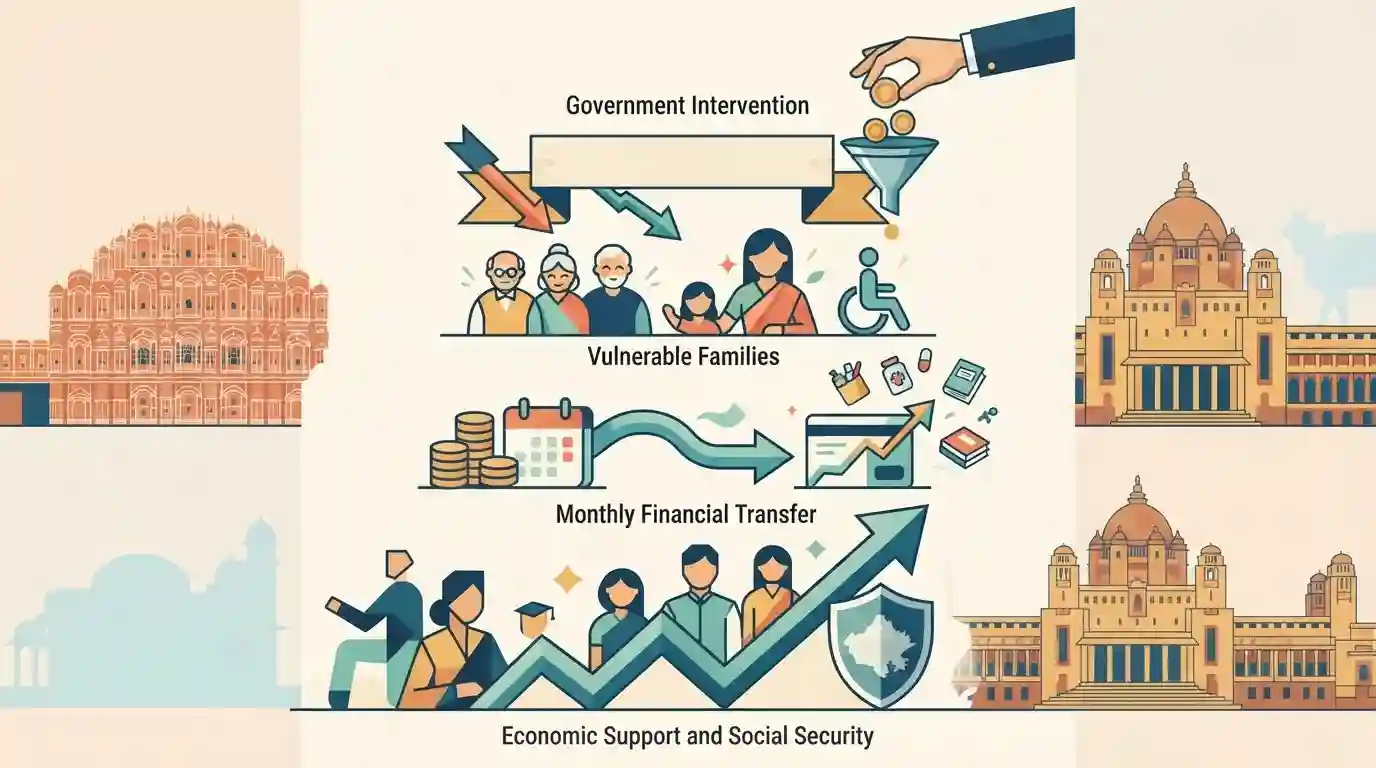
The Rajasthan Budget 2026 announced significant welfare relief, including a monthly financial transfer of ₹1,200 targeted at specific vulnerable families to boost social security and economic support within the state.
Key Points
- The Rajasthan Budget 2026 introduces major financial relief provisions, including a monthly transfer of ₹1,200 to eligible families.
- The policy targets social security enhancement, supporting vulnerable households across the state.
- Focuses on welfare measures implemented by the state administration to alleviate economic stress for marginalized demographics.
Important Terms
Rajasthan Budget 2026

The annual financial statement of the state of Rajasthan for the fiscal year 2026-27, presented by the state government, outlining fiscal policies, tax proposals, and major social welfare outlays.
UPSC context
Important for RPSC Economics and Polity; tests knowledge of state financial statements, welfare schemes, and budgetary allocations for vulnerable sections.
Government of Rajasthan
The executive branch of the state government in Rajasthan, responsible for governance, public administration, policy implementation, and formulating state financial budgets.
UPSC context
Essential for RPSC Indian Polity and Governance; evaluates understanding of state administrative framework, policy execution, and governance mechanisms.
Prelims Trap
Universal monthly cash transfers of ₹1,200 are provided to all households across Rajasthan under the state budget.
Aspirants often confuse the ₹1,200 monthly cash transfer for Sahariya-Kathodi families with universal basic income schemes, ignoring that it replaces specific in-kind rations (ghee and oil) for vulnerable tribal groups.
Static Concepts Connected
What are the special vulnerable tribal groups (PVTGs) identified in Rajasthan for targeted welfare schemes?
- Recognized PVTGs: Identified Groups: Sahariya and Kathodi are the primary Particularly Vulnerable Tribal Groups (PVTGs) recognized in Rajasthan.
- Concentration Districts: Geographic Focus: Sahariya tribals are mainly concentrated in Baran district (Shahbad and Kishanganj blocks), while Kathodi tribals reside in Udaipur and Sirohi districts.
- Special Support: Special Provisions: They receive dedicated state support like direct cash transfers, subsidized food grains, and specialized livelihood schemes due to extreme marginalization.
Cross-Topic Patterns
Tribal Welfare DBTs + Digital Labor Portals
Direct benefit transfers in tribal schemes like Sahariya-Kathodi intersect with digital governance initiatives like the Shram Setu Mobile App for labor coordination.
State Budgets + Fiscal Responsibility Metrics
State-level welfare expansions under Rajasthan Budget 2026 connect fiscal deficit targets under FRBM to social sector outlays.

Rajasthan budget DBTs and tribal welfare schemes (Sahariya-Kathodi) will feature in matching or multi-statement RPSC prelims questions.
Linked PYQs · 3
Linked PYQs · 3
- 2025RPSC_PRELIMSGS1
What is the objective of the Chief Minister Swanidhi Yojana in Rajasthan?
- 2024RPSC_PRELIMSGS1
Who among the following are eligible for Amrita Scheme in Rajasthan? (i) Persons with specially abled 40% or more disability. (ii) Specially abled category with more than 40% percent disability. (iii) B.P.L. family persons. (iv) Families where 2 or more people are specially abled. (v) Families with a specially abled transgender.
- 2024RPSC_PRELIMSGS1
Who among the following are eligible for Aastha Scheme in Rajasthan? (i) Persons with specially abled category. (ii) Specially abled category with more than 40 percent disability. (iii) If people are specially abled 2 or more people are specially abled. (iv) Families with 2 or more specially abled persons.
