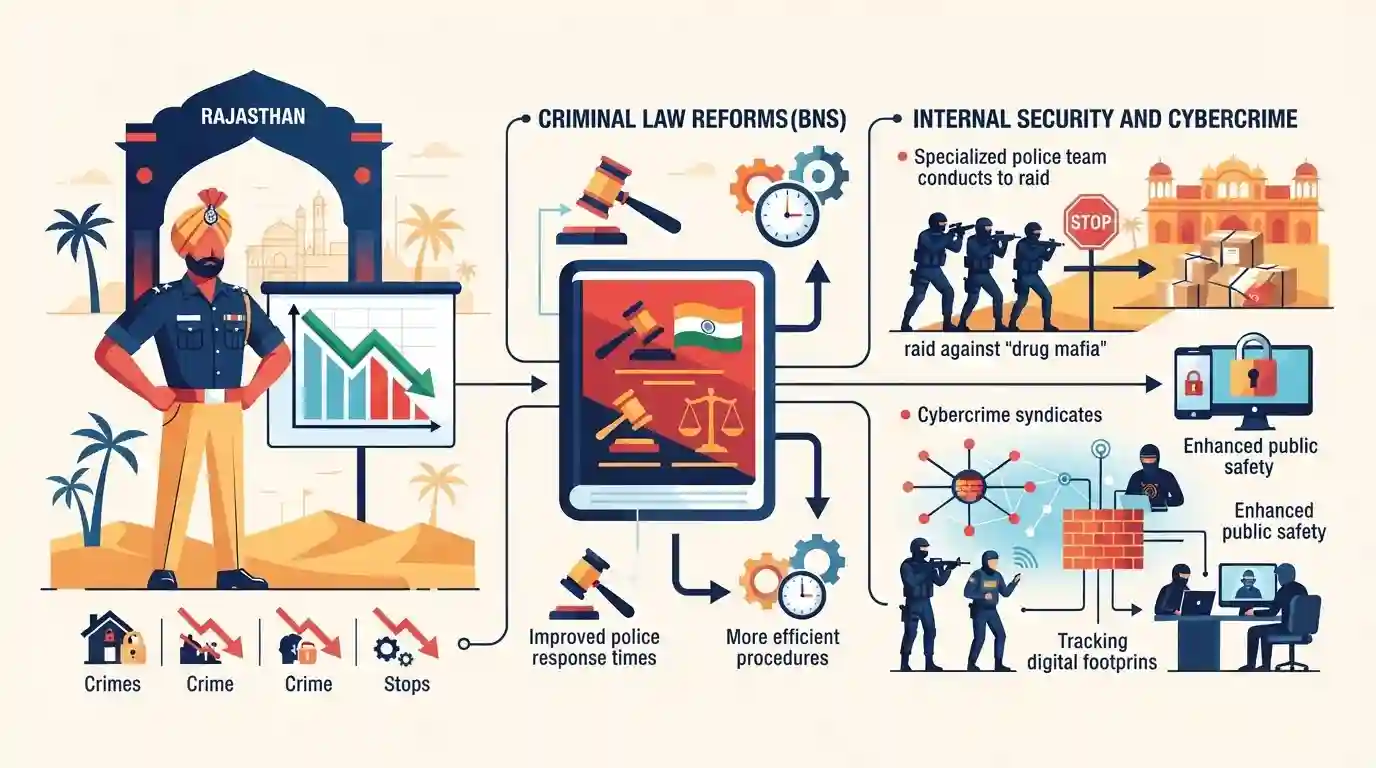
Rajasthan Police Reports Crime Decline Under BNS Framework
Source:indianmasterminds ↗
Why It Matters
Important for RPSC RAS aspirants to track law and enforcement updates, administrative performance, and the impact of new criminal laws (BNS) in Rajasthan.
Summary
A review by Rajasthan DGP Rajeev Kumar Sharma highlighted a notable decline in crime rates across Rajasthan following the implementation of the Bharatiya Nyaya Sanhita (BNS). The state police have ramped up special campaigns against drug mafias and cybercrime syndicates to improve public safety and governance in the state.
Key Points
- Rajasthan Police reported a significant decline in overall crime following the implementation of the Bharatiya Nyaya Sanhita (BNS).
- DGP Rajeev Kumar Sharma highlighted targeted operations against the drug mafia (such as anti-narcotics drives) and proactive measures against cybercrime.
- The state police are focusing on modernizing criminal investigation frameworks and strengthening public safety across Rajasthan.
Important Terms
Bharatiya Nyaya Sanhita (BNS)

New criminal code replacing the IPC, emphasizing modern offences like cybercrime and organized crime, with streamlined provisions for speedy justice.
UPSC context
Important for Mains GS Paper II (Polity and Governance - Criminal Law Reforms) and RPSC Mains (Law and Order / Legal Reforms).
Rajasthan Police
The premier law enforcement agency of Rajasthan, headed by the Director General of Police (DGP), responsible for maintaining internal security, law and order, and investigating crimes in the state.
UPSC context
Important for RPSC Papers (Rajasthan Governance, Administrative System, and Internal Security).
Prelims Trap
The Bharatiya Nyaya Sanhita (BNS) is a central legislation whose implementation data and crime decline trends are exclusively evaluated by the Union Home Ministry without state police intervention.
Aspirants often confuse the implementation of the new criminal laws (BNS, BNSS, BSA) with central jurisdiction alone, missing state-specific execution and data trends monitored by the DGP.
Static Concepts Connected
What is the institutional hierarchy and command structure of the Rajasthan Police?
- DGP Command: Head of Police: The Director General of Police (DGP) is the highest-ranking police officer in the state, responsible for overall administration and law enforcement.
- Territorial Units: Ranges and Districts: The state is divided into police ranges headed by Inspector Generals (IGs) or Deputy IGs (DIGs), further subdivided into districts led by Superintendents of Police (SPs).
- Specialized Wings: Specialized Wings: Includes specialized branches like the Anti-Corruption Bureau (ACB), Cyber Crime units, and Intelligence wing reporting directly to state police headquarters.
Cross-Topic Patterns
Cybercrime Modernization & National Security Frameworks
The integration of AI-enabled helplines and digital FIRs bridges state-level internal security with the national cybersecurity architecture like the Indian Cyber Crime Coordination Centre (I4C).
Anti-Narcotics Drives & Property Seizure Laws
The use of property attachment and asset demolition against drug mafias reflects overlapping anti-organized crime frameworks akin to MCOCA and national NDPS Act provisions.

Expect a statement-based question pairing BNS crime statistics decline with Rajasthan's specific institutional responses like R4C and zero-FIRs.
Linked PYQs · 2
Linked PYQs · 2
- 2025RPSC_PRELIMSGS1
Under Section 7 of the Rajasthan Lokayukta and Upa-Lokayukta Act, 1973, the Lokayukta has the power to investigate charges against ministers and public servants in certain cases. Which of the following is not part of those investigations?
- 2024RPSC_PRELIMSGS1
According to the Rajasthan Lokayukta and Deputy Lokayukta Act, 1973, the Lokayukta in Rajasthan can investigate allegations against ministers and public servants in certain cases. Which of the following subject is included in such cases? (i) Involves grievance/any suffering caused by public servant. (ii) Used his position as a public servant to obtain, for himself or for any other person, any valuable thing or financial benefit. (iii) Sexual harassment of woman, cause injury to any person. (iv) Can be related to being guilty of corruption of the trust reposed in him as a public servant.
