State BJP Apologizes for Protocol Lapse During Independence Day Event
Source:theprint ↗
Why It Matters
The incident touches upon the constitutional and civic protocols surrounding national symbols (like the National Song), as well as the historical significance of Vande Mataram in India's freedom struggle. Furthermore, the location (Badi Chaupar) highlights Jaipur's UNESCO-recognized urban architecture, making it relevant for Rajasthan history and culture.
Summary
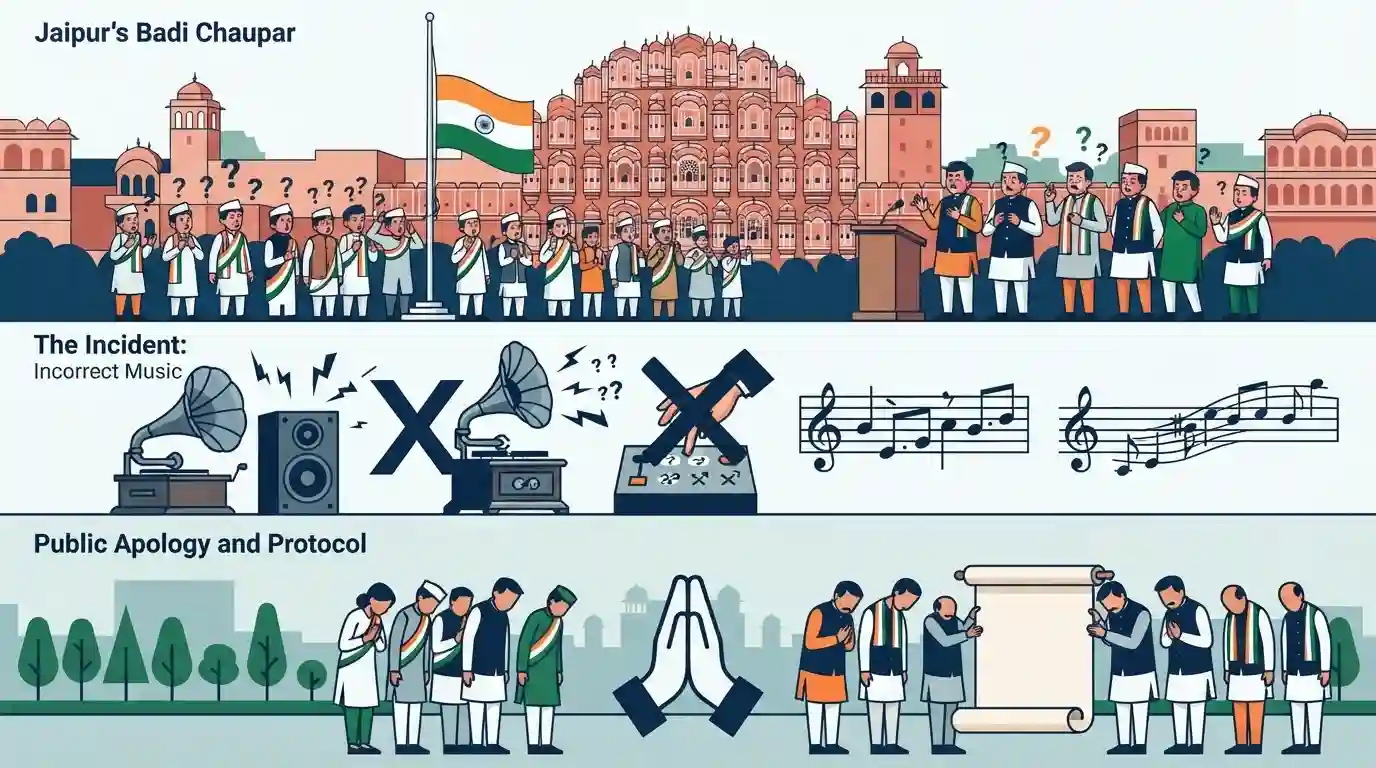
The Rajasthan unit of the BJP issued a public apology after the national song 'Vande Mataram' was played to the wrong musical tune during an Independence Day flag-hoisting ceremony at Badi Chaupar in Jaipur. The incident drew criticism and embarrassment for the party, highlighting the importance of adhering to the strict protocols and respect mandated for India's national symbols.
Key Points
- During an Independence Day celebration at Badi Chaupar, Jaipur, the Rajasthan BJP mistakenly played the national song 'Vande Mataram' with an incorrect musical tune.
- The incident caused significant embarrassment for the party, prompting a formal apology from the state leadership for the lapse in protocol.
- Badi Chaupar is a historically and culturally significant square in the walled city of Jaipur, traditionally used by political parties for major public events and flag-hoisting ceremonies.
- 'Vande Mataram', penned by Bankim Chandra Chatterjee, holds the official status of India's National Song, requiring specific reverence and protocol during its rendition.
- The mishap sparked discussions regarding the proper awareness and implementation of protocols related to national symbols, anthems, and songs.
Important Terms
Prevention of Insults to National Honour Act, 1971

A central law enacted to penalise deliberate disrespect or insults to Indian national symbols, including the National Flag, the Constitution, the National Anthem, and the National Song.
UPSC context
Relevant for GS Paper II (Polity) and Prelims, testing knowledge of statutory protections for national symbols and fundamental duties.
Flag Code of India
A comprehensive set of guidelines introduced in 2002 that consolidates laws, practices, and conventions governing the display, hoisting, and handling of the Indian National Flag.
UPSC context
Important for GS Paper II and Prelims. It tests understanding of the rules governing national symbols and citizens' display rights.
Vande Mataram
India's National Song, composed by Bankim Chandra Chatterjee in his 1882 novel Anandamath. It served as a powerful source of inspiration and a symbol of nationalism during the Indian freedom struggle.
UPSC context
Relevant for GS Paper I (Modern History) and Prelims, testing knowledge of India's cultural heritage and key symbols of the freedom movement.
Badi Chaupar
A prominent historic public square and major intersection located in the heart of Jaipur's planned walled city, known for its distinctive grid layout and rich architectural heritage.
UPSC context
Crucial for RPSC exams and GS Paper I (Art & Culture), testing knowledge of Rajput architecture and Jaipur's historic urban planning.
Prelims Trap
"Article 51A of the Constitution explicitly mandates citizens to respect both the National Anthem and the National Song."
Article 51A (Fundamental Duties) explicitly lists respect for the National Flag and National Anthem, but omits the National Song. Aspirants often wrongly assume 'Vande Mataram' is explicitly named.
Static Concepts Connected
What are the key historical milestones of the National Song 'Vande Mataram'?
- Origin: Penned in Sanskrit-Bengali by Bankim Chandra Chatterjee in his 1882 novel Anandamath, set against the backdrop of the Sanyasi Rebellion.
- First Sung: First publicly sung by Rabindranath Tagore during the 1896 Calcutta session of the Indian National Congress.
- Adoption: The Constituent Assembly officially adopted its first two verses as India's National Song on January 24, 1950.
What defines the historical urban planning of Jaipur's walled city?
- Founders: Founded in 1727 by Maharaja Sawai Jai Singh II and designed by Bengali architect Vidyadhar Bhattacharya.
- Grid System: Laid out using Shilpa Shastra principles into nine rectangular blocks (Chowkris) representing the nine planets, intersecting at major squares like Badi Chaupar.
Cross-Topic Patterns
Statutory Protection of Symbols
The 2026 amendment extending the 1971 Prevention of Insults to National Honour Act to the National Song creates a new statutory parity, bridging Polity and Art & Culture.
Anandamath & Sanyasi Rebellion
Vande Mataram's literary origin directly links to the Sanyasi Rebellion (1770-1820s), a recurring topic in modern history questions on peasant and ascetic uprisings.

Expect multi-statement questions contrasting the statutory protection and Article 51A status of the National Song versus the National Anthem.
Linked PYQs · 2
Linked PYQs · 2
- 2025RPSC_PRELIMSGS1
Which painter first created the image of Bharat Mata to associate India's identity as a nation through a visual medium?
- 2024RPSC_PRELIMSGS1
Who painted the famous image of Bharat Mata to visually associate the identity of India, as a Nation?
