Rajasthan PM Surya Ghar National Awards Achievement
Source:economictimes ↗
Why It Matters
Renewable energy (specifically solar) is a core syllabus area for both Rajasthan Geography and Rajasthan Economy in the RPSC RAS exam. RPSC frequently tests specific awards, ranks, and officers representing key state initiatives, making this development highly relevant for direct objective questions.
Summary
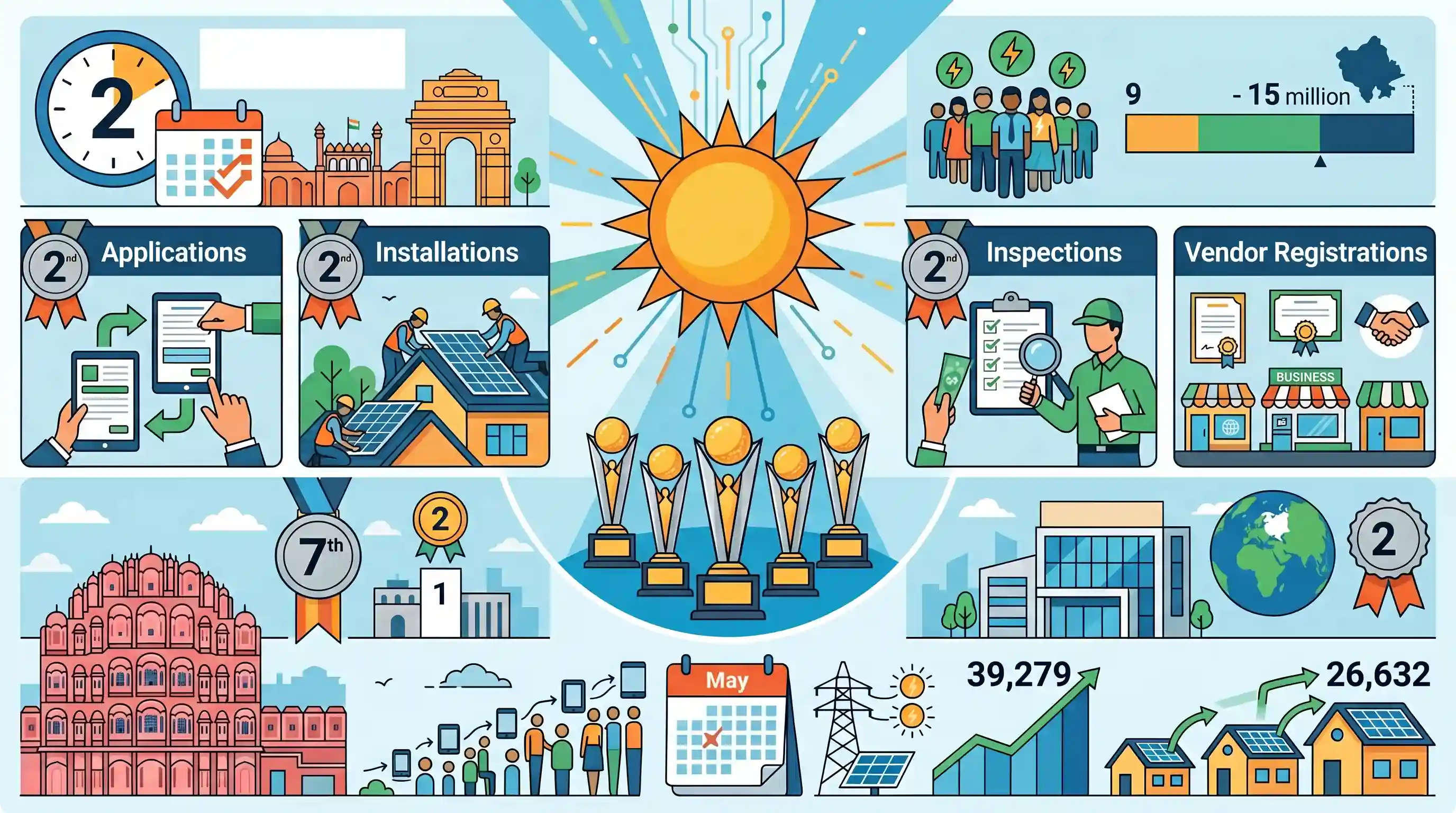
Rajasthan won six national awards under the PM Surya Ghar: Muft Bijli Yojana at a ceremony in New Delhi marking the scheme's second anniversary. Organized by the Ministry of New and Renewable Energy, Rajasthan achieved second-place rankings among states with 9 to 15 million power consumers in applications, installations, inspections, and vendor registrations. Furthermore, Jaipur ranked 7th among national districts for installations, and Milon Solar Energy Centre won second prize among northern region vendors. During May, Rajasthan's discoms registered 39,279 applicants and installed 26,632 rooftop systems.
Key Points
- Rajasthan bagged six prestigious national awards under the PM Surya Ghar: Muft Bijli Yojana at an event organized in New Delhi by the Ministry of New and Renewable Energy.
- Among states with 9 million to 15 million electricity consumers, Rajasthan secured second-place awards in four distinct categories during May: rooftop solar applications, installations, physical inspections, and vendor registrations.
- The state-level awards were received by Arti Dogra, Energy Secretary and Chairperson of Rajasthan Discoms, from Union Minister for New and Renewable Energy, Pralhad Joshi.
- At the district level, Jaipur secured the 7th position nationwide for the highest number of rooftop solar installations. The award was received by Mahima Sarabhai, Superintending Engineer (PM Surya Ghar), Jaipur Discom.
- At the vendor level, Milon Solar Energy Centre won the second prize in the northern region vendor category for rooftop solar installations.
- In May, Rajasthan's three major power distribution companies (Jaipur, Jodhpur, and Ajmer Discoms) registered 39,279 applicants, completed 27,700 physical verifications, installed 26,632 rooftop solar systems, and empanelled 177 new vendors.
Important Terms
PM Surya Ghar: Muft Bijli Yojana

A central sector scheme launched in 2024 providing up to 300 units of free monthly electricity to one crore Indian households through subsidized residential rooftop solar installations.
UPSC context
GS Paper II (Government Schemes) and GS Paper III (Energy/Infrastructure), testing clean energy access and domestic solar transition.
Ministry of New and Renewable Energy
The central administrative nodal ministry of the Government of India responsible for research, development, policy formulation, and deployment of non-conventional and renewable energy sources.
UPSC context
GS Paper III (Infrastructure and Energy), assessing institutional frameworks driving India's net-zero and clean energy target compliance.
PM-KUSUM
A central scheme launched in 2019 that solarizes agricultural water pumps and grid-connected feeders, aiming to improve water-energy security and double farmers' incomes.
UPSC context
GS Paper III (Agriculture and Infrastructure), testing sustainable irrigation reforms, decentralised power, and farmer income support models.
Rajasthan Solar Energy Policy
The state-level policy framework designed to exploit Rajasthan's vast solar irradiance and arid lands, targeting massive green power capacity addition and regional clean energy investments.
UPSC context
GS Paper III (Energy and Infrastructure), examining state-level policy execution and clean energy potentials in federal structures.
Rajasthan Discoms
The state’s three public electricity distribution companies—Jaipur, Jodhpur, and Ajmer discoms—responsible for power supply, agricultural solarization, and implementation of rooftop solar initiatives.
UPSC context
GS Paper III (Energy and Subsidies), analyzing power sector structural viability, AT&C losses, and decentralised grid integration issues.
Prelims Trap
The PM Surya Ghar subsidy is applicable to both residential households and commercial/industrial enterprises for setting up rooftop solar.
Central Financial Assistance (CFA) under this scheme is strictly restricted to residential consumers. Commercial and industrial sectors do not receive these capital subsidies.
Static Concepts Connected
What is the difference between Net Metering and Gross Metering?
- Net Metering: The consumer uses self-generated solar power first, and only the net surplus exported to (or deficit drawn from) the grid is billed.
- Gross Metering: The entire solar energy generated is fed directly into the grid, and the consumer is billed separately for total household consumption.
- Net Billing: Exported solar power is valued at a specific feed-in tariff, which is typically lower than the retail consumer tariff.
How does high residential solar penetration affect DISCOM finances?
- Cross-Subsidy Loss: High-paying residential consumers reduce grid reliance, shrinking the pool of revenue used to subsidize agricultural and low-income consumer categories.
- Fixed Cost Recovery: DISCOMs must still pay fixed capacity charges to thermal plants while receiving lower volumetric energy charges from net-metered solar prosumers.
- Grid Infrastructure Strain: Reverse power flows during peak sunshine hours stress local distribution transformers, requiring capital expenditure for grid balancing.
Cross-Topic Patterns
Solar waste and circular economy
Rapid solar rooftop expansion under PM Surya Ghar will surge PV module waste, requiring strict e-waste framework integration to recover critical minerals like silicon and silver.
Federalism and energy transition
Success of central renewable schemes depends on state DISCOMs' operational agility, showing how cooperative federalism and regulatory alignment drive India's climate commitments.

Expect a 2026 Prelims question testing the PM Surya Ghar subsidy slabs, net-metering dynamics, and the role of State Nodal Agencies.
Linked PYQs · 4
Linked PYQs · 4
- 2025RPSC_PRELIMSGS1
Which of the following statements are correct with respect to the PM Surya Ghar Free Electricity Scheme? (i) Under this scheme, solar plants will be installed on one crore houses to provide free electricity up to 300 units per month. (ii) Provision of 30% subsidy for installing rooftop solar plants (iii) 100% online system for registration, application, approval and grant (iv) Provision of lending to each applicant at a bank interest rate of 4%
- 2024RPSC_PRELIMSGS1
Which of the following statements about Rajasthan Multi Bijli Yojana is/are correct? A. Provide plants on one side to provide 100 solar plants. B. Subsidy for setting up rooftop solar panels. C. Provision of loan at book interest.
- 2021RPSC_PRELIMSGS1
In which year was the Rajasthan Solar Energy Policy announced?
- 2023RPSC_PRELIMSGS1
Which agency has been given the responsibility of implementing the PM-KUSUM scheme (Component A) in Rajasthan, which involves the establishment of solar power plants with a capacity of 0.5 MW to 2 MW?
