Rajasthan Assembly Session to Implement Full Digitization
Source:times-of-india ↗
Why It Matters
This development is highly significant for the RPSC RAS exam as it bridges digital governance (e-Governance) with state legislature polity. Understanding NeVA, the roles of the Speaker and Governor, and the digitized transition of the Legislative Assembly represents a core aspect of administrative reforms in Rajasthan.
Summary
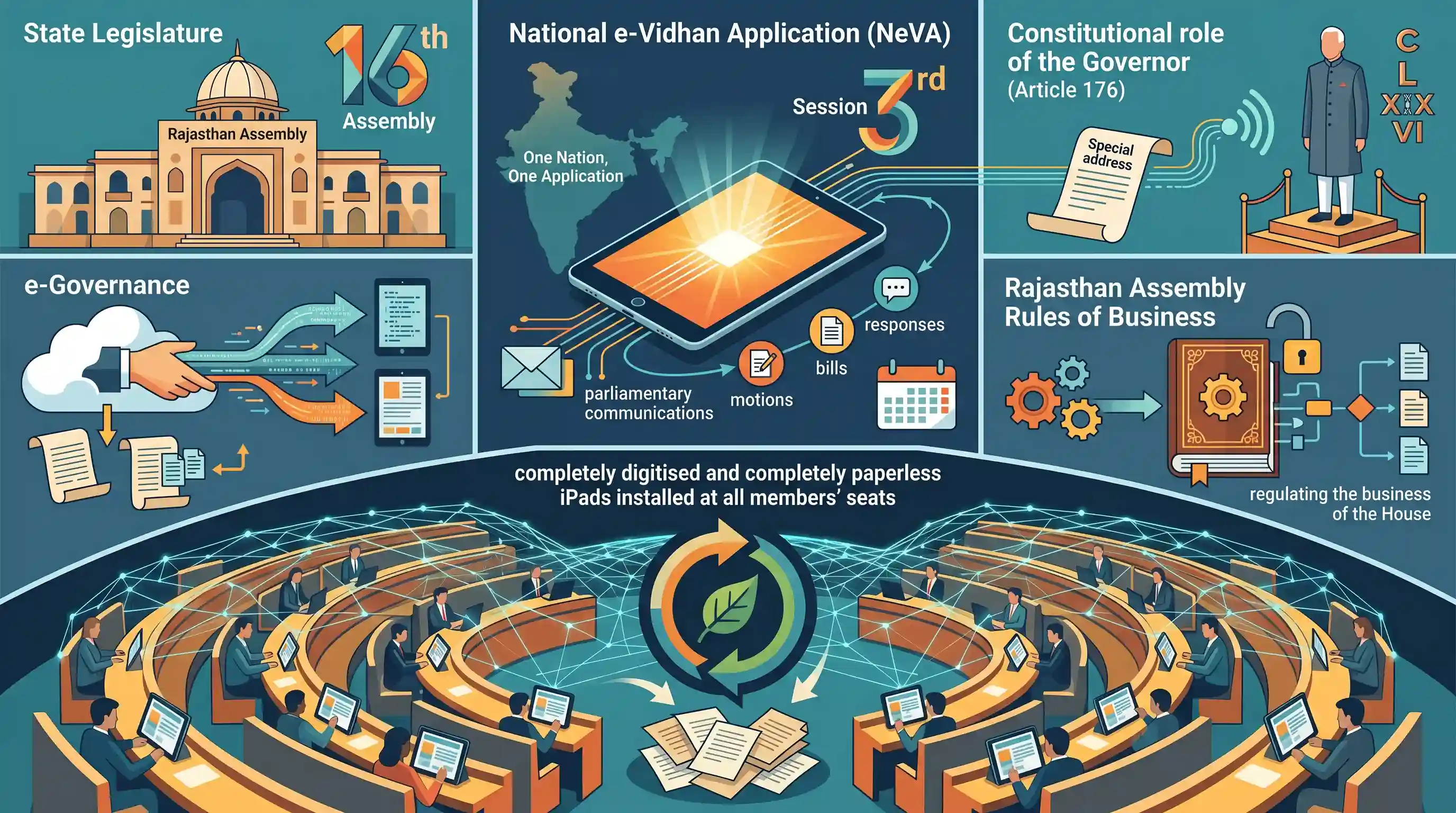
The third session of the 16th Rajasthan Assembly, commencing January 31, 2025, is set to be fully digitised under the National e-Vidhan Application (NeVA). All parliamentary communications, motions, and responses will be handled online, transitioning the assembly to a completely paperless environment with iPads installed at all members' seats.
Key Points
- The third session of the 16th Rajasthan Legislative Assembly, starting on January 31, 2025, will be fully digitised and paperless.
- Under the National e-Vidhan Application (NeVA) initiative, all communications, answers to MLAs' questions, attention motions, special mentions, and petitions will be submitted online by state government departments.
- iPads have been installed at all members' seats in the Assembly hall to facilitate paperless functioning.
- An e-Learning cum e-Facilitation Centre is being established to train government officials and assembly staff on NeVA modules.
- Governor Haribhau Bagde will deliver the opening address, and a Rajasthan Armed Constabulary (RAC) battalion will present a Guard of Honour upon his arrival.
- Assembly Speaker Vasudev Devnani, Chief Minister Bhajanlal Sharma, Parliamentary Affairs Minister Jogaram Patel, and Assembly Principal Secretary Bharat Bhushan Sharma are overseeing the implementation.
Important Terms
National e-Vidhan Application (NeVA)

A cloud-based, member-centric digital platform under the Digital India Programme, designed to streamline legislative operations, provide real-time document access, and transition India's state legislatures into paperless institutions.
UPSC context
GS Paper II: e-Governance. Tests understanding of digital administration and the 'One Nation, One Application' vision.
Rajasthan Legislative Assembly
The unicameral legislative body of Rajasthan, comprising 200 directly elected members, responsible for lawmaking, executive oversight, and passing the state budget.
UPSC context
GS Paper II: State Legislature. Tests knowledge of state polity, legislative procedures, and federal structure.
Article 176 of the Constitution of India
A constitutional provision mandating the Governor to deliver a special address to the State Legislature at the commencement of the first session each year and after every general election.
UPSC context
GS Paper II: Constitutional Offices. Tests executive-legislative relations and constitutional duties of the Governor.
e-Governance
The application of information and communication technology (ICT) to deliver government services, exchange information, and integrate standing processes to improve public administration efficiency.
UPSC context
GS Paper II: Important Aspects of Governance. Tests concepts of tech-driven administrative reforms and digital service delivery.
Prelims Trap
The National e-Vidhan Application (NeVA) is a Mission Mode Project administered and funded directly by MeitY.
Because NeVA is a key component of the 'Digital India' program, aspirants often assume MeitY is the nodal ministry. However, it is administered entirely by the Ministry of Parliamentary Affairs.
Static Concepts Connected
What is the National e-Vidhan Application (NeVA) and its core structure?
- Nodal Authority: Administered by the Ministry of Parliamentary Affairs (MoPA) to digitize all 37 state/UT legislative chambers into paperless environments.
- Funding Pattern: Centrally Sponsored Scheme where funding is shared 60:40 for general states, 90:10 for NE/Himalayan states, and 100% for UTs without legislature.
- Pioneering States: Bihar Legislative Council was the first chamber (2021) and Nagaland Legislative Assembly was the first state assembly (2022) to go paperless.
What are the key constitutional requirements of Article 176?
- Timing of Address: Mandates the Governor to deliver a special address at the start of the first session after elections and the first session of each year.
- Cabinet Advice: The address is drafted by the state cabinet; the Governor cannot alter the policy content, as established in Nabam Rebia (2016).
- Procedural Bar: No legislative business can be transacted by the House until the Governor's mandatory address has been delivered.
Cross-Topic Patterns
Digital Public Infrastructure + Federalism
NeVA's deployment highlights how Central digital schemes bridge regional divides via differentiated funding ratios (60:40 vs 90:10), requiring fiscal coordination between Union and State executives.
Eco-friendly governance + SDG targets
Transitioning legislative bodies to paperless environments directly implements SDG 12 (Sustainable Consumption) and SDG 13 (Climate Action), aligning legislative procedures with environmental governance goals.

NeVA's nodal ministry (MoPA) paired with Article 176 legislative procedures is a high-probability match for multi-statement prelims 2026.
Linked PYQs · 3
Linked PYQs · 3
- 2025RPSC_PRELIMSGS1
Which of the following statements regarding subordinate legislation in the Rajasthan Legislative Assembly is not correct?
- 2023RPSC_PRELIMSGS1
What is the minimum number of members in the Council of Ministers of Rajasthan?
- 2021RPSC_PRELIMSGS1
The Rajasthan Public Service Commission submits its annual report to
