Corruption and accountability in Jal Jeevan Mission execution
Source:Indian Express ↗
Why It Matters
This article provides a stark example of how corruption can derail flagship development projects like the Jal Jeevan Mission. It is highly relevant for GS Paper 4 (Ethics and Probity in Governance) and GS Paper 2 (Governance and Implementation of Government Schemes) as it demonstrates the real-world impact of a lack of integrity among public officials.
Summary
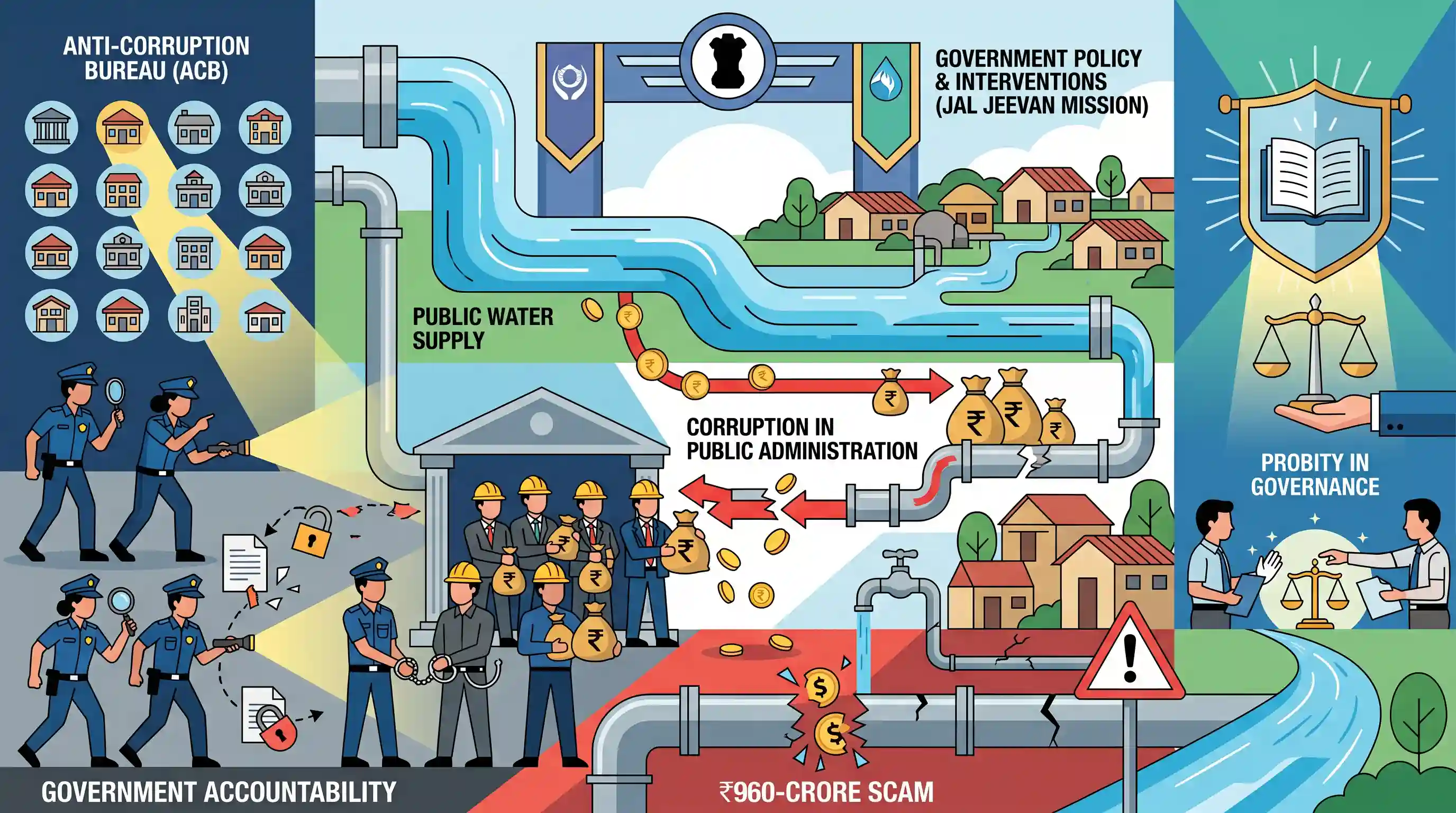
The Anti-Corruption Bureau (ACB) of Rajasthan has arrested nine senior engineers from the Public Health Engineering Department (PHED) following raids at 15 locations. The arrests are part of an investigation into a massive ₹960-crore scam concerning the Jal Jeevan Mission (JJM), a crucial government initiative designed to ensure tap water supply to rural households. This major fraud highlights critical vulnerabilities in the implementation of flagship welfare schemes, underscoring the urgent need for probity, transparency, and strict accountability among civil servants to prevent the mismanagement of public funds.
Key Points
- The Rajasthan Anti-Corruption Bureau (ACB) arrested nine senior engineers of the Public Health Engineering Department (PHED).
- The arrests follow early-morning raids across 15 locations in connection with a ₹960-crore corruption case.
- The fraud involves the Jal Jeevan Mission (JJM), a flagship central scheme aimed at providing tap water to rural households.
- This incident raises significant concerns regarding probity, accountability, and ethical conduct of public officials in executing large-scale welfare projects.
Important Terms
Jal Jeevan Mission (JJM)

Centrally sponsored flagship scheme providing 55 litres of potable water per capita daily to all rural households through Functional Household Tap Connections (FHTC).
UPSC context
GS Paper 2 & 3. Tests implementation of welfare schemes, rural infrastructure, and federal cooperation in water management.
Probity in Governance
The adherence to highest standards of honesty, integrity, and uprightness in public service, focusing on the ethical quality of administrative processes and decision-making.
UPSC context
GS Paper 4 (Ethics). A core concept for evaluating moral legitimacy and institutional integrity in public administration.
Anti-Corruption Bureau (ACB)
State-level law enforcement agency specialized in preventing, detecting, and investigating bribery and criminal misconduct among public officials within a state's jurisdiction.
UPSC context
GS Paper 2 & 4. Relevant for institutional mechanisms against corruption and the role of state-level investigative bodies.
Public Health Engineering Department (PHED)
State nodal department responsible for designing, executing, and maintaining water supply and sanitation infrastructure, often leading the grassroots implementation of JJM.
UPSC context
GS Paper 2 (Governance). Tests understanding of the executive machinery and line departments in executing social sector policies.
Prevention of Corruption Act, 1988
The principal legal framework in India for prosecuting public servants for bribery, criminal misconduct, and abuse of official position for private gain.
UPSC context
GS Paper 2 & 4. Primary statute for governance reforms and criminal justice involving administrative corruption cases.
Administrative Accountability
The obligation of civil servants to be answerable for their actions, decisions, and the transparent utilization of public funds in accordance with legal mandates.
UPSC context
GS Paper 2 & 4. Key pillar of good governance; tests checks on bureaucratic power and public fund management.
Prelims Trap
Jal Jeevan Mission is a Central Sector Scheme completely funded and directly implemented by the Union Ministry of Jal Shakti.
JJM is a Centrally Sponsored Scheme, not a Central Sector Scheme. While the Centre provides financial assistance, planning and implementation are done by States.
Static Concepts Connected
What are the core targets and funding mechanisms of the Jal Jeevan Mission (JJM)?
- Objective: To provide 55 litres of safe tap water per capita per day to every rural household via Functional Household Tap Connections (FHTC).
- Funding Pattern: It is a Centrally Sponsored Scheme. Funding is shared 90:10 for Himalayan/NE states, 50:50 for other states, and 100% by Centre for UTs.
- Local Governance: Village Water and Sanitation Committees (VWSCs) or Pani Samitis play a critical role in planning, operating, and maintaining village water supply infrastructure.
How does the Prevention of Corruption (Amendment) Act, 2018 regulate investigations against public servants?
- Prior Sanction: Section 17A mandates prior approval from the appropriate government before police can conduct any enquiry or investigation into offenses by public officials.
- Bribe Giving: The amendment expressly criminalized the act of giving a bribe, treating both bribe-givers and bribe-takers as offenders under the law.
- Commercial Organizations: It introduced provisions to hold commercial organizations liable if their employees or representatives offer bribes to gain business advantages.
Cross-Topic Patterns
Governance gaps in Centrally Sponsored Schemes
Massive leakage in a flagship scheme like JJM illustrates how state-level bureaucratic corruption directly undermines national GS2 welfare targets and rural infrastructure goals.
Ethics case studies on infrastructure probity
This incident is highly relevant for GS4 case studies involving conflict of interest, tender manipulation, and the collapse of accountability in public engineering departments.

Expect a GS2/GS4 question evaluating institutional mechanisms like 'Pani Samitis' as safeguards against bureaucratic corruption in CSS.
Linked PYQs · 3
Linked PYQs · 3
- 2024MainsGS2
The Doctrine of Democratic Governance makes it necessary that the public perception of the integrity and commitment of civil servants becomes absolutely positive. Discuss.
- 2019MainsGS4
What do you understand by probity in governance ? Based on your understanding of the term, suggest measures for ensuring probity in government.
- 2024MainsGS4
“The 'Code of Conduct' and 'Code of Ethics' are the sources of guidance in public administration. There is code of conduct already in operation, whereas code of ethics is not yet put in place. Suggest a suitable model for code of ethics to maintain integrity, probity and transparency in governance.”
