Rajasthan Electoral Roll Revision and Voter List Purification
Source:Indian Express ↗
Why It Matters
The purity of the electoral roll is the bedrock of electoral democracy in India. Understanding the mechanisms of voter registration and list purification is crucial for UPSC aspirants, as it directly connects to the role of the Election Commission, the application of the Representation of the People Act, and broader discussions on electoral reforms.
Summary
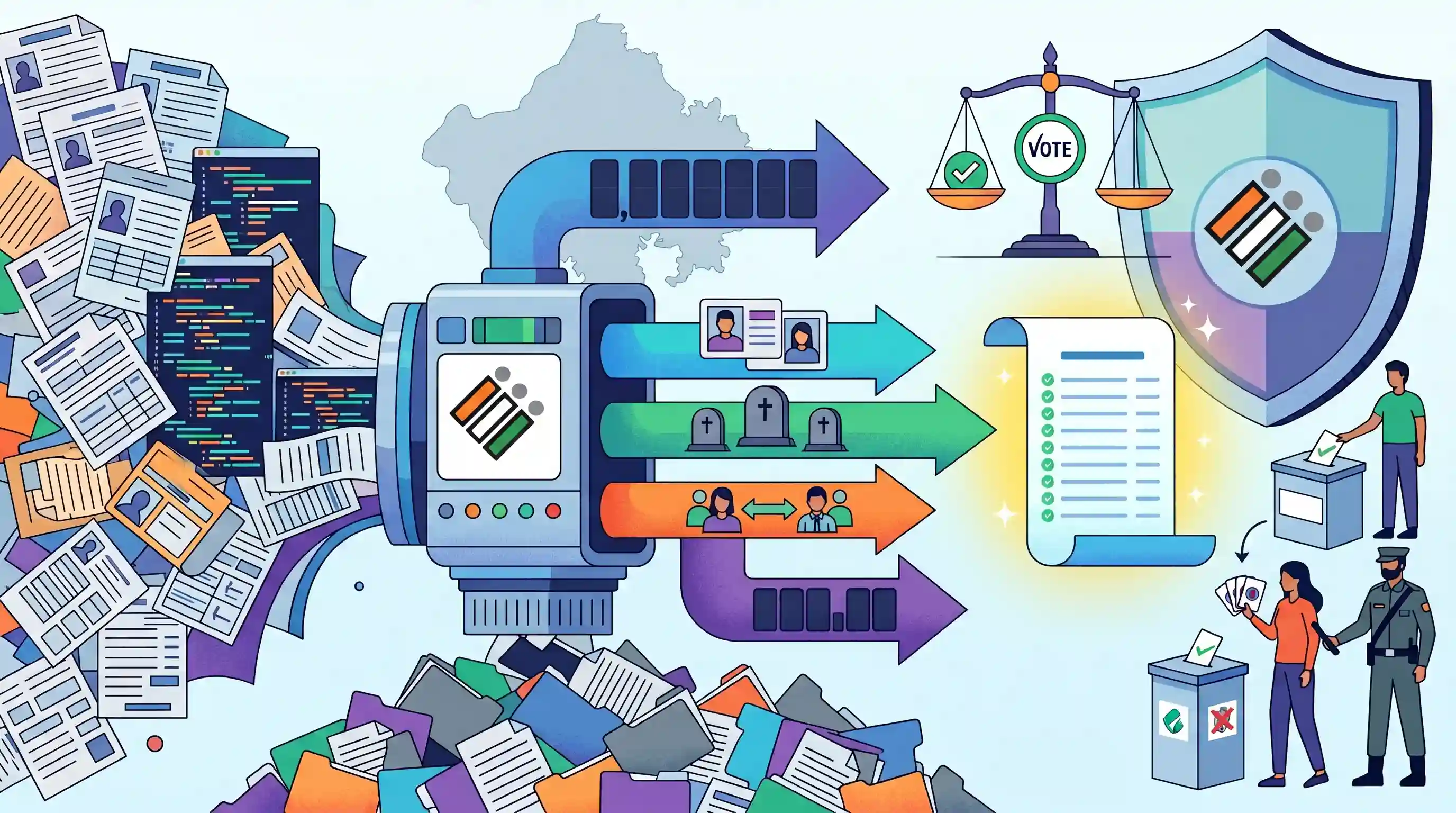
In a major electoral roll purification exercise, the Election Commission has removed over 31.36 lakh names from the final voter rolls in Rajasthan under the latest revision for 2026. This large-scale deletion targets duplicate entries, deceased individuals, and shifted voters to ensure the accuracy and integrity of the voter list. Maintaining a pure electoral roll is a fundamental prerequisite for free and fair elections, as it prevents electoral malpractices like bogus voting and ensures that the democratic process accurately reflects the genuine electorate as mandated by the Representation of the People Act, 1950.
Key Points
- Over 31.36 lakh names have been removed from the final electoral rolls in Rajasthan under the latest revision exercise.
- The deletions target invalid entries such as deceased voters, duplicate registrations, and individuals who have permanently shifted out of their constituencies.
- Regular electoral roll purification is essential to maintain the sanctity of the democratic process and prevent bogus voting.
- The preparation and revision of electoral rolls are governed by the Representation of the People Act, 1950, overseen by the Election Commission of India.
- A clean and accurate voter database is a critical component for ensuring free and fair elections and reflects true voter turnout statistics.
Important Terms
Representation of the People Act, 1950

A 1950 Act providing for the allocation of seats, delimitation of constituencies, and the preparation/revision of electoral rolls. It sets the basic qualifications for voters in India.
UPSC context
GS-II: Electoral reforms and significant provisions of the RPA. It tests understanding of the legal basis for voter registration.
Election Commission of India (ECI)
A permanent constitutional body established under Article 324 to oversee, direct, and control elections to Parliament, State Legislatures, and the offices of President and Vice-President.
UPSC context
GS-II: Appointment, powers, and responsibilities of constitutional bodies. Essential for topics on democratic integrity.
Special Intensive Revision (SIR)
A comprehensive, door-to-door verification drive by the ECI to update voter lists. Unlike routine annual updates, it involves intensive re-verification of all entries, typically before major elections.
UPSC context
GS-II: Governance and Electoral Reforms. Important for understanding operational mechanisms ensuring "one person, one vote."
Electoral Roll Purification
The systematic process of removing duplicate, deceased, and shifted voters from the electoral roll to ensure accuracy and prevent bogus voting.
UPSC context
GS-II: Issues relating to the conduct of free and fair elections. Tests knowledge of election integrity measures.
Booth Level Officer (BLO)
The ground-level official (usually a local government employee) responsible for the door-to-door verification of voters and the maintenance of electoral rolls in a specific polling area.
UPSC context
GS-II: Local-level administrative machinery for elections. Highlighted as the primary interface between the ECI and the public.
Article 324 of the Constitution
The constitutional provision that vests the "superintendence, direction and control" of all elections to Parliament and State Legislatures in the Election Commission of India.
UPSC context
GS-II: Constitutional bodies and their powers. A high-yield article for polity questions regarding election independence.
Prelims Trap
"The preparation and revision of electoral rolls is governed by the Representation of the People Act, 1951."
RPA 1950 deals exclusively with the preparation of electoral rolls, allocation of seats, and delimitation. RPA 1951 handles the actual conduct of elections.
Static Concepts Connected
What differentiates RPA 1950 from RPA 1951?
- RPA 1950: Governs the allocation of seats, delimitation of constituencies, qualifications of voters, and the preparation/revision of electoral rolls.
- RPA 1951: Governs the actual conduct of elections, qualifications/disqualifications of MPs and MLAs, election petitions, and corrupt practices.
What are the rules regulating voter registration and deletion?
- Sections 17 & 18: Under RPA 1950, it is illegal for a citizen to be registered in more than one constituency, or multiple times in the same constituency.
- Form 7: The statutory form prescribed under the Registration of Electors Rules, 1960 to object to an inclusion or to seek the deletion of a voter's name.
- Qualifying Dates: Youth turning 18 now have four qualifying dates (Jan 1, Apr 1, Jul 1, Oct 1) to register, rather than waiting for a single annual date.
Cross-Topic Patterns
Voter ID-Aadhaar Linking & Privacy
Electoral roll purification links to the Election Laws (Amendment) Act, 2021, which enables Aadhaar-Voter ID linkage to curb duplication, sparking ongoing Right to Privacy (Puttaswamy) debates.
Delimitation Freeze 2026
While electoral rolls are updated continuously, physical constituency boundaries and seat allocations remain frozen until the first Census published after 2026, as per the 84th Constitutional Amendment.

Expect a multi-statement Prelims question in 2026 testing the precise boundaries between RPA 1950 (rolls) and RPA 1951 (conduct).
Linked PYQs · 4
Linked PYQs · 4
- 2024MainsGS2
Examine the need for electoral reforms as suggested by various committees with particular reference to "one nation one election" principle.
- 2020MainsGS2
There is a need for simplification of procedure for disqualification of persons found guilty of corrupt practices under the Representation of Peoples Act". Comment.
- 2017PrelimsGS1
Right to vote and to be elected in India is a
- 2017PrelimsGS1
For election to the Lok Sabha, a nomination paper can be filed by
