Rajasthan Sets Ten Crore Tree Planting Target for 2026 Monsoon
Source:ilovejaipur ↗
Why It Matters
Environmental targets, afforestation programs, and district-level ecological distributions (such as sandalwood in Udaipur/Sirohi/Banswara) are heavily tested in RPSC RAS exams, reflecting the state's emphasis on combating desertification and enhancing forest cover.
Summary
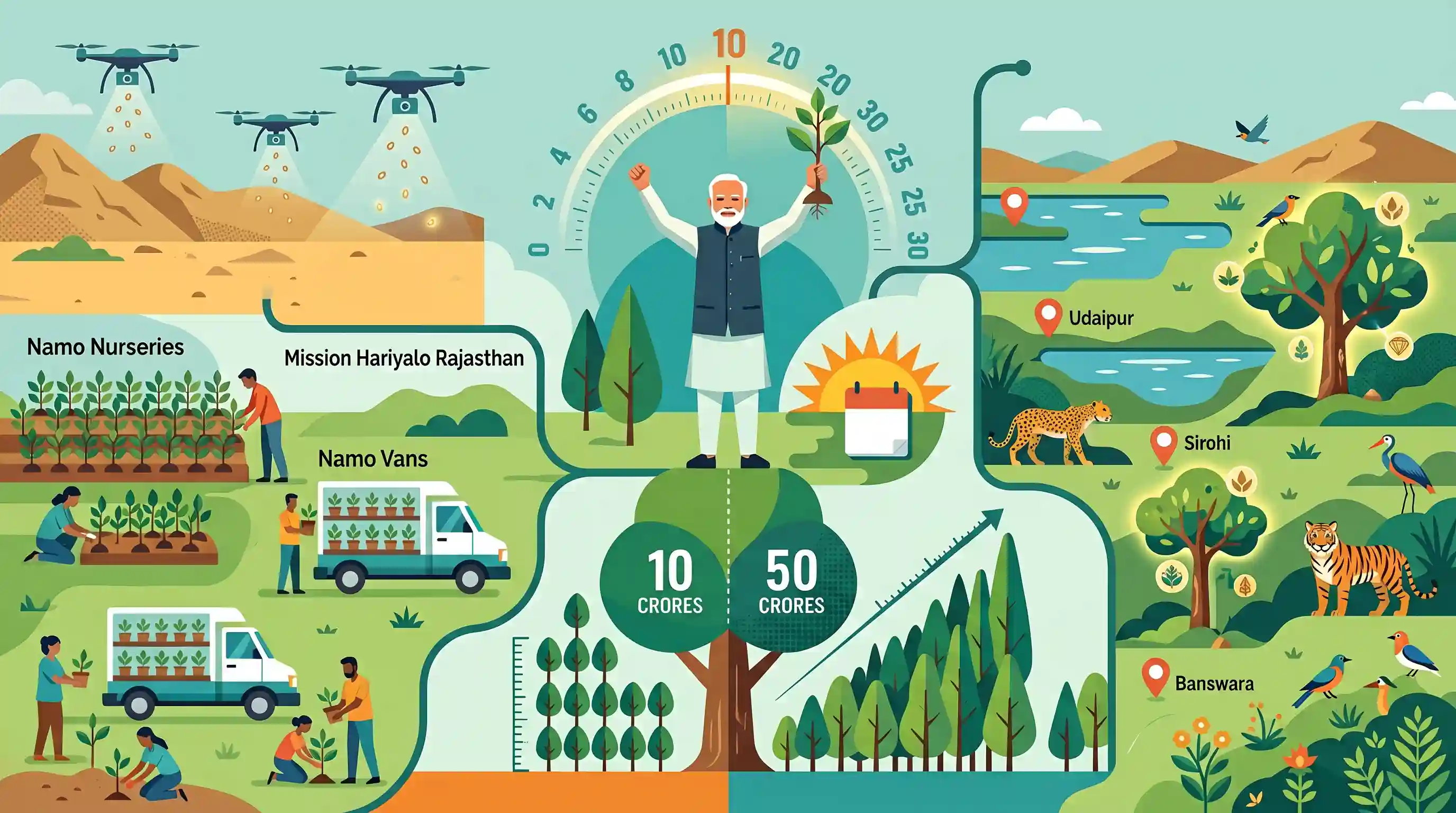
The Government of Rajasthan, led by Chief Minister Bhajan Lal Sharma, has set an ambitious target of planting 10 crore trees during the 2026 monsoon under 'Mission Hariyalo Rajasthan'. This campaign, launching on World Environment Day (June 5), is part of a larger 50-crore tree-planting goal for 2024-2028. Key features of the drive include drone seeding in hilly areas, the creation of Namo Nurseries and Namo Vans, and dedicated sandalwood forestry projects in Udaipur, Sirohi, and Banswara.
Key Points
- Under Mission Hariyalo Rajasthan, the state government has set a target of planting 10 crore trees during the 2026 monsoon season, starting on June 5, 2026 (World Environment Day).
- The broader target under Mission Hariyalo Rajasthan is to plant 50 crore trees between 2024 and 2028. Previous targets were exceeded, with 7.22 crore trees planted in 2024 (against a 7 crore target) and over 11.74 crore in 2025 (against a 10 crore target).
- Key initiatives include setting up one Namo Nursery in every district and the phased development of Namo Vans at each panchayat samiti.
- Special emphasis is placed on developing sandalwood (chandan) forest sites in Southern Rajasthan districts (Udaipur, Sirohi, and Banswara) using fencing and drip irrigation.
- Innovative methods such as drone seeding will be utilized in hilly and forest areas, alongside traditional planting of gular trees, free fruit sapling distribution to farmers, and the involvement of local Vriksh Mitras.
Important Terms
Mission Hariyalo Rajasthan

An ambitious afforestation campaign by the Rajasthan government aiming to plant 50 crore saplings between 2024 and 2028 to combat desertification, restore degraded ecosystems, and expand the state's forest cover.
UPSC context
GS Paper III: Conservation and Environmental Pollution; tests knowledge of state-level afforestation policies and ecological restoration strategies.
Revenue Department
A state government department responsible for land administration, maintaining land records (like Khasra and Khatauni), and identifying government-owned land for development, conservation, or public afforestation programs.
UPSC context
GS Paper II: Governance and Administrative Structure; tests understanding of state land administration and inter-departmental coordination in governance.
Public Works Department
A key government agency in Indian states tasked with planning, constructing, and maintaining public infrastructure, including roads, highways, bridges, government buildings, and organizing roadside plantation projects under environmental initiatives.
UPSC context
GS Paper III: Infrastructure Development; tests knowledge of public infrastructure execution, state administrative agencies, and environmental integration.
Indian Railways
India's state-owned national railway system, managed by the Ministry of Railways, which coordinates with state governments to utilize railway land assets for ecological drives and public plantation campaigns.
UPSC context
GS Paper III: Infrastructure and Mobilization of Resources; tests understanding of national transport infrastructure and resource-sharing for sustainable growth.
Government of Rajasthan
The democratic governing authority of Rajasthan, headed constitutionally by the Governor and executively by the Chief Minister, responsible for implementing state laws, development policies, and environmental programs.
UPSC context
GS Paper II: Federalism and State Legislature; tests knowledge of state-level executive functions, policy formulation, and regional governance.
Prelims Trap
Sandalwood is a total root parasite (holoparasite) that depends entirely on host plants for all its metabolic and energy needs.
Sandalwood is actually a hemiparasite (semi-root parasite); it performs photosynthesis to synthesize its own food but relies on host roots for water and minerals.
Static Concepts Connected
What is the ecological and biological nature of Sandalwood (Santalum album)?
- Hemiparasitic nature: It is a semi-root parasite that attaches to host roots via haustoria to absorb water and minerals.
- Photosynthetic capability: Unlike total parasites, it contains chlorophyll and synthesizes its own organic food through photosynthesis.
- Climatic preference: It thrives in dry deciduous forests, tolerating rocky soils and moderate rainfall, but cannot withstand waterlogging.
How do India's national and Rajasthan's state forest policies differ in forest cover targets?
- National target: The National Forest Policy, 1988, sets a nationwide goal of 33% of geographical area under forest and tree cover.
- Rajasthan state target: Due to arid geography, Rajasthan's 2010 and 2023 policies set a modified target of 20% forest and vegetal cover.
Cross-Topic Patterns
Afforestation versus grassland conservation
Mass tree-planting in arid zones can degrade native grasslands and desert ecosystems, threatening endemic species like the Great Indian Bustard.
Bilateral funding in sub-national climate action
External agencies like JICA and AFD heavily fund state-level forestry, demonstrating how international climate finance bypasses centralized execution to target local ecosystems.

Questions in 2026 may test Sandalwood's hemiparasitic nature alongside sub-national variations in India's 33% national forest cover target.
Linked PYQs · 2
Linked PYQs · 2
- 2016RPSC_PRELIMSGS1
When was the first Forest Policy approved by the Government of Rajasthan?
- 2025RPSC_PRELIMSGS1
Choose the incorrect statement with respect to the Rajasthan Forestry and Biodiversity Project (Phase-2).
