Artificial Intelligence Redefines Modern Statecraft and Diplomacy
Source:Indian Express ↗
Why It Matters
The intersection of emerging technologies and traditional diplomacy is becoming a central theme in global geopolitics. Understanding 'techplomacy' and AI's role in national security equips UPSC aspirants to address GS2 questions on international relations and global governance, as well as GS3 questions on technology and internal security.
Summary
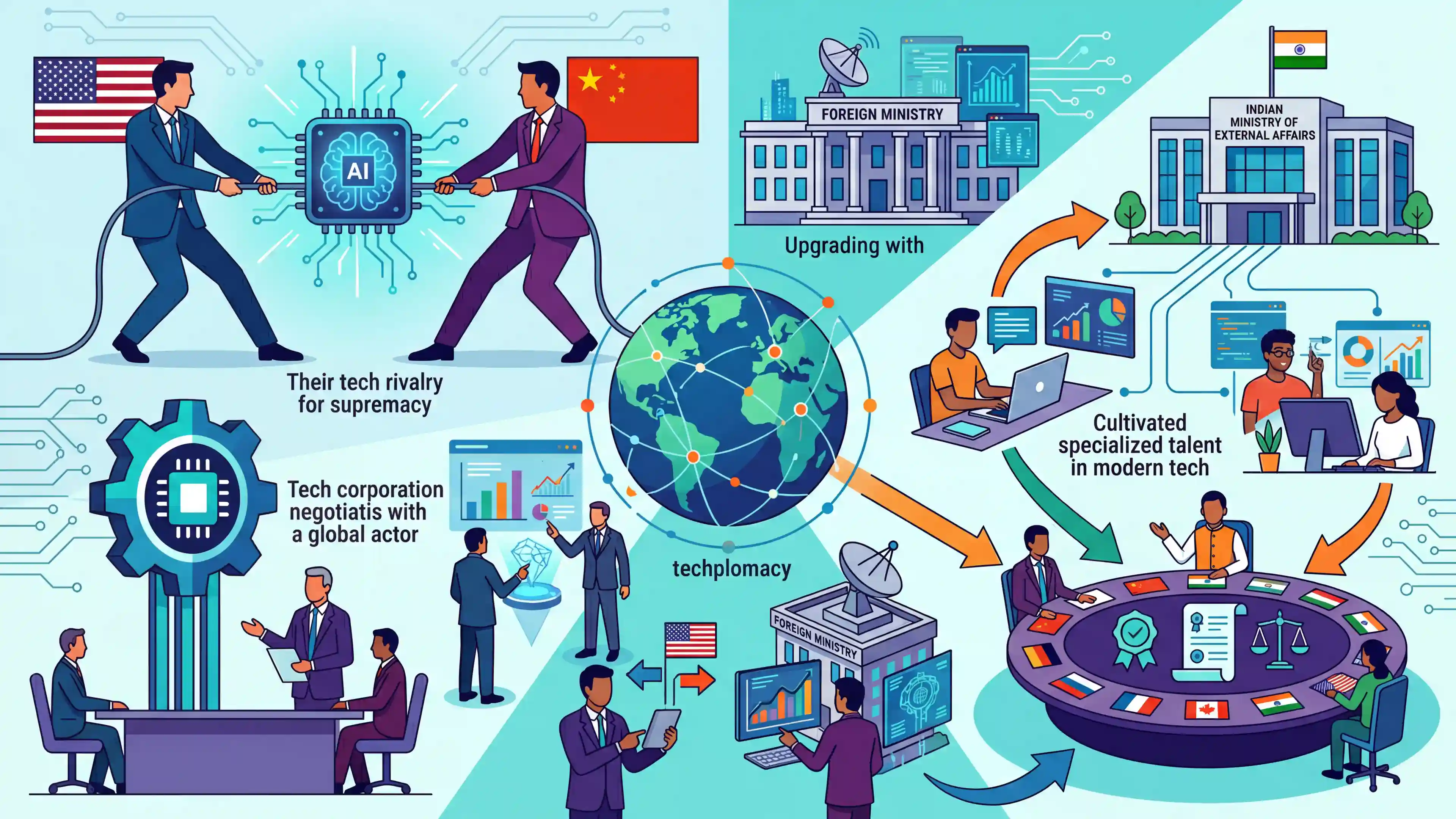
In his column, C. Raja Mohan explores the profound impact of Artificial Intelligence (AI) on modern diplomatic practice and national security. He argues that the advent of AI is not merely a technological shift but a geopolitical revolution that redefines statecraft. Foreign ministries globally are adapting by employing 'techplomacy'—using AI for predictive analytics, rapid language translation, and strategic modeling. The article highlights the intensified tech rivalry between the US and China, treating AI supremacy as a core component of national security. Furthermore, Mohan points out the rising geopolitical clout of Big Tech, compelling governments to engage with corporations as quasi-state actors. For India, the imperative is clear: the Ministry of External Affairs must modernize, cultivate specialized tech talent, and actively shape global AI governance frameworks to safeguard its strategic interests in an increasingly digitized world order.
Key Points
- AI is fundamentally transforming statecraft, forcing foreign ministries to adopt 'techplomacy' and integrate predictive analytics and language models into diplomatic negotiations.
- The strategic competition over AI, particularly between the US and China, is creating a new technological arms race that impacts national security and geopolitical alliances.
- Big Tech corporations now wield geopolitical influence comparable to nation-states, necessitating a new form of multi-stakeholder diplomacy where diplomats negotiate directly with tech giants.
- India must urgently modernize its diplomatic apparatus, building sovereign AI capabilities and integrating specialized technological expertise into its foreign policy establishment to remain competitive.
- The weaponization of AI through deepfakes, information warfare, and autonomous systems poses unprecedented challenges to global security, requiring updated international laws and governance frameworks.
Important Terms
Bletchley Declaration

A 2023 international agreement signed by 28 nations (including India) to address risks from 'frontier AI,' focusing on cybersecurity, disinformation, and the need for global safety cooperation.
UPSC context
GS-2 (IR/Agreements) and GS-3 (S&T). Tests understanding of international frameworks for managing emerging technological risks and India's participation.
Techplomacy
A diplomatic practice involving strategic engagement between states, international organizations, and tech corporations to shape global digital policy and manage the geopolitical impact of innovation.
UPSC context
GS-2 (International Relations). Analyzes modern shifts in statecraft and the rising influence of non-state actors in foreign policy.
Global AI Governance Frameworks
The evolving international network of norms, treaties (e.g., EU AI Act), and institutional bodies (UN, GPAI) aimed at ensuring safe, ethical, and human-centric AI development.
UPSC context
GS-2 (Global Institutions). Critical for discussing multilateralism and India's advocacy for inclusive, risk-based international standards.
Big Tech (as Geopolitical Actors)
Large technology corporations (e.g., Google, SpaceX) that exercise sovereign-like power by controlling critical digital infrastructure, data flows, and technologies essential for national security.
UPSC context
GS-2 (IR) and GS-3 (Security). Examines the 'technopolar' shift and the challenges private-sector authority poses to national sovereignty.
Frontier AI
Highly capable, general-purpose generative AI models that can perform complex tasks but pose significant, unpredictable risks to security, biotechnology, and public trust.
UPSC context
GS-3 (Science & Technology). Specific terminology used in policy debates regarding high-risk developments in artificial intelligence.
Ministry of External Affairs (MEA)
India's central authority for foreign policy; the article emphasizes its need to modernize by cultivating specialized tech talent to navigate a digitized world order.
UPSC context
GS-2 (Policy/Governance). Focuses on institutional reform and India's strategic responses to global technological shifts.
Prelims Trap
"The Bletchley Declaration is a legally binding UN treaty on AI safety that excludes China."
The Declaration is a voluntary (non-binding) agreement hosted by the UK, not the UN, and it notably includes both the US and China.
Static Concepts Connected
What is the Global Partnership on Artificial Intelligence (GPAI)?
- Nature & Secretariat: An international, multi-stakeholder initiative hosted by the OECD to guide responsible AI development and bridge the gap between theory and practice.
- India's Role: India is a founding member and served as the Lead Chair for 2024, pushing the 'New Delhi Declaration' for inclusive AI growth.
How are non-state actors shifting modern diplomatic statecraft?
- Techplomacy: Nations are appointing 'Tech Ambassadors' to negotiate directly with Big Tech corporations, recognizing them as quasi-state entities wielding geopolitical power.
- Sovereignty challenges: Because tech giants control critical digital infrastructure, governments are forced to balance global tech integration with 'Sovereign AI' capabilities.
Cross-Topic Patterns
Sovereign AI + DPI strategy
India's push for 'Sovereign AI' (IndiaAI Mission) mirrors its approach to Digital Public Infrastructure—ensuring national control over critical tech stacks rather than relying on foreign monopolies.
Deepfakes + Border Security architecture
The weaponization of AI connects directly to GS3 Internal Security: AI-guided drones for smuggling and deepfakes for cross-border information warfare challenge traditional border management.

Bletchley Declaration, GPAI, and Sovereign AI are highly likely to form a multi-statement Prelims tech-governance question in 2026.
Linked PYQs · 4
Linked PYQs · 4
- 2023MainsGS3
Introduce the concept of Artificial Intelligence (AI). How does Al help clinical diagnosis? Do you perceive any threat to privacy of the individual in the use of Al in healthcare?
- 2017MainsGS3
Discuss the potential threats of Cyber attack and the security framework to prevent it.
- 2024MainsGS3
Social media and encrypting messaging services pose a serious security challenge. What measures have been adopted at various levels to address the security implications of social media? Also suggest any other remedies to address the problem.
- 2020PrelimsGS1
With the present state of development, Artificial Intelligence can effectively do which of the following? 1. Bring down electricity consumption in industrial units 2. Create meaningful short stories and songs 3. Disease diagnosis 4. Text-to-Speech Conversion 5. Wireless transmission of electrical energy Select the correct answer using the code given below:
