Rajasthan Police proposes cost recovery from tower protesters
Source:timesofindia ↗
Why It Matters
It highlights an innovative administrative and legal approach by a state police force to tackle public nuisance and resource wastage, testing the application of the newly enacted Bharatiya Nyaya Sanhita (BNS) and the balance between the right to protest and public order.
Summary
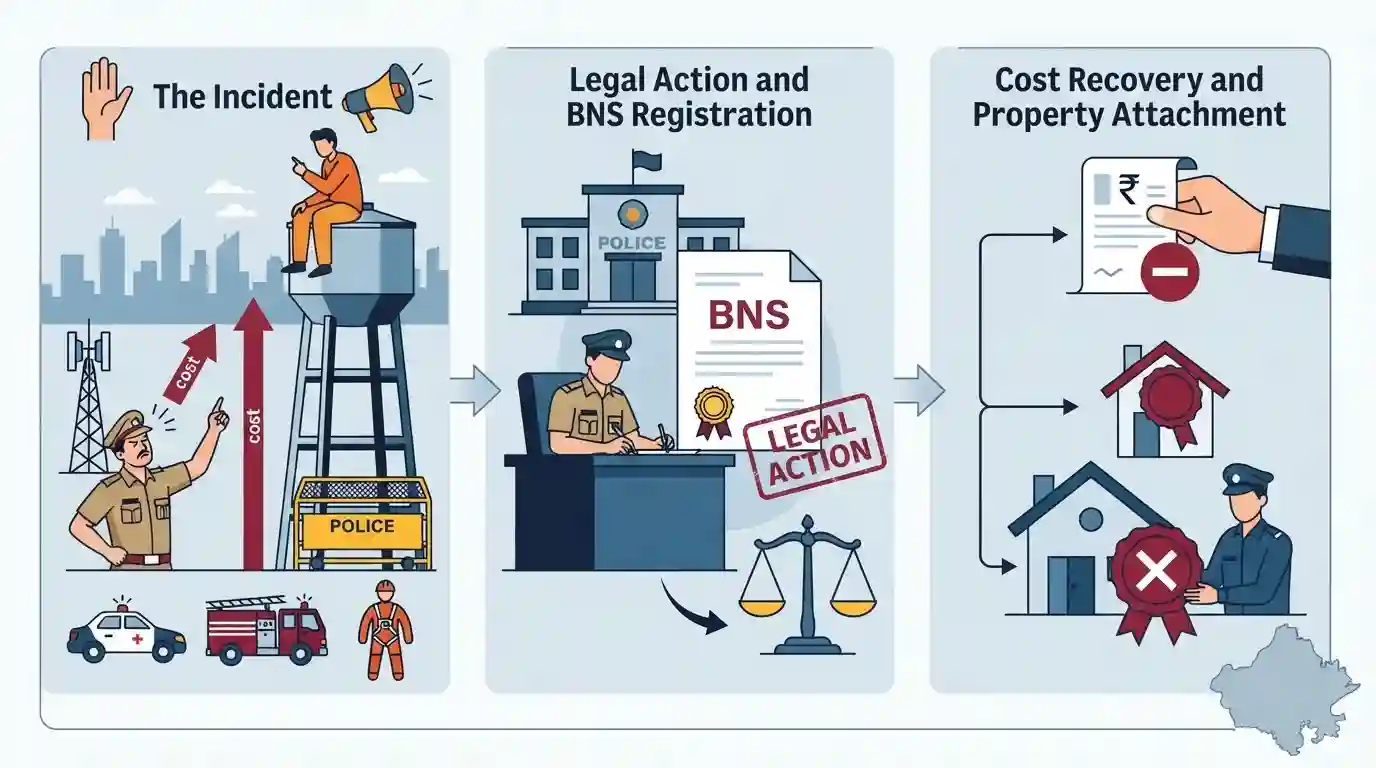
The Rajasthan Police is proposing a new Standard Operating Procedure (SOP) to deter "Sholay-style" protests where individuals climb water tanks or mobile towers. Under the proposed rules, authorities will register FIRs using the Bharatiya Nyaya Sanhita (BNS) and recover the financial costs of deploying emergency services—such as the SDRF, police, and fire brigades—directly from the protesters. Failure to pay these costs could result in legal proceedings for property attachment.
Key Points
- Rajasthan Police is drafting a Standard Operating Procedure (SOP) to penalize protesters who climb elevated structures like water tanks and mobile towers to press their demands.
- The SOP mandates the recovery of costs incurred by the state for deploying emergency services, including the SDRF, fire department, civil defence, and police, during such protests.
- FIRs will be registered against the protesters under relevant provisions of the Bharatiya Nyaya Sanhita (BNS) for endangering personal safety and causing public nuisance.
- If the protesters fail to reimburse the government for the operational costs, authorities plan to approach the courts for the attachment of their properties.
Important Terms
Bharatiya Nyaya Sanhita (BNS)

The Bharatiya Nyaya Sanhita (BNS) is India's new criminal code, implemented in July 2024 to replace the colonial-era Indian Penal Code (IPC). It modernizes criminal law with provisions for cyber crimes, terrorism, and victim rights.
UPSC context
Important for Law and Order / Constitution sections; tests knowledge of India's modernized legal framework and the shift away from colonial-era laws.
State Disaster Response Force (SDRF)
The state-level counterpart to the National Disaster Response Force (NDRF), the SDRF handles localized search, rescue, and relief operations during natural or man-made disasters, coordinating directly with state and district authorities.
UPSC context
Crucial for Disaster Management topics; candidates must understand the division of state-vs-national responsibilities and funding mechanisms under the Disaster Management Act.
Rajasthan Police
The law enforcement agency for the state of Rajasthan, responsible for maintaining public order, investigating crimes, and implementing new operational procedures like cost-recovery for public disruptions under the BNS framework.
UPSC context
Relevant for State Governance and Administration; tests awareness of state-specific policing strategies, reforms, and the practical application of national laws like the BNS.
Prelims Trap
The Rajasthan Police has the direct authority to attach protesters' properties to recover costs.
Police cannot unilaterally confiscate assets. The SOP specifies that the state will approach the courts to initiate legal proceedings for property attachment if costs are not paid.
Static Concepts Connected
What is the administrative structure and mandate of the SDRF in Rajasthan?
- Administrative Control: The State Disaster Response Force (SDRF) functions under the direct administrative control of the Rajasthan Police.
- Leadership: It is headed by a senior police officer of the Additional Director General of Police (ADGP) rank.
- Operational Mandate: Beyond natural disasters, SDRF is deployed for man-made crises, including specialized high-altitude rescues from towers.
How is the right to protest legally balanced against public order?
- Constitutional Right: Article 19(1)(a) and (b) guarantee freedom of speech and the right to assemble peacefully without arms.
- Reasonable Restrictions: Under Article 19(2) and (3), the state can impose reasonable restrictions in the interest of sovereignty, integrity, and public order.
- Public Nuisance: Disruptive acts, even if non-violent, can be classified as public nuisance and penalized under the Bharatiya Nyaya Sanhita (BNS).
Cross-Topic Patterns
Property Damage vs. Operational Cost Recovery
While traditional laws focus on recovering costs for vandalized public property, this SOP sets a new administrative precedent by targeting the operational deployment costs of emergency services during disruptive protests.
Transitioning from IPC to BNS in Policing
The specific invocation of BNS Section 292 for public nuisance over the traditional IPC highlights the operational shift in Rajasthan's policing following the recent nationwide overhaul of criminal laws.

Expect a multi-statement question linking Article 19 restrictions, BNS public nuisance clauses, and the administrative control of SDRF.
Linked PYQs · 1
Linked PYQs · 1
- 2025RPSC_PRELIMSGS1
Under Section 7 of the Rajasthan Lokayukta and Upa-Lokayukta Act, 1973, the Lokayukta has the power to investigate charges against ministers and public servants in certain cases. Which of the following is not part of those investigations?
