Rajasthan Chief Secretary Set to Receive One Year Service Extension
Source:firstindia ↗
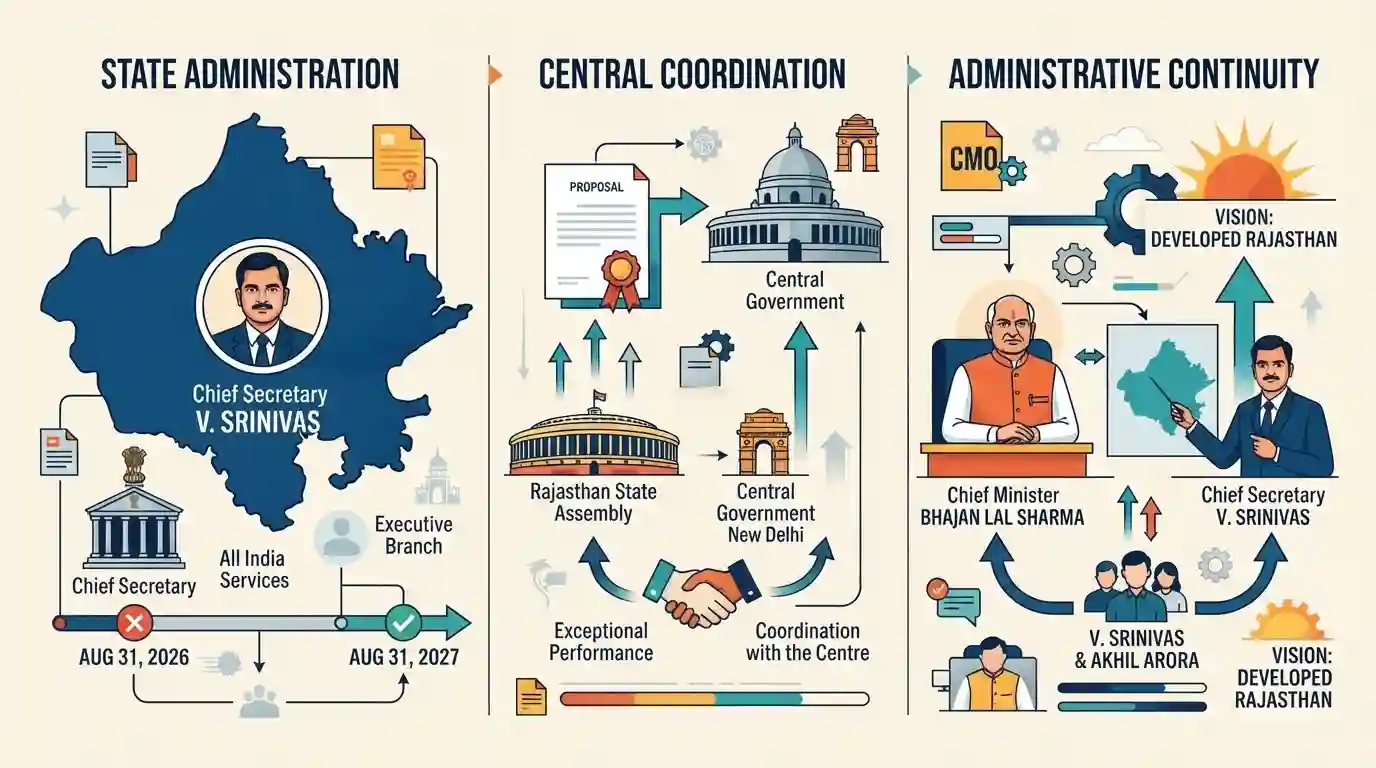
Why It Matters
The Chief Secretary is the highest-ranking civil servant in a state. Their appointment, tenure, and extension involve both the State Government (which recommends) and the Central Government (which approves extensions for All India Services officers). This highlights the nuances of state-centre administrative relations and state governance structures relevant to RPSC Prelims.
Summary
Rajasthan Chief Secretary V. Srinivas, originally set to retire on August 31, 2026, is likely to receive a one-year extension. Chief Minister Bhajan Lal Sharma forwarded the proposal to the Central Government on July 24, highlighting Srinivas's exceptional performance and coordination with the Centre. The move is intended to ensure administrative continuity in the Chief Minister's Office (CMO), allowing the team of V. Srinivas and Akhil Arora to effectively execute the state's vision for a 'Developed Rajasthan'.
Key Points
- Rajasthan Chief Secretary V. Srinivas is set to receive a one-year extension in service.
- CM Bhajan Lal Sharma proposed the extension to the Central Government on July 24, citing Srinivas's outstanding coordination and work.
- The extension aims to maintain administrative continuity in the CMO, ensuring the V. Srinivas-Akhil Arora duo can implement the 'Developed Rajasthan' mandate.
Important Terms
Chief Secretary

The highest-ranking civil servant in a state government, typically an IAS officer. They serve as the principal advisor to the Chief Minister, head the state secretariat, and coordinate across all state departments.
UPSC context
GS Paper 2 (State Governance). Tests understanding of state administrative hierarchy, civil services, and center-state bureaucratic linkages.
All India Services (AIS)
A unique tier of Indian civil services (IAS, IPS, IFoS) recruited centrally by the Union Government but allocated to state cadres, serving both the Centre and the states under shared administrative control.
UPSC context
GS Paper 2 (Polity/Federalism). Tests knowledge of Article 312, center-state relations, and the structural framework of Indian bureaucracy.
Chief Minister's Office (CMO)
The administrative apparatus that directly supports a state's Chief Minister. It facilitates inter-departmental coordination, oversees policy implementation, and acts as the primary hub of executive decision-making at the state level.
UPSC context
GS Paper 2 (State Governance). Evaluates the practical functioning of the state executive and the centralization of administrative power.
Central Government
The union-level executive authority in India's federal structure. In the context of All India Services, it acts as the overarching cadre-controlling authority with the power to approve service extensions.
UPSC context
GS Paper 2 (Federalism). Highlights the centralizing features of the Indian Constitution, especially the Union's control over All India Services.
Prelims Trap
The Chief Secretary has a fixed tenure and service extension requires only the State Governor's approval.
A Chief Secretary has no constitutionally fixed tenure. Furthermore, extending an All India Service officer's service beyond superannuation requires prior approval from the Central Government, not just the Governor.
Static Concepts Connected
How is the Chief Secretary of a state appointed and what are their primary roles?
- Appointment: Chosen and appointed by the Chief Minister from among senior IAS officers, though the formal executive order is issued in the Governor's name.
- Tenure: There is no fixed tenure; the officer serves at the pleasure and confidence of the Chief Minister.
- Key Functions: Acts as the principal advisor to the CM, ex-officio Secretary to the State Cabinet, and heads the State Civil Services Board.
What are the rules regarding the service extension of an All India Service (AIS) officer?
- Superannuation age: AIS officers generally retire at the age of 60. Extensions are exceptions based on public interest.
- Central Approval: A state cannot independently extend an officer's service. It requires prior approval from the Central Government (DoPT) under the All India Services (Death-cum-Retirement Benefits) Rules.
- Extension limits: A Chief Secretary can typically be given an extension for up to six months, though further extensions are sometimes negotiated with the Centre's consent.
Cross-Topic Patterns
Federalism and All India Services control
The requirement of Central approval for extending a State Chief Secretary's tenure often becomes a flashpoint in opposition-ruled states, reflecting broader federal tensions over the control of All India Services.
Second ARC on fixed administrative tenures
The Second ARC recommended a fixed tenure of 3-4 years for the Chief Secretary to ensure administrative independence, contrasting with the current practice of extensions based on political preference.

Expect a comparative Prelims statement contrasting the fixed tenure rules and extension powers for the Cabinet Secretary vs Chief Secretary.
Linked PYQs · 2
Linked PYQs · 2
- 2021RPSC_PRELIMSGS1
The Rajasthan Public Service Commission submits its annual report to
- 2021RPSC_PRELIMSGS1
Who is authorized to appoint the Chairman of the Rajasthan State Human Rights Commission?
