Legislative Preparation and All Party Meeting for UP Assembly Session
Source:theprint ↗
Why It Matters
Understanding the functioning of the state legislature, the process of introducing supplementary budgets, and the mechanism of replacing ordinances with regular bills is crucial for candidates studying Indian Polity and state governance mechanisms for UPPSC Prelims.
Summary
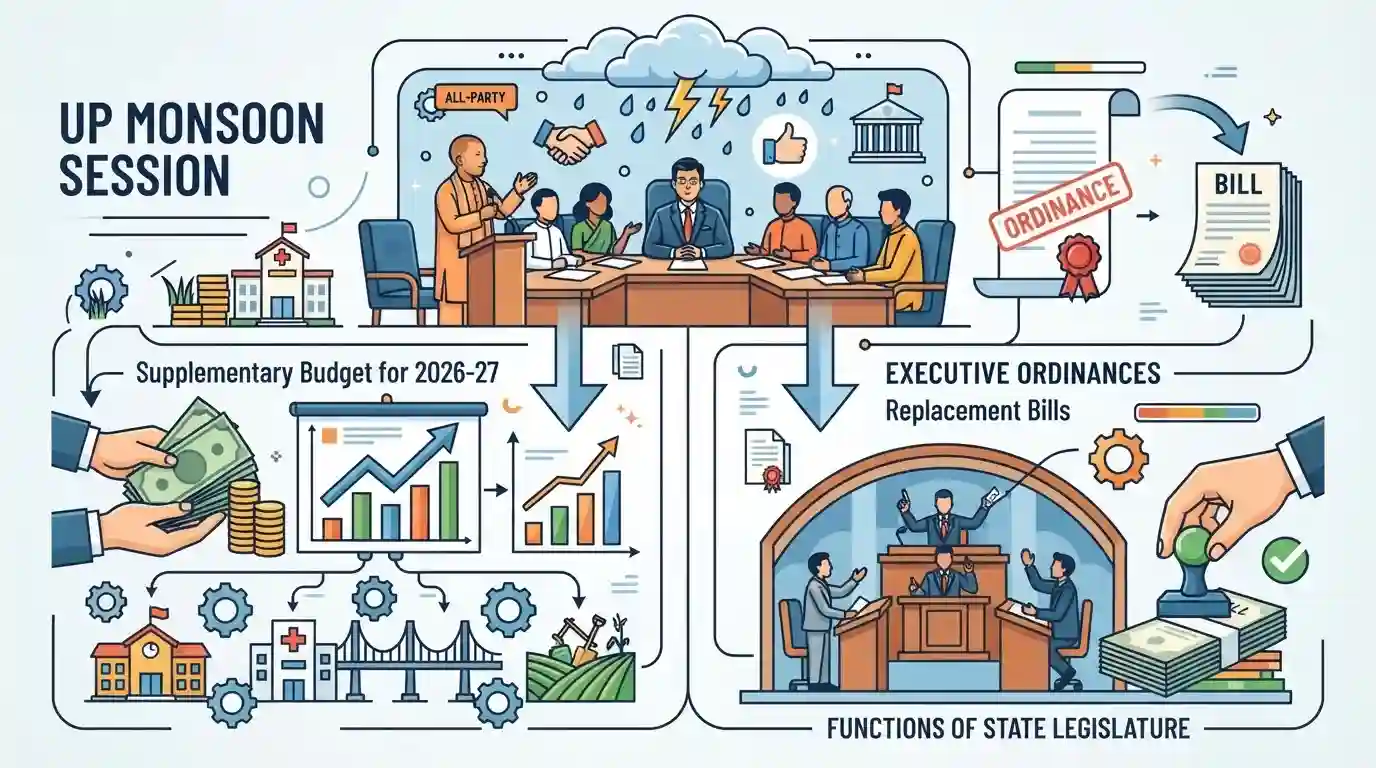
Ahead of the UP Monsoon Session starting August 3, Chief Minister Yogi Adityanath urged legislators to prioritize public interest and development during an all-party meeting led by Speaker Satish Mahana. The session's primary agenda includes passing the supplementary budget for the 2026-27 financial year and introducing replacement bills for ordinances promulgated after the previous session's prorogation.
Key Points
- The Uttar Pradesh Monsoon Session of the state legislature begins on August 3, focusing on public interest and state development.
- Chief Minister Yogi Adityanath convened an all-party meeting to ensure constructive discussions and the smooth functioning of the House.
- The UP government will present the supplementary budget for the 2026-27 financial year during the session.
- Replacement bills for ordinances promulgated since the previous session (which was adjourned sine die and prorogued) will also be introduced.
Important Terms
UP Legislative Assembly

The lower house of the bicameral legislature of Uttar Pradesh. With 403 seats filled by direct elections, it holds primary legislative and financial powers, including passing the state budget and replacing ordinances with bills.
UPSC context
GS Paper 2 (State Legislature). Tests composition, powers, and significance of the Vidhan Sabha in state governance.
UP Legislative Council
The upper house of Uttar Pradesh's bicameral legislature. Consisting of indirectly elected and nominated members, it acts as a revising chamber but cannot reject money bills or override the Assembly on ordinary bills.
UPSC context
GS Paper 2 (State Legislature). Tests bicameralism under Article 169 and the comparative powers of both state legislative houses.
Rashtriya Lok Dal
A regional political party predominantly active in western Uttar Pradesh. Founded in 1996, it focuses on agrarian issues, farmers' rights, and regional development, significantly influencing state-level coalition dynamics.
UPSC context
GS Paper 2 (Political Parties). Tests the role of regional parties, identity politics, and coalition dynamics in India's federal structure.
Prelims Trap
The Speaker of the State Legislative Assembly has the power to adjourn sine die and prorogue the session.
While the Speaker can adjourn the House sine die, the formal notification of prorogation (terminating the session) is exclusively issued by the Governor under Article 174.
Static Concepts Connected
What is the procedure for Supplementary Grants in a State Legislature?
- Constitutional Basis: Article 205 allows supplementary grants when the authorized budget amount for a particular service in the current financial year is insufficient.
- Identical Procedure: It is regulated by the exact same procedure as the regular state budget, requiring the Governor's prior recommendation to be introduced.
- Appropriation Bill: It must be followed by a supplementary Appropriation Bill under Article 204 to legally withdraw the extra funds from the State's Consolidated Fund.
What is the constitutional lifespan of a State Ordinance under Article 213?
- Legal Force: Governor-promulgated ordinances have the same legal force as an Act of the State Legislature but are strictly temporary in nature.
- Six-week Limit: An ordinance must be approved by the state legislature within six weeks of its reassembly, otherwise it ceases to operate.
- Replacement Bill: To make the temporary law permanent, the state government introduces a replacement bill during the legislative session.
Cross-Topic Patterns
Symmetry in Union-State Polity
UPSC frequently tests state legislature procedures (Articles 205, 213) by having aspirants contrast them with their exact Union counterparts (Articles 115, 123) to check for subtle asymmetric exceptions.
Ordinance vs Budgetary timelines
UPSC often mixes the 6-week expiry deadline of an ordinance with the 14-day limit for money bills, testing an aspirant's precision regarding legislative timelines.

A multi-statement Prelims question comparing the Governor's and President's ordinance-making timelines and limits is highly probable.
Linked PYQs · 5
Linked PYQs · 5
- 2024UPPSC_PRELIMSGS1
Which one of the following is not correctly matched ?
- 2023UPPSC_PRELIMSGS1
According to the Central Budget 2023-24, which of the following statements is not correct regarding total expenditure?
- 2023UPPSC_PRELIMSGS1
Which one of the following is not true about the total outlay in the Union Budget 2023-24?
- 2017UPPSC_PRELIMSGS1
A resolution passed by the Rajya Sabha under Article 249 of the constitution empowering Parliament to legislate on a state subject in national interest remains in force for a period.
- 2016UPPSC_PRELIMSGS1
A resolution passed under clause (1) of Article 249 shall remain in force for a period not exceeding
