Rainfall impact on elephant distribution in Western Ghats
Source:The Hindu ↗
Why It Matters
Human-elephant conflict is a critical, recurrent challenge across India's wildlife corridors. This article provides empirical insights from the Western Ghats on how rainfall and land-use changes drive animal displacement. Understanding these dynamics is essential for designing sustainable, community-backed conservation strategies, which frequently feature in both Prelims and Mains (GS Paper III) examinations.
Summary
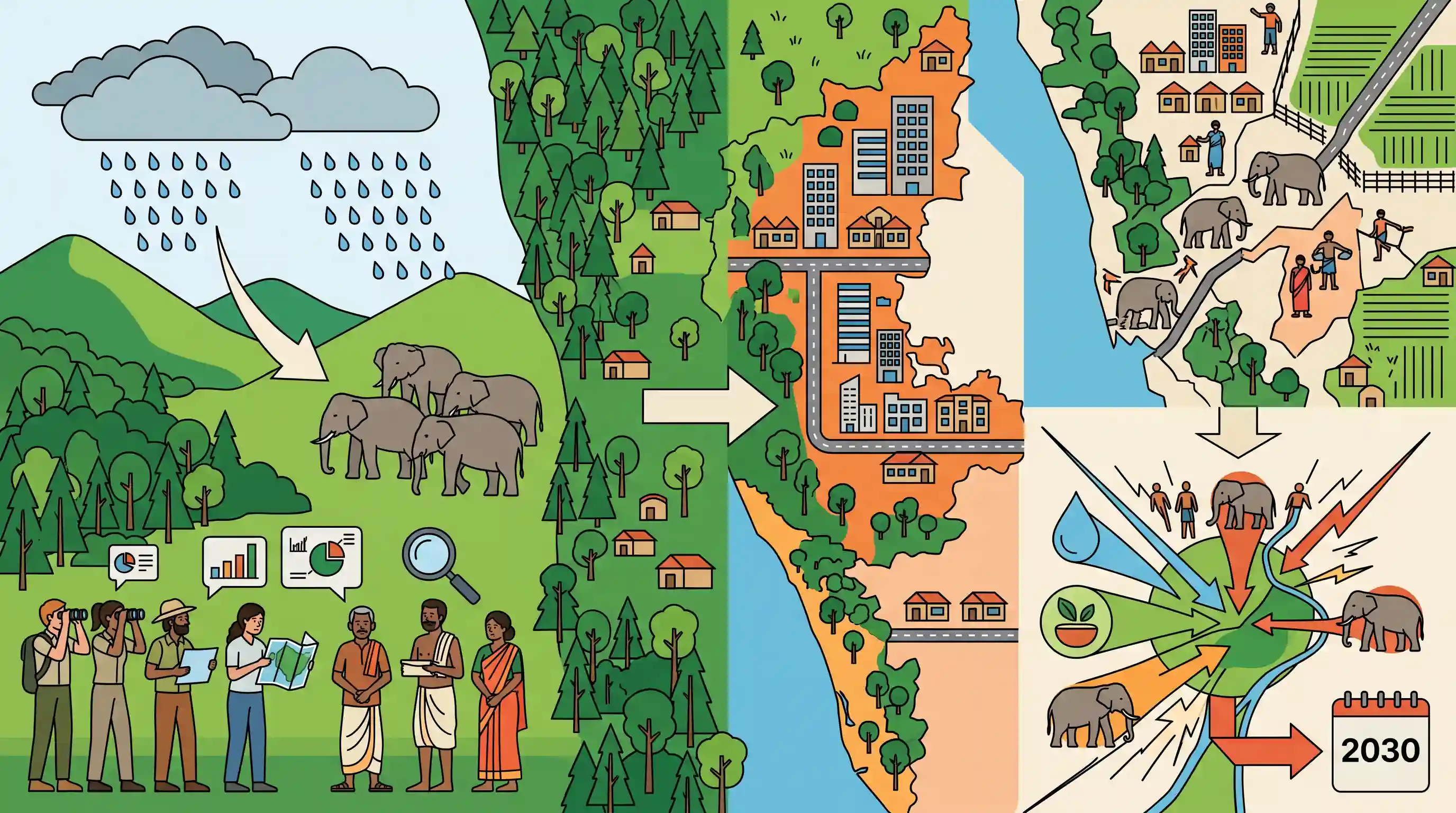
A research study by the Centre for Wildlife Studies (CWS) in the southern Western Ghats of Karnataka and Kerala has found that rainfall is the single strongest environmental driver of elephant occurrence. By integrating ecological modelling with local community knowledge, the study maps human-elephant interactions and projects trends up to 2030. Highlighting rapid land-use shifts—such as a 31% rise in human settlements in Karnataka and 16% in Kerala alongside declining dense forest cover—the report warns of increasingly fragmented and unpredictable elephant distributions. Because both humans and elephants are drawn to resource-dense, high-rainfall environments, safely sharing these spaces remains a complex conservation challenge.
Key Points
- A study by the Centre for Wildlife Studies (CWS) reveals that rainfall is the strongest environmental factor linked to reported Asian elephant occurrences in the southern Western Ghats of Karnataka and Kerala.
- The study combines scientific ecological modelling with local community knowledge, utilizing interviews of 507 residents from villages surrounding key national parks and forest divisions.
- In Karnataka, human settlements were positively associated with elephant presence, suggesting that elephants tolerate a certain amount of human presence up to a critical threshold before retreating.
- Between 2012 and 2022, human settlements increased by 31% in Karnataka and 16% in Kerala, while dense vegetation cover declined.
- Projections for 2030 predict more fragmented and less predictable patterns of elephant occurrence, with Kerala's elephant presence becoming strongly confined to areas near protected zones.
- The primary conservation challenge lies in the shared resource needs of humans and elephants, as both rely heavily on the same high-rainfall, high-water, and forest-proximate landscapes.
Important Terms
Centre for Wildlife Studies (CWS)

A premier Indian non-profit organization established in 1984, dedicated to scientific research, wildlife conservation, policy advocacy, and community-based mitigation of human-wildlife conflict.
UPSC context
GS Paper III (Environment). Evaluates the role of non-governmental scientific institutions in wildlife research and policy formulation.
Western Ghats
A 1,600 km long mountain range running parallel to India’s western coast, recognized as a global biodiversity hotspot and UNESCO World Heritage Site famous for its high endemism.
UPSC context
GS Paper I (Geography) & III (Environment). Vital for monsoon dynamics, ecological sensitive zoning, and peninsular biodiversity conservation.
Asian Elephant
Asia's largest land mammal (Elephas maximus), classified as Endangered on the IUCN Red List and protected under Schedule I of India's Wildlife (Protection) Act, 1972.
UPSC context
GS Paper III (Biodiversity). Key for species-specific preservation questions, tracking threat parameters, and assessing environmental impact policies.
Human-Wildlife Conflict (HWC)
Negative interactions between humans and wild animals, resulting in crop damage, property loss, injuries, or deaths on both sides, driven by habitat fragmentation and land-use changes.
UPSC context
GS Paper III (Ecology). Essential for discussing mitigation strategies, wildlife corridor restoration, and human-nature coexistence policies.
Project Elephant
A Centrally Sponsored Scheme launched by India in 1992 to provide financial and technical support to states for conserving wild elephants, their habitats, and crucial migratory corridors.
UPSC context
GS Paper III (Environmental Conservation). Important for evaluating government initiatives, biodiversity protection schemes, and federal environmental governance.
Prelims Trap
Asian elephants strictly avoid human-modified landscapes and are only found in core protected forest areas with zero human footprint.
The CWS study highlights that elephants tolerate a level of human settlement (positive association in Karnataka) due to shared resource needs, meaning they do not strictly avoid humans until a critical threshold is crossed.
Static Concepts Connected
What are the defining biological and social traits of the Asian Elephant?
- Social Hierarchy: Herds are strictly matriarchal, led by the oldest and largest female who makes crucial decisions on migration and defense.
- Gestation Period: They possess the longest gestation period of any land mammal, lasting 18 to 22 months.
- Reproductive Lifespan: Females retain reproductive capacity late in life, successfully calving well into their 40s and 50s.
Which geographical features bridge the Western and Eastern Ghats for wildlife migration?
- BR Hills Confluence: The Biligirirangan Hills (BRT Wildlife Sanctuary) serve as the primary ecological corridor facilitating gene flow between the two mountain ranges.
- Sigur Plateau: The Sigur Plateau connects Nilgiris to the Eastern Ghats, acting as a critical migratory bottleneck for elephants and tigers.
Cross-Topic Patterns
Monsoon variability and crop-raiding dynamics
Changing rainfall patterns alter fodder and water availability, pushing elephants out of drying forest cores into high-rainfall, human-dominated agricultural zones, intensifying conflicts.
Forest rights vs. migration corridors
Reconciling community forest rights under FRA 2006 with the legal notification of ecologically fragile elephant corridors requires navigating complex federal-state and center-tribal dynamics.

UPSC may link Southern Western Ghats ecology (BR Hills) with elephant biology and WPA protection status in a single 2026 question.
Linked PYQs · 3
Linked PYQs · 3
- 2020PrelimsGS1
With reference to Indian elephants, consider the following statements: 1. The leader of an elephant group is a female. 2. The maximum gestation period can be 22 months. 3. An elephant can normally go on calving till the age of 40 years only. 4. Among the States in India, the highest elephant population is in Kerala. Which of the statements given above is/are correct?
- 2017PrelimsGS1
From the ecological point of view, which one of the following assumes importance in being a good link between the Eastern Ghats and the Western Ghats?
- 2023PrelimsGS1
Consider the following statements: 1. Amarkantak Hills are at the confluence of Vindhya and Sahyadri Ranges. 2. Biligirirangan Hills constitute the easternmost part of Satpura Range. 3. Seshachalam Hills constitute the southernmost part of Western Ghats. How many of the statements given above are correct?
