Delhi NCR Rains Lower Temperatures as IMD Issues Yellow Alert
Source:The Hindu ↗
Why It Matters
The article touches on frequent urban governance and environmental challenges: urban flooding due to inadequate drainage infrastructure, IMD's colour-coded weather warning system, and the measurement of air quality (AQI) by the CPCB—all highly relevant for UPSC Prelims and Mains (GS1 and GS3).
Summary
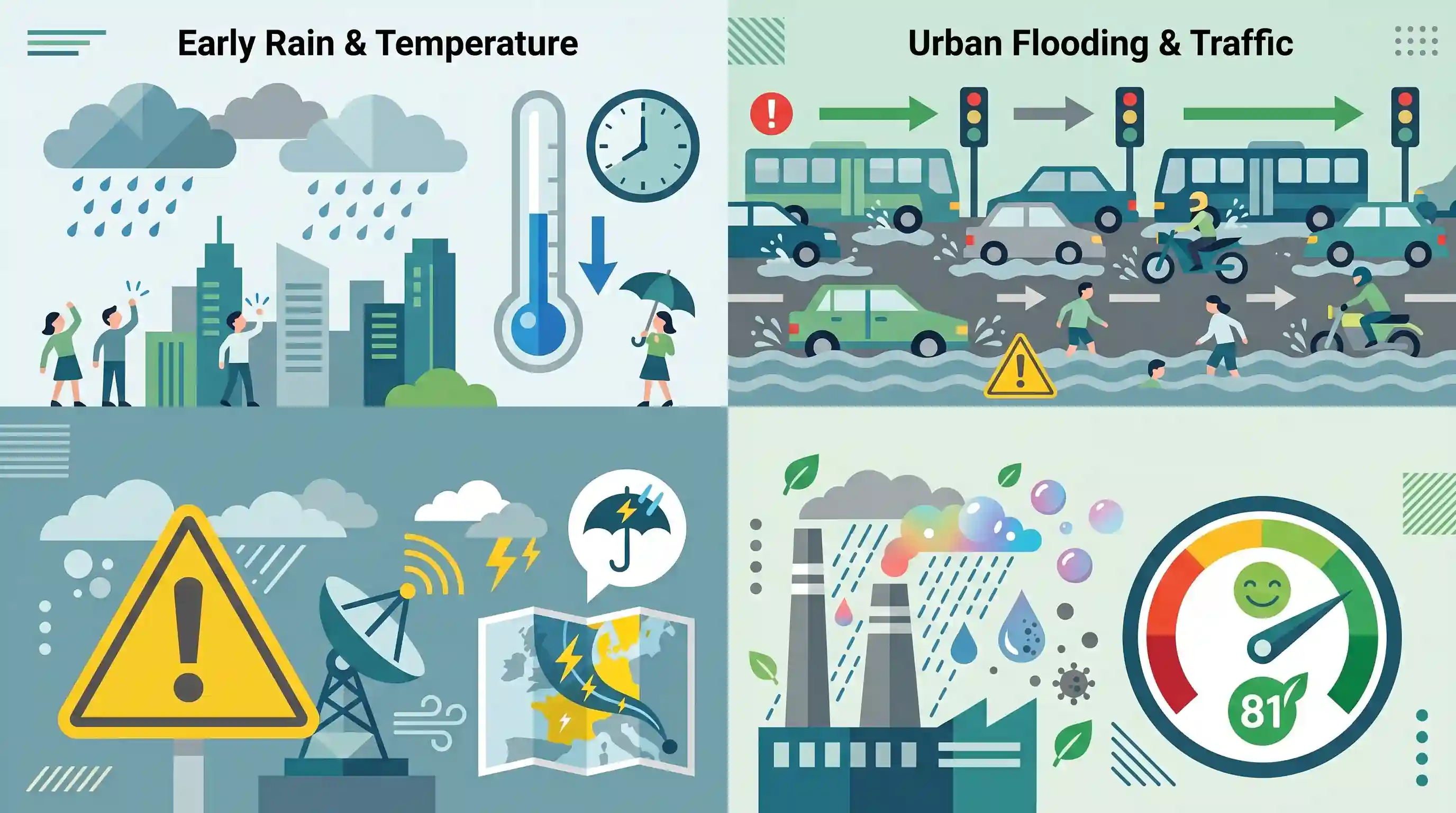
Early morning rainfall in Delhi-NCR brought much-needed relief from the heat, lowering temperatures but simultaneously causing significant urban waterlogging and traffic disruptions. The India Meteorological Department (IMD) issued a 'yellow alert' for the region. Benefiting from the rain, the city's Air Quality Index (AQI) improved to 81, falling under the 'satisfactory' category as per the Central Pollution Control Board (CPCB).
Key Points
- Rainfall in Delhi-NCR lowered the minimum temperature to 22.9°C, providing relief from the heat.
- The downpour led to severe urban waterlogging, disrupting peak-hour traffic.
- The IMD issued a 'yellow alert' for the region, forecasting continued thunderstorms and rain.
- Air quality improved significantly, with the CPCB recording an AQI of 81 (categorized as 'satisfactory').
Important Terms
India Meteorological Department (IMD)

India's national meteorological service (Ministry of Earth Sciences) founded in 1875. It manages weather forecasting, seismology, and provides early warnings for natural disasters like cyclones and heavy rainfall.
UPSC context
GS Paper 1 (Geography) and GS Paper 3 (Disaster Management); tests knowledge of institutional frameworks for weather monitoring.
Central Pollution Control Board (CPCB)
A statutory apex body under MoEFCC established in 1974. It coordinates pollution control activities, sets environmental quality standards, and implements the Water and Air (Prevention and Control of Pollution) Acts.
UPSC context
GS Paper 2 (Statutory bodies) and GS Paper 3 (Environmental Pollution); critical for governance and ecology questions.
Air Quality Index (AQI)
A metric monitoring eight major pollutants (PM10, PM2.5, NO2, SO2, CO, O3, NH3, Pb) using a 'One Number-One Color-One Description' format to communicate air health levels across six categories.
UPSC context
GS Paper 3 (Environment & Ecology); frequently tested in Prelims (pollutants) and Mains (pollution management).
Urban Flooding
The inundation of developed land where heavy rainfall exceeds the drainage capacity of artificial environments; often categorized as a man-made disaster due to unplanned urbanisation and encroachment.
UPSC context
GS Paper 1 (Geographical phenomena) and GS Paper 3 (Disaster Management); highly relevant for urban planning and climate resilience topics.
Yellow Alert
A cautionary weather warning from the IMD meaning "Be Aware." It indicates potentially bad weather that could worsen or cause localized disruptions like waterlogging and traffic congestion.
UPSC context
GS Paper 3 (Disaster Management); tests understanding of early warning systems and disaster preparedness protocols.
Regional Weather Forecasting Centre (RWFC)
Specialized operational units under the IMD's six Regional Meteorological Centres that provide localized, district-level weather forecasts and specific alerts for regional geographical zones.
UPSC context
GS Paper 3 (Disaster Management); relevant to decentralized weather monitoring and local administrative preparedness.
Prelims Trap
"CPCB is a statutory body established under the Air (Prevention and Control of Pollution) Act, 1981."
CPCB was actually established under the Water (Prevention and Control of Pollution) Act, 1974. It was only later entrusted with additional powers under the 1981 Air Act.
Static Concepts Connected
Which 8 major pollutants are tracked under the National Air Quality Index (AQI)?
- Particulate Matter: PM10 and PM2.5, which are the primary drivers of severe smog.
- Gases: Nitrogen Dioxide (NO2), Sulphur Dioxide (SO2), Carbon Monoxide (CO), Ozone (O3), and Ammonia (NH3). Note: Carbon Dioxide (CO2) is NOT included.
- Heavy Metal: Lead (Pb) is the only heavy metal tracked in the standardized index.
How does the IMD classify weather warnings using colour codes?
- Green: No advisory is issued; weather is safe.
- Yellow: "Be updated" or "aware". Signals severely bad weather spanning across several days.
- Orange: "Be prepared". Issued as a warning for extremely bad weather with potential for power outages and commute disruptions.
- Red: "Take action". Bad weather conditions are likely to disrupt travel, power, and pose a significant risk to life.
Cross-Topic Patterns
Urban Flooding & Sponge Cities
Urban flooding is a distinct disaster caused by impervious concretization. Connecting this with the 'Sponge City' concept and NDMA guidelines on urban drainage is crucial for GS-III Mains.
Wet Scavenging vs Winter Inversions
The sudden drop in AQI post-rain highlights the natural atmospheric 'wet scavenging' process, directly contrasting with winter temperature inversions that trap particulate matter over the NCR.

Expect a composite Prelims 2026 statement-based question mixing IMD color codes, AQI pollutants (CO vs CO2), and CPCB's parent Act.
Linked PYQs · 3
Linked PYQs · 3
- 2024MainsGS3
Flooding in urban areas is an emerging climate-induced disaster. Discuss the causes of this disaster. Mention the features of two such major floods in the last two decades in India. Describe the policies and frameworks in India that aim at tackling such floods.
- 2016PrelimsGS1
In the cities of our country, which among the following atmospheric gases are normally considered in calculating the value of Air Quality Index? 1. Carbon dioxide 2. Carbon monoxide 3. Nitrogen dioxide 4. Sulfur dioxide 5. Methane Select the correct answer using the code given below.
- 2022MainsGS1
Discuss the meaning of colour-coded weather warnings for cyclone prone areas given by India Meteorological Department.
