Indian Railways Modernizes Colonial Era Yamuna Bridge for Logistics
Source:Indian Express ↗
Why It Matters
Upgrading legacy transport infrastructure is a critical aspect of India's economic growth. It demonstrates the technical feasibility of modernizing colonial-era assets to meet current capacity demands, reducing logistical bottlenecks without the immense capital expenditure required for entirely new greenfield projects.
Summary
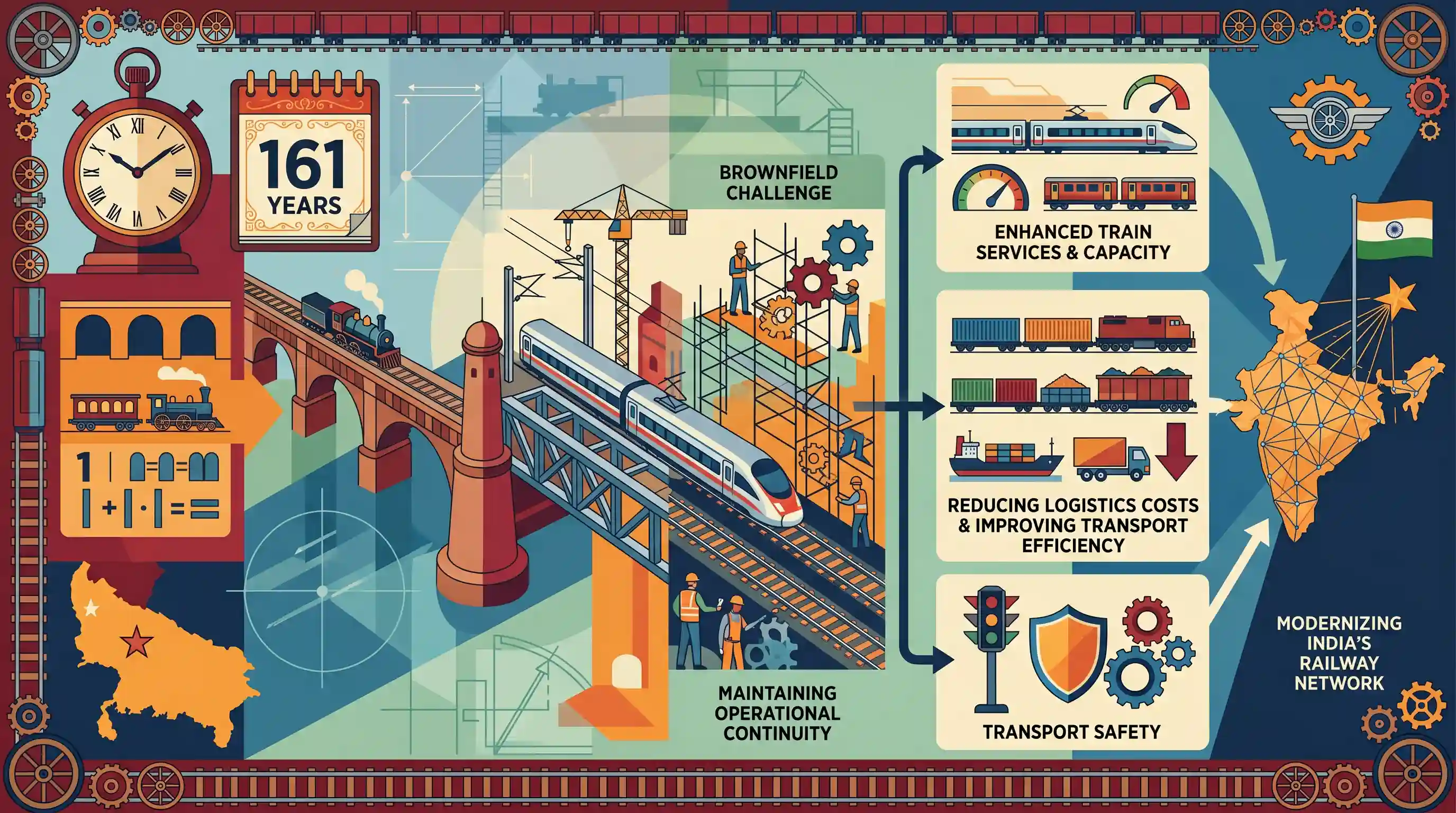
The Indian Railways has undertaken the structural upgradation of a 161-year-old Yamuna Bridge in Uttar Pradesh to enhance train services and capacity on critical routes. Built during the colonial era, this heritage infrastructure is being modernized to handle contemporary traffic volumes, higher speeds, and heavier rolling stock. The initiative underscores the complex engineering challenges associated with brownfield infrastructure projects—specifically, upgrading legacy assets while maintaining operational continuity. By eliminating structural bottlenecks, the project aligns with broader national objectives of reducing logistics costs, improving transport safety, and modernizing India's railway network.
Key Points
- Indian Railways is upgrading a 161-year-old colonial-era railway bridge over the Yamuna River in Uttar Pradesh.
- The infrastructural upgrade aims to remove speed bottlenecks, accommodate heavier rolling stock, and improve overall train services on key routes.
- The project highlights the engineering challenges of brownfield development, involving the modernization of operational legacy structures without severely disrupting ongoing rail traffic.
- This initiative reflects a broader push to modernize India's aging transport network, enhancing logistical efficiency and safety while maintaining heritage assets.
Important Terms
Indian Railways

India's state-owned national railway system, managed by the Ministry of Railways; it is one of the world's largest rail networks, serving as the backbone of national transport and logistics.
UPSC context
GS Paper 3 (Infrastructure). Evaluates the role of rail in national integration, economic growth, and the shift toward technology-driven modernization.
Brownfield Project
Infrastructure development involving the expansion or redevelopment of existing assets, such as colonial-era bridges, rather than starting on new, undeveloped land (Greenfield).
UPSC context
GS Paper 3 (Infrastructure). Tests understanding of project management challenges, particularly upgrading legacy systems while maintaining operational continuity.
Logistics Cost
The total expenditure incurred in moving goods from producers to consumers, including transport and warehousing; India aims to reduce this from ~14% to 8% of GDP.
UPSC context
GS Paper 3 (Economy). Key for global competitiveness; relates to the National Logistics Policy and reducing structural bottlenecks in transport.
PM Gati Shakti
A national master plan for multi-modal connectivity launched to ensure integrated planning and synchronized execution of infrastructure projects across various ministries and departments.
UPSC context
GS Paper 3 (Infrastructure). Flagship reform testing integrated planning, logistics efficiency, and the removal of departmental silos in governance.
Heritage Infrastructure
Historical structures or systems, like century-old rail bridges, that possess cultural or engineering value and require specialized conservation efforts during modern upgrades.
UPSC context
GS Paper 1 (Culture) and Paper 3 (Infrastructure). Addresses the balance between preserving national industrial legacy and meeting contemporary functional needs.
Rolling Stock
The collective term for all vehicles that move on a railway, including locomotives, passenger carriages, and freight wagons.
UPSC context
GS Paper 3 (Infrastructure/Technology). Central to discussions on modernization, speed enhancement (e.g., Vande Bharat), and upgrading safety standards within the network.
Prelims Trap
Modernizing a 161-year-old operational railway bridge is classified as a Greenfield infrastructure project.
It is a classic Brownfield project as it involves modifying an existing, operational asset. Greenfield refers to building completely new infrastructure from scratch on unused land.
Static Concepts Connected
What is the difference between Greenfield and Brownfield infrastructure projects?
- Greenfield: Fresh investments in new facilities constructed from scratch on previously undeveloped land, requiring fresh environmental clearances and land acquisition.
- Brownfield: Investments in modifying, upgrading, or expanding an existing, operational facility (e.g., upgrading the 1865 Yamuna Bridge).
- Challenges: Brownfield avoids high land acquisition costs but often involves complex engineering challenges to maintain operational continuity during upgrades.
How did the introduction of railways impact the colonial Indian economy?
- Deindustrialization: Enabled cheaper British factory-made goods to flood inland markets, displacing local artisans and ruining traditional Indian handicrafts.
- Extractive Economy: Facilitated the rapid transport of raw materials (like cotton and indigo) from the rural hinterland to major ports for export.
- Commercialization of Agriculture: Encouraged a shift from food crops to cash crops, which exacerbated the severity of famines in the late 19th century.
Cross-Topic Patterns
Colonial assets meet PM Gati Shakti
Upgrading legacy brownfield projects eliminates structural bottlenecks, aligning historical heritage conservation directly with modern goals of reducing logistics costs under PM Gati Shakti.
Adaptive civil engineering and conservation
The 19th-century 'Elephant's Foot' pier of the Naini bridge demonstrates early adaptive civil engineering that is now being conserved while being upgraded for heavier modern axle loads.

Brownfield vs Greenfield concepts mixed with the economic impacts of colonial railway expansion could form a multi-statement Prelims MCQ.
Linked PYQs · 3
Linked PYQs · 3
- 2022MainsGS3
Why is Public Private Partnership (PPP) required in infrastructural projects ? Examine the role of PPP model in the redevelopment of Railway Stations in India.
- 2021MainsGS3
“Investment in infrastructure is essential for more rapid and inclusive economic growth.” Discuss in the light of India's experience.
- 2020PrelimsGS1
Which of the following statements correctly explains the impact of Industrial Revolution on India during the first half of the nineteenth century?
