Aadhaar Based Ticketing Rules to Curb IRCTC Touts
Source:Indian Express ↗
Why It Matters
It provides a concrete case study for GS-2 (E-governance) and GS-3 (Infrastructure) on how digital identity (Aadhaar) can be utilized to plug leakages, eliminate middlemen (touts), and improve the efficiency of public service delivery in large-scale government utilities like the Indian Railways.
Summary
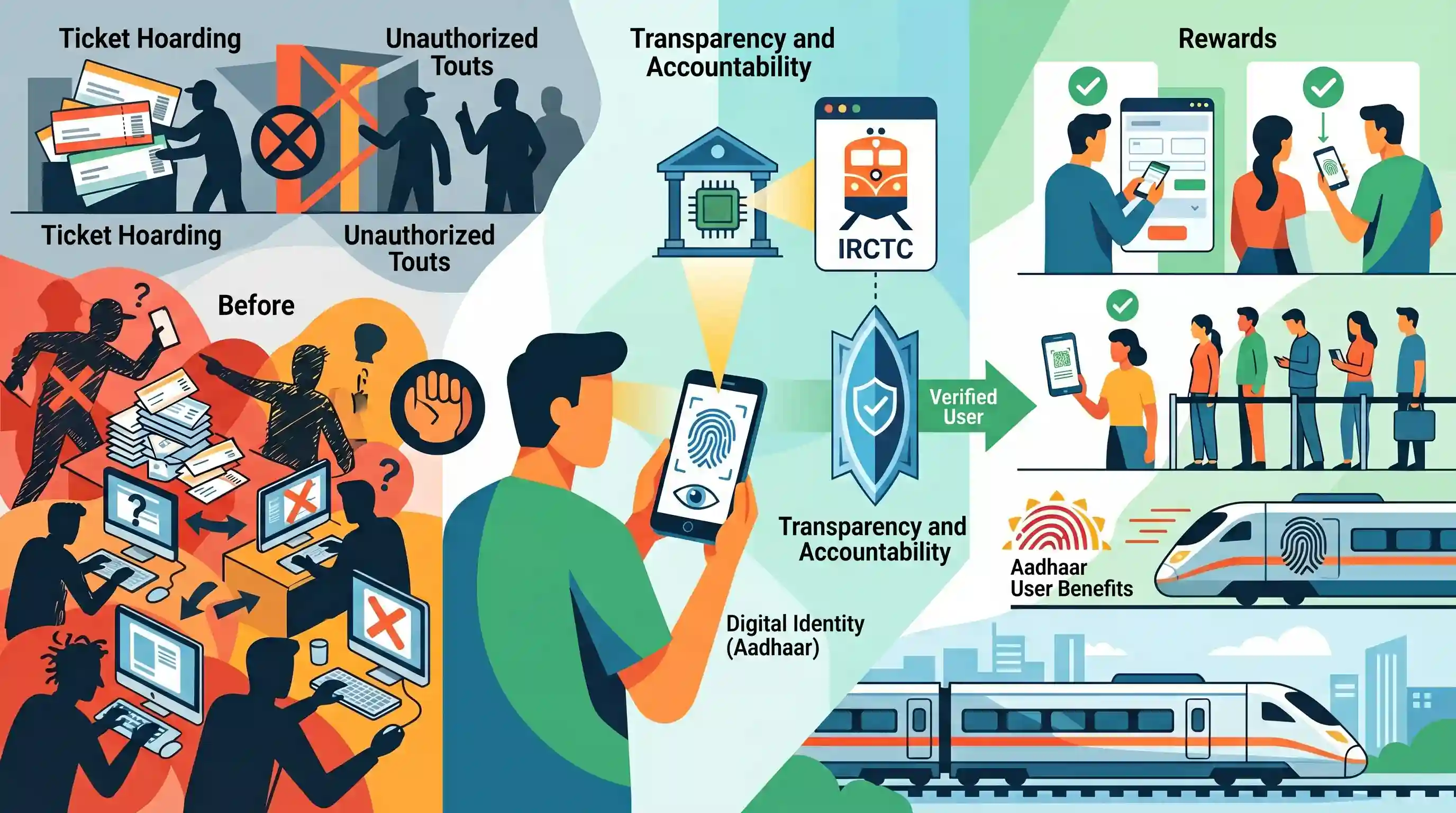
The article discusses the Indian Railways' initiative to modify train ticket booking rules and timings for IRCTC users who have authenticated their accounts with Aadhaar. By integrating UIDAI's digital identity framework with the IRCTC ticketing portal, the government aims to reward verified users while systematically curbing ticket hoarding, black marketing, and unauthorized touts. This integration is a prime example of e-governance in action, demonstrating how digital public infrastructure can be leveraged to ensure transparent, efficient, and equitable access to essential public transport services.
Key Points
- IRCTC has introduced changes in the train ticket booking timings and rules specifically for users who have authenticated their accounts using Aadhaar.
- The integration incentivizes passengers to link their IRCTC accounts with their Aadhaar numbers by offering enhanced booking privileges and a smoother experience.
- This move is primarily aimed at curbing the menace of ticket touts, black marketing, and the use of automated booking software by ensuring that tickets are booked by verified, genuine individuals.
- The policy highlights a practical application of e-governance, utilizing biometric-backed digital identity to improve transparency, accountability, and equity in public service delivery.
Important Terms
Aadhaar Act, 2016

The 2016 legislation providing statutory backing to Aadhaar for the targeted delivery of subsidies and services funded by the Consolidated Fund of India.
UPSC context
GS Paper II: Government Policies. Tests legislative frameworks for digital identity and its 'Money Bill' status.
UIDAI (Unique Identification Authority of India)
A statutory authority under the Ministry of Electronics and IT, responsible for Aadhaar enrollment, authentication, and managing the Central Identities Data Repository.
UPSC context
GS Paper II: Statutory Bodies. Tests the role of technology-driven institutions in e-governance and data security.
E-Governance
The application of Information and Communication Technology (ICT) to deliver government services, ensuring transparency, efficiency, and direct accountability to citizens.
UPSC context
GS Paper II: E-Governance applications. Tests how digital platforms like IRCTC reduce corruption and improve public access.
Digital India
A flagship program launched in 2015 to transform India into a digitally empowered society by improving infrastructure and digital literacy.
UPSC context
GS Paper II/III: Government Schemes. Tests the impact of digital infrastructure on socio-economic development and inclusive growth.
IRCTC (Indian Railway Catering and Tourism Corporation)
A Mini-Ratna Public Sector Undertaking under the Ministry of Railways that manages online ticketing, catering, and tourism operations for Indian Railways.
UPSC context
GS Paper III: Infrastructure. Tests the digitalization and operational efficiency of critical public transport services.
Advance Reservation Period (ARP)
The specific timeframe during which passengers can book train tickets before the journey date; recently reduced from 120 to 60 days.
UPSC context
GS Paper III: Public Policy. Tests understanding of administrative measures to manage high-demand public resources.
Prelims Trap
Aadhaar authentication is strictly mandatory for all users to book any reserved train tickets on the IRCTC platform.
Aadhaar is not mandatory for all bookings. It acts as a voluntary incentive for enhanced quotas (24 tickets) and priority booking windows, aligning with Supreme Court rulings against blanket mandates.
Static Concepts Connected
Where can Aadhaar be legally mandated under the Aadhaar Act?
- Section 7: Mandatory for receiving welfare subsidies, benefits, or services explicitly funded by the Consolidated Fund of India.
- Puttaswamy Ruling: Struck down mandatory use by private entities and restricted blanket government mandates lacking statutory backing or passing the proportionality test.
- Voluntary Use: Permitted for verification in services where incentives are offered (like IRCTC quotas), provided non-exclusionary alternatives exist for basic access.
What are the three foundational layers of India's Digital Public Infrastructure?
- Identity Layer: Aadhaar and e-KYC systems providing biometric-backed, unique, and verifiable digital identification.
- Payments Layer: Unified Payments Interface (UPI) and Aadhaar Payment Bridge for interoperable, instant financial transfers.
- Data Layer: Consent-based secure sharing frameworks like DigiLocker and the Account Aggregator network.
Cross-Topic Patterns
Service efficiency vs Privacy Rights
IRCTC's targeted Aadhaar utility balances e-governance efficiency with privacy norms, showcasing a practical application of the Puttaswamy doctrine's proportionality test.
DPI expansion beyond DBT
This links India Stack's Identity Layer to public transport, moving Aadhaar's utility from simple Direct Benefit Transfers (DBT) to dynamic resource allocation and anti-hoarding.

Expect a GS2/GS3 question evaluating how DPIs like Aadhaar balance administrative efficiency (anti-hoarding) with data privacy.
Linked PYQs · 4
Linked PYQs · 4
- 2018PrelimsGS1
The identity platform 'Aadhaar' provides open "Application Programming Interfaces (APIs)". What does it imply? 1. It can be integrated into any electronic device. 2. Online authentication using iris is possible. Which of the statements given above is/are correct?
- 2020PrelimsGS1
Consider the following statements: 1. Aadhaar metadata cannot be stored for more than three months. 2. State cannot enter into any contract with private corporations for sharing of Aadhaar data. 3. Aadhaar is mandatory for obtaining insurance products. 4. Aadhaar is mandatory for getting benefits funded out of the Consolidated Fund of India. Which of the statements given above is/are correct?
- 2024MainsGS2
e-governance is not just about the routine application of digital technology in service delivery process. It is as much about multifarious interactions for ensuring transparency and accountability. In this context evaluate the role of the 'Interactive Service Model' of e-governance.
- 2023MainsGS2
e-governance, as a critical tool of governance, has ushered in effectiveness, transparency and accountability in governments. What inadequacies hamper the enhancement of these features ?
