Indian Railways Establishes Accessible Help Booths for Divyangjan
Source:The Hindu ↗
Why It Matters
It provides a concrete example of inclusive public infrastructure (accessible transport for PwDs) and illustrates how government agencies can collaborate with NGOs to improve the delivery of welfare services to vulnerable groups.
Summary
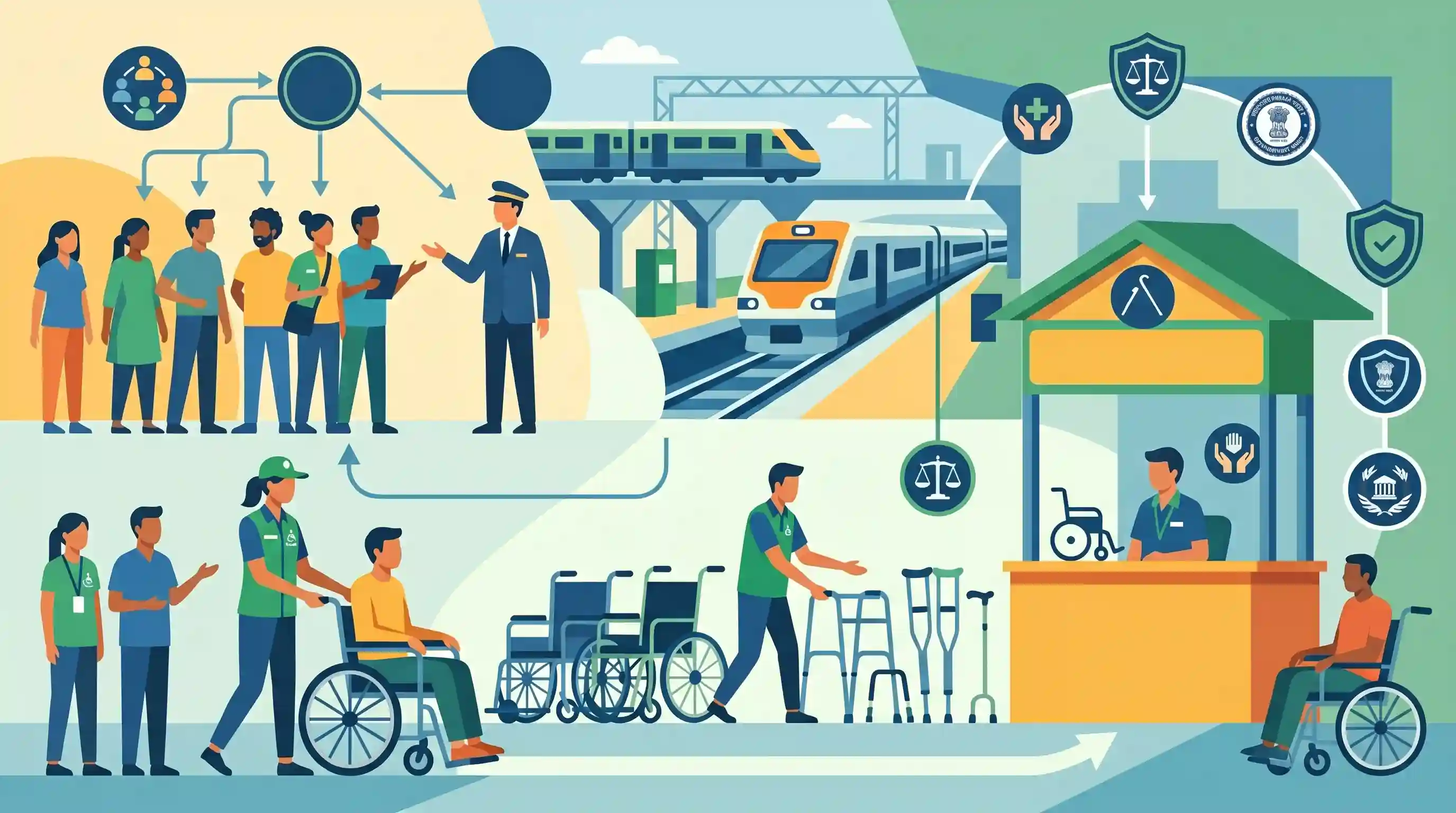
The Indian Railways is establishing Accessible Help Booths at select major stations (NSG-1 to NSG-3 categories) to support passengers with disabilities (Divyangjan). These booths will be stationed at key entry and exit points, offering free wheelchairs, assistive devices, and immediate guidance from trained 'Divyangjan Sahayaks'. To operationalize the initiative, the Waltair Railway Division has invited NGOs working in disability empowerment to supply volunteers, with the Railways providing basic training on support services. This step highlights efforts toward inclusive infrastructure and underscores the role of civil society in facilitating public service delivery.
Key Points
- Indian Railways is setting up Accessible Help Booths at NSG-1 to NSG-3 category stations to assist passengers with disabilities.
- The booths will provide free wheelchairs, assistive devices, and on-the-spot support at major entry and exit points.
- Trained volunteers, designated as 'Divyangjan Sahayaks', will manage the booths and guide the passengers.
- The Waltair Railway Division has invited Expressions of Interest (EOIs) from NGOs in the disability welfare sector to provide volunteers free of cost.
- The initiative exemplifies government-civil society collaboration to improve inclusive public infrastructure and service delivery.
Important Terms
Divyangjan

Term meaning 'divine body,' used officially in India to refer to Persons with Disabilities (PwDs) to emphasize their potential and promote dignity over limitation.
UPSC context
GS Paper II: Welfare schemes for vulnerable sections; tests understanding of inclusive terminology and government policy shifts toward dignity.
Rights of Persons with Disabilities (RPwD) Act, 2016
Legislation that expanded disability categories from 7 to 21 and mandated universal accessibility in public buildings and transport by specified deadlines.
UPSC context
GS Paper II: Laws for the betterment of vulnerable sections; crucial for questions on social justice and legal safeguards.
Sugamya Bharat Abhiyan
Also known as the Accessible India Campaign, it is a flagship mission to ensure barrier-free access in the built environment, transportation, and ICT ecosystems.
UPSC context
GS Paper II & III: Infrastructure and Social Justice; tests knowledge of specific mission targets for inclusive public transport.
NSG (Non-Suburban Group) Stations
A railway classification (NSG-1 to NSG-6) based on earnings and passenger footfall, used to determine the level of amenities provided at stations.
UPSC context
GS Paper III: Infrastructure; tests technical knowledge of how Indian Railways manages and upgrades high-traffic vs. low-traffic hubs.
Non-Governmental Organizations (NGOs)
Independent, non-profit organizations that facilitate development and welfare by bridging the gap between government policies and grassroots implementation.
UPSC context
GS Paper II: Role of civil society; tests the understanding of NGOs as implementing partners in public service delivery.
Divyangjan Sahayak
Trained personnel or volunteers deployed at railway help booths to provide immediate assistance, such as wheelchair support and guidance, to passengers with disabilities.
UPSC context
GS Paper II: Social Justice; relevant for the implementation of welfare measures through human-centric public service infrastructure.
Prelims Trap
"Divyangjan Sahayaks are a newly created permanent employee cadre within the Indian Railways."
They are volunteers provided by disability-welfare NGOs free of cost, representing a government-civil society collaboration rather than a direct railway employment scheme.
Static Concepts Connected
What are the three core pillars of the Accessible India Campaign (Sugamya Bharat Abhiyan)?
- Built Environment: Ensuring public spaces, government offices, and facilities are completely barrier-free for PwDs.
- Transportation System: Making airports, railway stations, and public transport systems accessible, such as converting 50% of railway stations into accessible hubs.
- ICT Ecosystem: Upgrading websites, public documents, and media to be accessible for visually and hearing-impaired individuals.
How does the RPwD Act, 2016 mandate physical accessibility?
- Reasonable Accommodation: The Act requires the government to make necessary modifications to ensure PwDs can exercise their rights on an equal basis with others.
- Barrier-free access: It legally mandates barrier-free access in all transport systems, including roads, railways, and aviation, within stipulated timelines.
- Private sector inclusion: The Act explicitly mandates that private service providers also must ensure accessibility to their services and built environments.
Cross-Topic Patterns
NGOs filling State capacity gaps
The Railways utilizing NGO volunteers (Divyangjan Sahayaks) mirrors a broader trend of the State leveraging civil society to overcome capacity constraints and ensure last-mile public service delivery.
Infrastructure as a tool for social inclusion
Inclusive infrastructure (GS3) is a prerequisite for fulfilling the RPwD Act mandates (GS2). Without accessible transit, the economic integration and fundamental rights of PwDs remain compromised.

Expect a GS2 Mains question evaluating the progress of the 'Accessible India Campaign' in bridging transit infrastructure gaps for PwDs.
Linked PYQs · 5
Linked PYQs · 5
- 2017MainsGS2
Does the Rights of Persons with Disabilities Act, 2016 ensure effective mechanism for empowerment and inclusion of the intended beneficiaries in the society? Discuss.
- 2021MainsGS2
Can Civil Society and Non-Governmental Organizations present an alternative model of public service delivery to benefit the common citizen? Discuss the challenges of this alternative model.
- 2019MainsGS2
Performance of welfare schemes that are implemented for vulnerable sections is not so effective due to absence of their awareness and active involvement at all stages of policy process. Discuss.
- 2021MainsGS3
“Investment in infrastructure is essential for more rapid and inclusive economic growth.” Discuss in the light of India's experience.
- 2022MainsGS3
Why is Public Private Partnership (PPP) required in infrastructural projects ? Examine the role of PPP model in the redevelopment of Railway Stations in India.
