Kerala SilverLine rail project and Centre State federal friction
Source:Indian Express ↗
Why It Matters
This development is a prime example of the friction points in Centre-State relations over infrastructure financing and approvals. For UPSC aspirants, it serves as a crucial case study for GS-2 (Federalism) and GS-3 (Infrastructure and Investment Models), demonstrating the hurdles in implementing large-scale joint ventures and the critical importance of a robust Detailed Project Report (DPR).
Summary
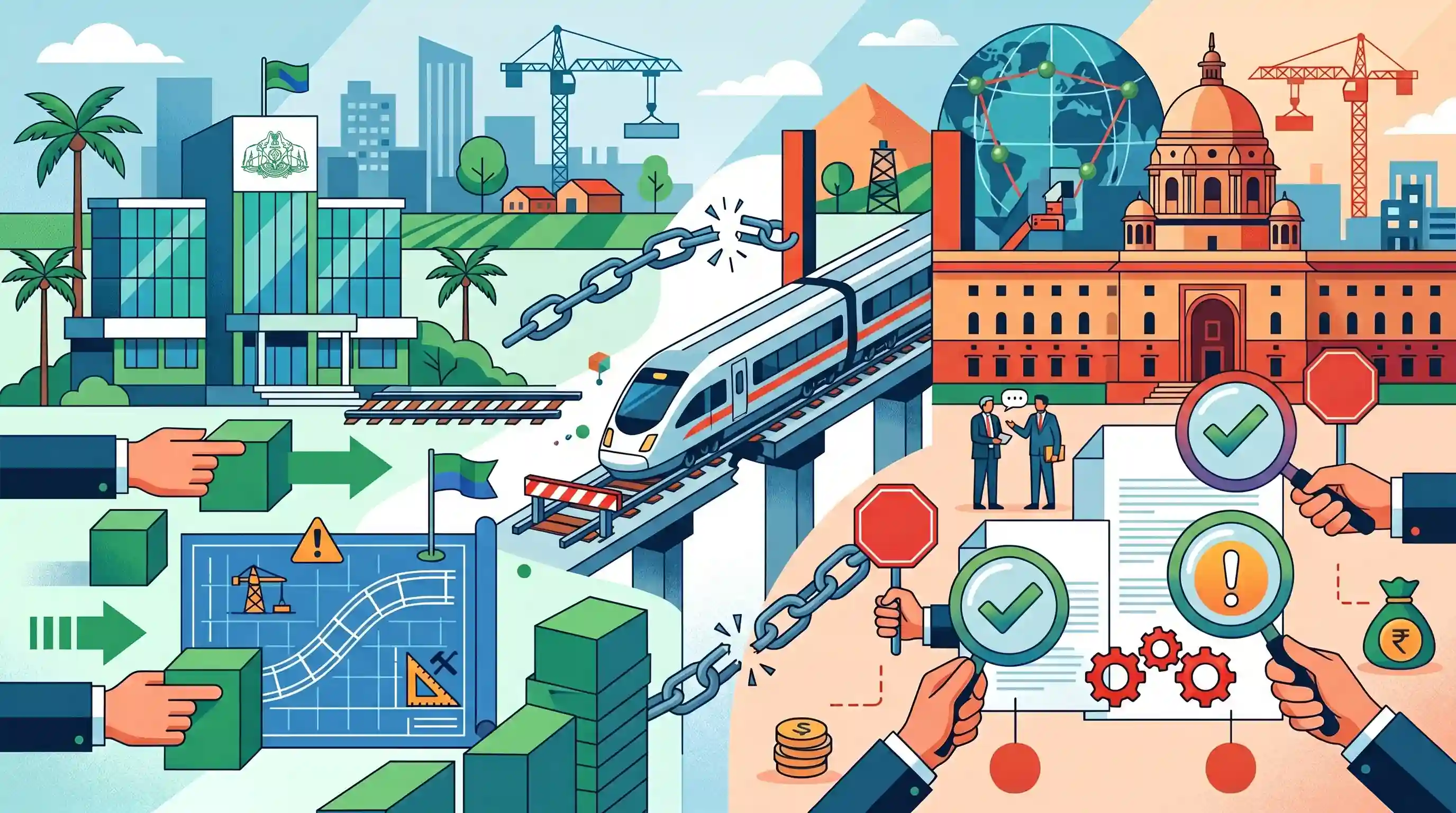
The Kerala Rail Development Corporation Limited (K-Rail) SilverLine semi high-speed rail project remains in limbo due to conflicting approaches between the Union and state governments. The Ministry of Railways has demanded a revision of the Detailed Project Report (DPR), raising concerns regarding technical and financial viability. In response, the Kerala state government is pressing to execute the corridor as a standalone state project. This situation underscores the ongoing challenges in Centre-State cooperative federalism, particularly concerning the funding, approval, and execution of large-scale infrastructure projects.
Key Points
- The K-Rail (SilverLine) semi high-speed rail project in Kerala faces continued uncertainty as the Ministry of Railways has sought a revision of its Detailed Project Report (DPR).
- The Kerala government is pushing for the initiative to be considered a standalone state project to bypass federal approval bottlenecks and delays.
- The SilverLine project aims to drastically reduce travel time between Thiruvananthapuram and Kasaragod but has faced scrutiny over cost, alignment, and technical feasibility.
- The impasse highlights broader challenges in executing mega-infrastructure projects under Centre-State joint ventures, stressing the friction points in cooperative federalism.
Important Terms
SilverLine Semi High-Speed Rail Project

A proposed 529-km rail corridor in Kerala connecting Thiruvananthapuram and Kasaragod. It aims to reduce travel time to under four hours using trains operating at speeds of 200 km/h.
UPSC context
GS Paper III: Infrastructure (Railways). Focuses on connectivity, regional development, and environmental/financial sustainability challenges in large-scale state-led projects.
Kerala Rail Development Corporation Limited (K-Rail)
A Joint Venture company between the Government of Kerala (51%) and the Ministry of Railways (49%) established to implement major railway infrastructure projects within the state.
UPSC context
GS Paper II: Statutory/Regulatory Bodies. Illustrates the Joint Venture model for infrastructure and the complexities of shared ownership between Centre and State.
Detailed Project Report (DPR)
A comprehensive blueprint outlining a project's technical specifications, financial viability, socio-environmental impact, and implementation roadmap. It is mandatory for securing central clearances and funding.
UPSC context
GS Paper III: Investment Models. Tests understanding of project appraisal processes and the technical-administrative requirements for central sanctioning of state projects.
Cooperative Federalism
A constitutional concept where the Union and States work together horizontally and vertically to achieve common developmental goals through negotiation and shared responsibility.
UPSC context
GS Paper II: Centre-State Relations. The SilverLine impasse highlights tensions in project approvals and the need for consensus-building in federal governance.
Ministry of Railways
The Union ministry responsible for India's rail transport. It holds final authority over technical standards, safety certifications, and track-sharing permissions for state-led rail projects.
UPSC context
GS Paper II: Executive & Ministry Roles. Analyzes the Union's oversight role and the conflict between state aspirations and national rail-safety/financial standards.
Prelims Trap
States can independently execute intra-state standalone railway projects without Union approval.
Railways is exclusively a Union List subject (Entry 22). Even purely intra-state railway corridors require formal Union Ministry clearance to proceed.
Static Concepts Connected
How is legislative power regarding railways and transport distributed?
- Union List: "Railways" falls under Entry 22 of List I, granting the Centre exclusive legislative and approval authority.
- State List: "Communications" (such as roads, bridges, ferries, and municipal tramways) falls under Entry 13 of List II, allowing state autonomy.
What are the ecological concerns with semi-high-speed rail embankments?
- Hydrological disruption: Continuous earthen embankments act as massive walls, blocking natural drainage systems and exacerbating urban and rural flooding.
- Topographic alteration: High-speed rail requires minimal curves and gradients, forcing deep cuttings, land reclamations, and large-scale quarrying in ecologically sensitive terrains.
Cross-Topic Patterns
Federal friction in Capital Expenditure
The push for state-led infra conflicts with the Centre's macro-prudential oversight on off-budget borrowing and state debt sustainability, touching upon Article 293 and cooperative federalism.
Linear Projects vs Disaster Resilience
Kerala's history of devastating floods makes large linear embankments (like SilverLine) a dual-syllabus topic spanning Infrastructure Development and Disaster Management.

A mains question linking Union List Entry 22, cooperative federalism, and the debt sustainability of state mega-projects is highly likely.
Linked PYQs · 3
Linked PYQs · 3
- 2021MainsGS3
“Investment in infrastructure is essential for more rapid and inclusive economic growth.” Discuss in the light of India's experience.
- 2022MainsGS3
Why is Public Private Partnership (PPP) required in infrastructural projects ? Examine the role of PPP model in the redevelopment of Railway Stations in India.
- 2024MainsGS2
What changes has the Union Government recently introduced in the domain of Centre-State relations ? Suggest measures to be adopted to build the trust between the Centre and the States and for strengthening federalism.
