Infrastructure upgrade for urban rail transport decongestion
Source:Indian Express ↗
Why It Matters
Addressing infrastructural bottlenecks is crucial for India's economic growth. This development provides a concrete example of capacity building in public transport (Railways) that can be cited in answers regarding the National Rail Plan, urban decongestion, and infrastructure investment.
Summary
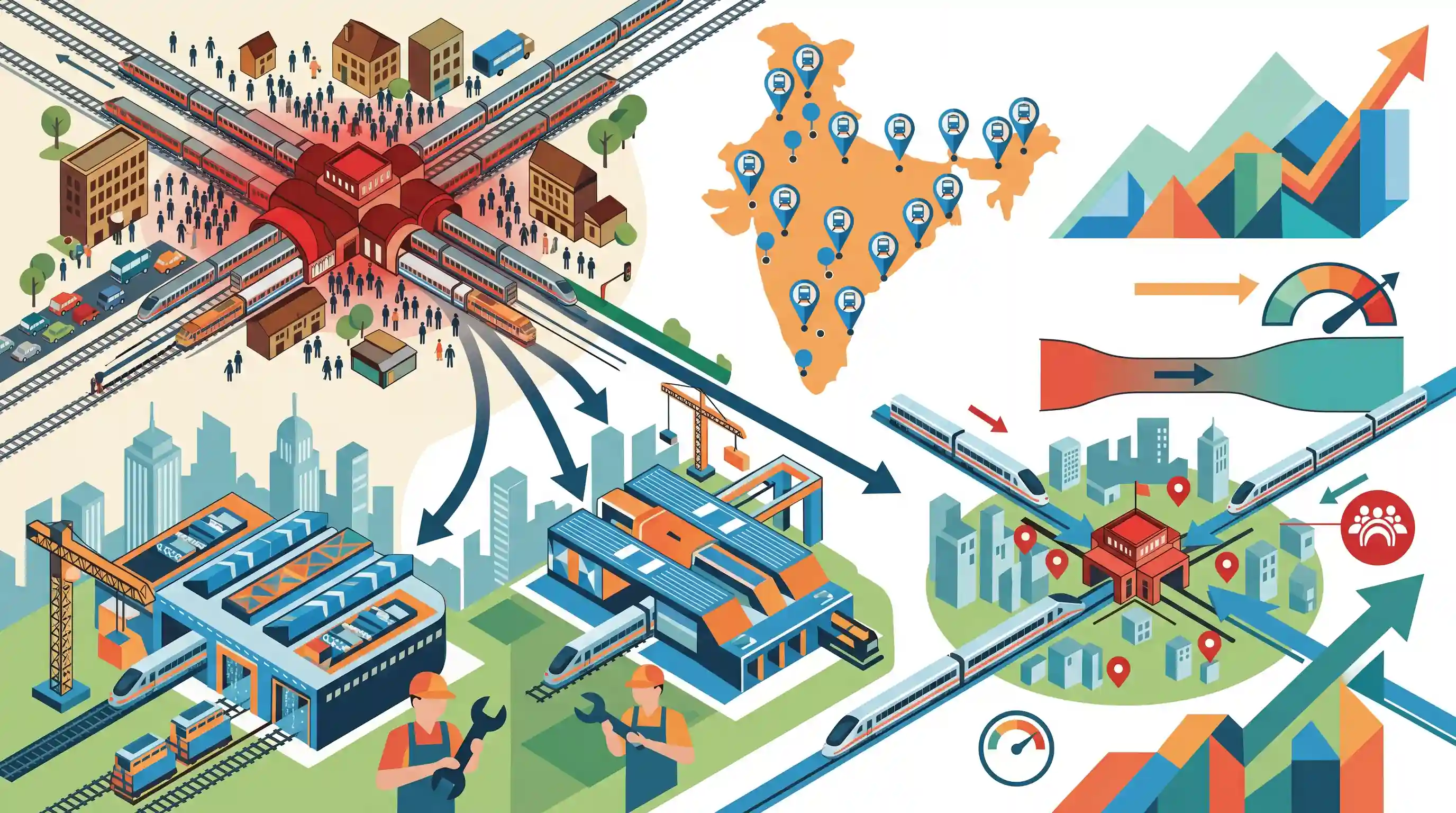
Indian Railways is planning the construction of 'Mega Coaching Terminals' across 20 major cities to double their capacity for handling passenger trains. By relocating train maintenance and origination/termination operations to these new, specialized terminals, the railways aim to decongest central city stations. This infrastructural upgrade will reduce operational bottlenecks, improve turnaround times, and pave the way for introducing more passenger trains to meet growing urban transport demands, aligning with the objectives of the National Rail Plan.
Key Points
- Indian Railways plans to construct Mega Coaching Terminals in 20 major cities to effectively double their train handling capacity.
- The initiative aims to decongest existing central railway stations by shifting train maintenance (pit lines) and terminal operations to these new outer hubs.
- Decongesting central hubs will allow them to function as transit points, significantly improving train turnaround times and overall network punctuality.
- This infrastructure boost is essential to accommodate the rising demand for passenger travel and facilitate the introduction of new train services like Vande Bharat.
- The project aligns with the National Rail Plan's vision to create a 'future-ready' railway system and enhances urban multimodal logistics.
Important Terms
National Rail Plan (NRP) 2030

A strategic roadmap to create a 'future-ready' railway system by 2030, focusing on capacity augmentation and increasing the rail freight modal share from 27% to 45%.
UPSC context
GS Paper III (Infrastructure: Railways). Tests understanding of long-term planning, modal shift targets, and sustainability in logistics.
PM Gati Shakti
A National Master Plan for multi-modal connectivity launched in 2021, using a GIS-based digital platform to integrate infrastructure planning across ministries to reduce logistics costs and improve efficiency.
UPSC context
GS Paper III (Infrastructure/Economy). Key for questions on integrated planning, multi-modal logistics, and inter-ministerial coordination.
Mega Coaching Terminals
Specialized, large-scale railway hubs designed for train maintenance, stabling, and turnaround operations, aimed at decongesting central stations and significantly increasing a city's train-handling capacity.
UPSC context
GS Paper III (Infrastructure). Specific strategy for urban decongestion and addressing capacity bottlenecks in high-density rail corridors.
Coaching Terminal
A railway facility where passenger trains originate, terminate, and undergo technical maintenance (washing, pit-line inspections), stabling, and cleaning before their next journey.
UPSC context
GS Paper III (Infrastructure). Technical term for railway operations; relevant for station redevelopment and urban transport planning.
Vision 2024
A time-bound subset of the National Rail Plan aimed at accelerating critical projects like 100% electrification and speed upgrades (160 kmph) on high-density routes by 2024.
UPSC context
GS Paper III (Infrastructure). Tests knowledge of immediate infrastructure milestones and specific modernization targets in the railway sector.
Prelims Trap
Mega Coaching Terminals are being developed primarily to double bulk freight handling capacity across Indian cities.
In railway terminology, 'coaching' strictly refers to passenger trains. These terminals focus on passenger train maintenance, origination, and termination—not freight operations.
Static Concepts Connected
What are the primary objectives of the National Rail Plan (NRP) 2030?
- Freight share: Increase the modal share of Indian Railways in freight transportation from the current ~27% to 45% by 2030.
- Future capacity: Develop robust infrastructure ahead of demand by 2030 to seamlessly cater to projected traffic requirements up to the year 2050.
- Net Zero 2030: Align with national environmental commitments by transforming Indian Railways into a 'Net Zero' Carbon Emitter by 2030.
- Freight speeds: Reduce overall freight transit times by significantly increasing the average speed of freight trains to 50 kmph.
Cross-Topic Patterns
Transit-Oriented Development (TOD)
Shifting maintenance to the outskirts frees up central station land. This allows the Rail Land Development Authority to monetize prime urban real estate and execute commercial TOD projects.
Passenger decongestion boosting freight speeds
Decongesting central hubs of passenger pit-lines directly improves track availability. This indirectly accelerates freight trains, aiding the National Rail Plan's goal of 50 kmph average freight speed.

Expect a Prelims question linking National Rail Plan 2030 targets (45% freight share, Net Zero by 2030) with PM Gati Shakti.
Linked PYQs · 2
Linked PYQs · 2
- 2021MainsGS3
“Investment in infrastructure is essential for more rapid and inclusive economic growth.” Discuss in the light of India's experience.
- 2025PrelimsGS1
Consider the following statements : I. Indian Railways have prepared a National Rail Plan (NRP) to create a 'future ready' railway system by 2028. II. 'Kavach' is an Automatic Train Protection system developed in collaboration with Germany. III. 'Kavach' system consists of RFID tags fitted on track in station section. Which of the statements given above are not correct?
