Kavach 4.0 Deployment on High-Density Railway Corridors
Source:Indian Express ↗
Why It Matters
Frequent railway accidents highlight the urgent need for robust safety mechanisms. Kavach is a prime example of 'Atmanirbhar Bharat' in high-end railway technology, replacing expensive imported systems. Its deployment on key economic corridors ensures safer and more efficient logistics and passenger transport.
Summary
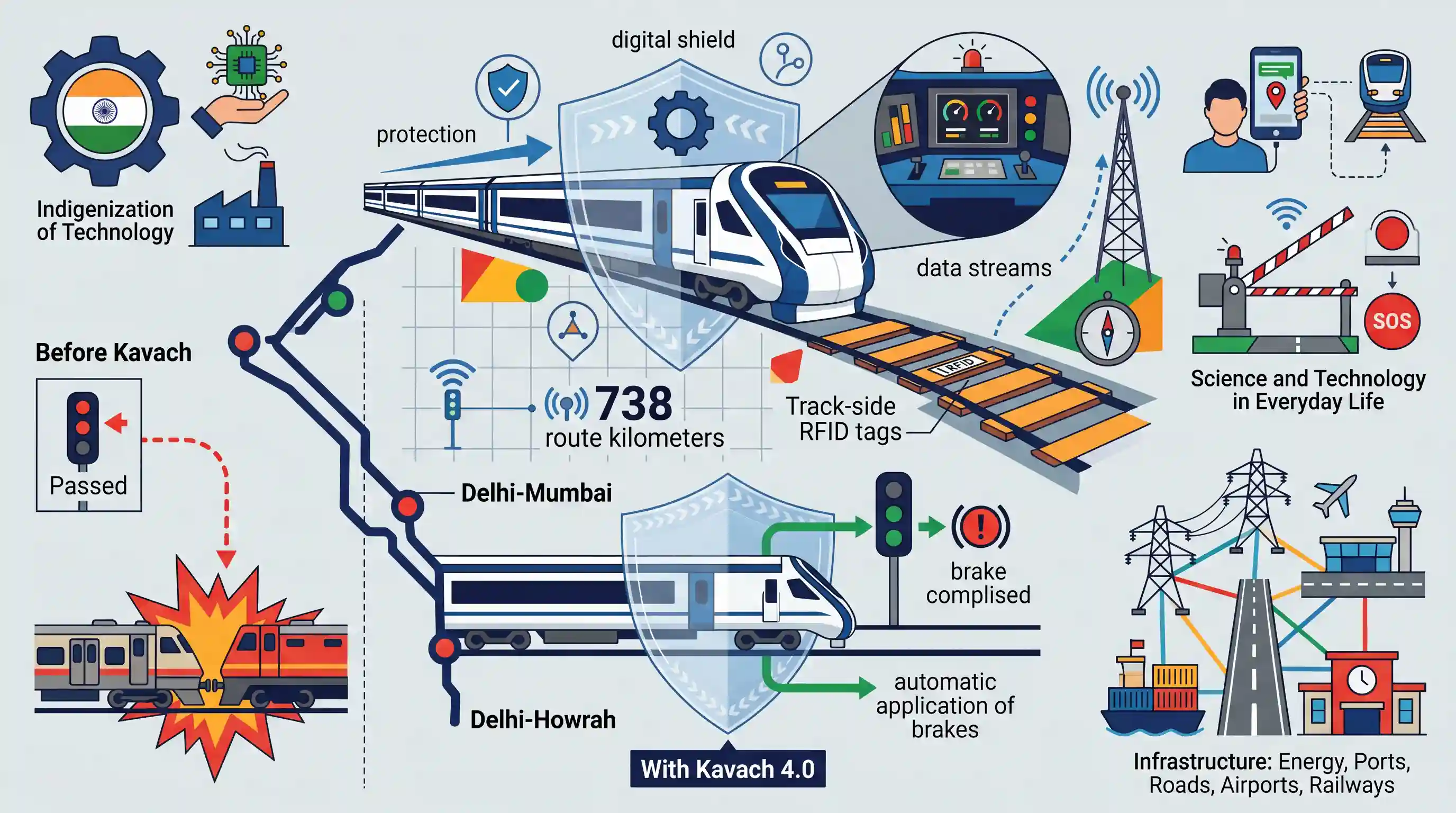
Indian Railways has commissioned Kavach 4.0, the latest version of its indigenous Automatic Train Protection (ATP) system, across 738 route kilometers on the high-density Delhi-Mumbai and Delhi-Howrah lines. The system is designed to drastically improve operational safety by preventing train collisions on India's most critical railway corridors, marking a major milestone in both railway infrastructure modernization and the indigenization of critical safety technology.
Key Points
- Indian Railways has successfully commissioned the upgraded Kavach 4.0 system over 738 route kilometers.
- The implementation targets high-density network (HDN) routes, specifically focusing on the critical Delhi-Mumbai and Delhi-Howrah corridors.
- Kavach is an indigenously developed Automatic Train Protection (ATP) system designed to prevent train collisions, primarily by automatically applying brakes if a driver ignores a signal.
- The widespread deployment of Kavach 4.0 marks a significant step forward in railway modernization and domestic safety technology adoption.
Important Terms
Kavach 4.0

India's latest indigenous Automatic Train Protection system. It prevents collisions by automatically applying brakes if a pilot misses signals, featuring improved location accuracy and yard-handling capabilities.
UPSC context
GS3: Infrastructure/S&T. Tests knowledge of indigenous safety technology and 'Atmanirbhar Bharat' milestones in railway modernization.
Automatic Train Protection (ATP) System
A fail-safe safety system that supervises train speed and braking. It intervenes if a train exceeds limits or risks collision, mitigating human errors like signal misinterpretation.
UPSC context
GS3: Science & Tech. Tests understanding of critical safety mechanisms in large-scale infrastructure and disaster prevention.
Research Designs and Standards Organisation (RDSO)
The specialized technical wing of the Ministry of Railways. It serves as a consultant and standard-setting body for railway equipment, design, and indigenous technology development.
UPSC context
GS3: Governance/Infrastructure. Tests awareness of institutional frameworks driving technical self-reliance in the transport sector.
Safety Integrity Level 4 (SIL-4)
The highest international benchmark for functional safety. It indicates an extremely low probability of failure (less than 1 in 10,000 years), mandatory for life-critical railway systems.
UPSC context
GS3: Science & Tech. Tests awareness of international technical standards and quality benchmarks in high-risk engineering sectors.
Signal Passing at Danger (SPAD)
A critical safety incident where a train passes a stop signal without authority. It is a leading cause of rail collisions that Kavach is designed to prevent.
UPSC context
GS3: Disaster Management/Infrastructure. Tests understanding of specific operational risks in the railway sector and safety protocols.
Indigenization of Technology
The domestic development of critical technologies to reduce import dependence. It is a strategic goal for sectors like railways to ensure national security and economic self-reliance.
UPSC context
GS3: Science & Tech/Economy. Tests knowledge of the 'Make in India' initiative and technological sovereignty in strategic infrastructure.
Prelims Trap
Kavach tracking relies primarily on India's indigenous satellite navigation system NavIC for collision avoidance.
Kavach fundamentally relies on localized track-mounted RFID tags and Ultra-High Frequency (UHF) radio for tracking, not satellite navigation.
Static Concepts Connected
What technologies power the Kavach Automatic Train Protection system?
- RFID Tags: Installed on tracks to provide precise, real-time positional data to the passing locomotive.
- UHF Radio: Facilitates constant, low-latency communication between locomotives and stationary railway equipment.
- SIL-4 Standard: Certified to Safety Integrity Level 4, the highest global safety standard (failure probability of 1 in 10,000 years).
What is Signal Passing at Danger (SPAD) in railway operations?
- Definition: Occurs when a train passes a stop signal without authority, which is a primary cause of major railway collisions.
- Kavach Intervention: The system automatically takes over and applies emergency brakes if the loco-pilot fails to control speed when approaching a red signal.
Cross-Topic Patterns
Kavach + Atmanirbhar Bharat tech indigenization
Kavach’s indigenous development by RDSO exemplifies import substitution in critical infrastructure, delivering SIL-4 safety at a fraction of the cost of equivalent European train protection systems.
High-Density Networks + PM Gati Shakti
Prioritizing Delhi-Mumbai & Delhi-Howrah high-density corridors directly serves the PM Gati Shakti mandate of de-bottlenecking key logistical arteries to ensure safer, faster freight movement.

Expect a 2026 Prelims tech question comparing Kavach's localized RFID/UHF mechanism with GPS/NavIC-based systems in transport safety.
Linked PYQs · 2
Linked PYQs · 2
- 2025PrelimsGS1
Consider the following statements : I. Indian Railways have prepared a National Rail Plan (NRP) to create a 'future ready' railway system by 2028. II. 'Kavach' is an Automatic Train Protection system developed in collaboration with Germany. III. 'Kavach' system consists of RFID tags fitted on track in station section. Which of the statements given above are not correct?
- 2021MainsGS3
“Investment in infrastructure is essential for more rapid and inclusive economic growth.” Discuss in the light of India's experience.
