Maoist Twin IED Blasts Target Jharkhand Railway Infrastructure
Source:Indian Express ↗
Why It Matters
This incident serves as a stark contemporary example of the internal security threats posed by Naxalism, specifically its tactics of sabotaging critical national infrastructure (railways) and targeting state personnel, which is highly relevant for GS3 questions on Left Wing Extremism and developmental challenges.
Summary
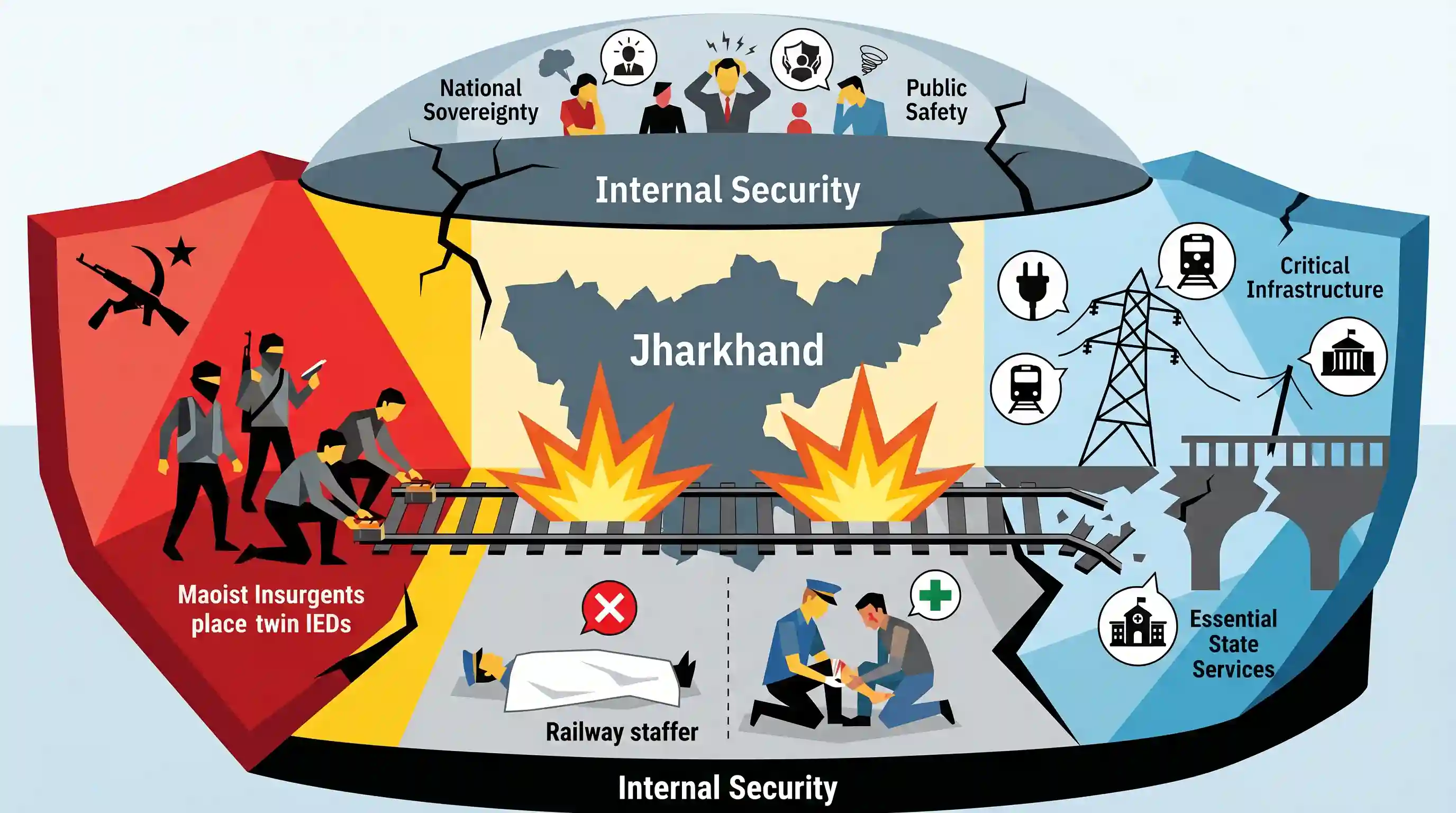
Maoist insurgents carried out twin IED blasts on railway tracks in Jharkhand, killing one railway staffer and severely injuring another. The attack demonstrates the continued capacity and intent of Left Wing Extremist groups to target critical national infrastructure and disrupt essential state services, posing significant internal security challenges.
Key Points
- Maoists executed twin Improvised Explosive Device (IED) blasts targeting railway tracks in Jharkhand.
- The attack resulted in the death of one railway staffer and severe injuries to another.
- The incident underscores the persistent threat of Left Wing Extremism (LWE) to critical state infrastructure and civilian personnel.
- Highlights the pressing need for enhanced security protocols for infrastructure maintenance workers in Naxal-affected areas.
Important Terms
Maoism

A form of armed insurgency motivated by the political ideology of Mao Zedong, aiming to overthrow the government through 'Protracted People's War' and mass mobilization.
UPSC context
GS Paper III: Internal Security; focuses on ideological origins and revolutionary strategies of extremist groups.
Left Wing Extremism (LWE)
The official term used by the Indian government to describe Maoist-led insurgencies, primarily affecting the 'Red Corridor' states like Jharkhand and Chhattisgarh.
UPSC context
GS Paper III: Linkages between development and spread of extremism; tests understanding of regional security threats.
Naxalism
An Indian radical movement originating from the 1967 Naxalbari uprising in West Bengal, characterized by violent struggle for land rights and socio-political change.
UPSC context
GS Paper III: Internal Security; tests historical evolution and socio-economic drivers of domestic insurgency.
Critical Infrastructure
Essential national assets like railway tracks and communications, which if damaged, have a debilitating impact on national security, economy, or public safety.
UPSC context
GS Paper III: Internal Security Challenges; deals with the vulnerability of state services to sabotage.
SAMADHAN Doctrine
The Ministry of Home Affairs' 2017 strategy to combat LWE, standing for Smart Leadership, Aggressive Strategy, Motivation, Actionable Intelligence, Dashboard-based KPIs, Harnessing Technology, Action Plan, and No financing.
UPSC context
GS Paper III: Government strategies for internal security; tests knowledge of specific policy frameworks to eliminate LWE.
Internal Security
Protection of the state from internal threats like insurgency, terrorism, and organized crime, ensuring the maintenance of peace and law within national borders.
UPSC context
GS Paper III: Core syllabus pillar; tests comprehensive management of non-state actor challenges and border security.
Prelims Trap
The geographical spread of Left Wing Extremism (Red Corridor) has steadily expanded in the last decade.
UPSC frequently reverses trend lines in statements. The 'Red Corridor' has significantly contracted over the past two decades, not expanded. Residual violence is confined to specific pockets.
Static Concepts Connected
What is the SAMADHAN doctrine used to counter Left Wing Extremism?
- Leadership & Strategy: Stands for Smart Leadership, Aggressive Strategy, and Motivation & Training to proactively neutralize insurgent threats.
- Tech & Intelligence: Emphasizes Actionable Intelligence, Dashboard-based KPIs, and Harnessing Technology to track and predict LWE movements.
- Action & Finance: Involves creating a tailored Action plan for each theater and ensuring No access to Financing for extremist outfits.
What is the Clear, Hold, and Build counter-insurgency strategy?
- Clear: Security forces conduct targeted operations to eliminate or drive out armed insurgents from a core geographical area.
- Hold: Establishing permanent security camps or Forward Operating Bases (FOBs) in cleared zones to prevent insurgents from returning.
- Build: Rapidly developing physical infrastructure (roads, rail) and social services to integrate the region and win local trust.
Cross-Topic Patterns
Naxalism & Critical Infrastructure Deficit
Maoists deliberately target railways, roads, and telecom towers to maintain a governance vacuum. This prevents state outreach and stalls the economic integration of remote tribal areas.
Resource Curse & LWE in Mineral Belts
The stark geographic overlap between India's richest mineral belts (like Jharkhand) and LWE hotspots highlights the persistent resource curse and alienation nexus fueling insurgency.

Mains 2026: Evaluate SAMADHAN doctrine's efficacy given LWE's tactical shift towards sabotaging critical infrastructure & civilian workers.
Linked PYQs · 2
Linked PYQs · 2
- 2022MainsGS3
Naxalism is a social, economic and developmental issue manifesting as a violent internal security threat. In this context, discuss the emerging issues and suggest a multilayered strategy to tackle the menace of Naxalism.
- 2018MainsGS3
Left Wing Extremism (LWE) is showing a downward trend, but still affects many parts of the country. Briefly explain the Government of India's approach to counter the challenges posed by LWE.
