Indian Railways Freight Reforms And Licensing Red Tape Reduction
Source:The Hindu ↗
Why It Matters
These reforms address systemic bottlenecks in Indian Railways—such as high compliance costs, slow project delivery, environmental pollution, and rigid state monopoly over design—by leveraging digitalisation, streamlining licensing, and lowering barriers to private investment. They are highly relevant for GS-3 discussions on economic growth, infrastructure modernisation, logistics cost reduction, and sustainable development.
Summary
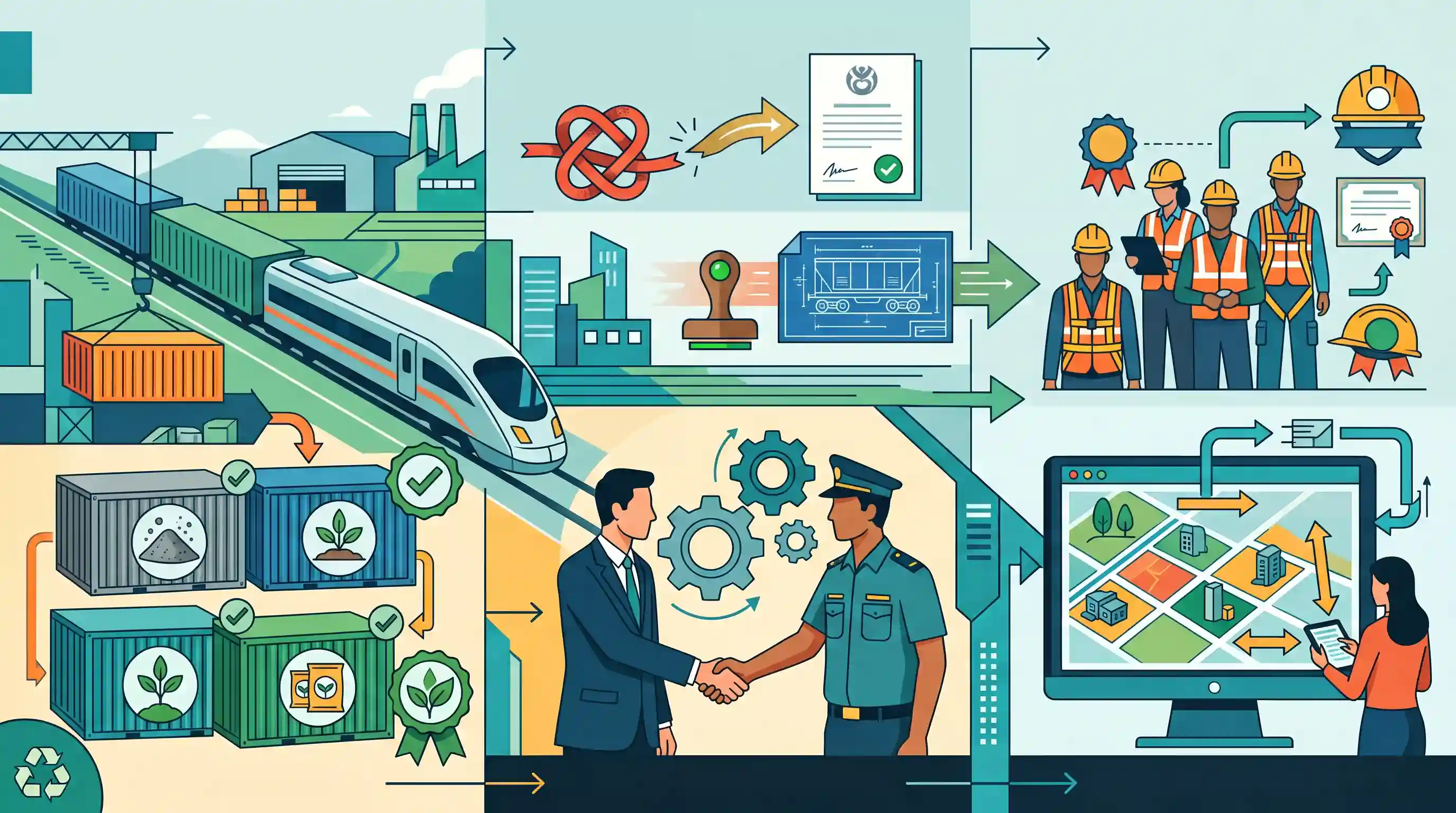
Railway Minister Ashwini Vaishnaw announced a comprehensive set of policy reforms aimed at cutting red tape, modernising infrastructure, and shifting toward eco-friendly bulk freight logistics. Major reforms include transporting fly ash and fertilizers in closed containers, introducing a single unified license for container train operators, streamlining custom wagon design approvals, initiating mandatory skill certifications for railway contractors, and launching 'Rail Bhoomi'—a digital platform for land acquisition workflow management.
Key Points
- Transition to Eco-friendly Bulk Logistics: Indian Railways is shifting bulk commodities like fly ash, fertilizers, and foodgrains from open wagons to closed, leak-proof containers to curb air pollution and contamination, allowing clean pneumatic unloading directly into cement/factory sites.
- Simplification of Freight Rates: Complex multi-slab freight structures for fertilizers and foodgrains are replaced by a transparent, flat and tapering per-tonne-per-kilometre rate structure.
- Easing Regulatory Burden: A single unified license with a flat, non-refundable registration fee of ₹25 crore replaces four complex route categories (which previously cost up to ₹50 crore plus steep renewal fees). Extensions beyond the initial 20-year period will now be free.
- Wagon Design Liberalisation: Private industries are empowered to design and manufacture custom wagons through a streamlined five-stage approval process, replacing strict control by RDSO. Oil companies can now procure or lease specialized POL tank wagons directly.
- Mandatory Skill Certification: A new skill certification framework requires contractor-executed safety-sensitive railway works to be handled only by certified artisans and supervisors, to be rolled out over 24 months.
- Accelerating Project Delivery: Construction reforms mandate a 10% performance security deposit at the start of a contract with zero deductions from subsequent running bills, safeguarding contractor cash flow and attracting serious bidders.
- Digital Land Management via 'Rail Bhoomi': Developed by CRIS, this online platform integrates key railway systems (IRPSM, IPAS, HRMS) to manage land acquisition workflows with live dashboards tracking timelines and compensation.
Important Terms
Rail Bhoomi

A web-based digital portal developed by CRIS for end-to-end management, processing, and monitoring of land acquisition for railway infrastructure projects, minimizing delays.
UPSC context
GS Paper III: Infrastructure, tests digital governance reforms, ease of doing business, and modernizing public infrastructure.
Research Designs and Standards Organisation (RDSO)
The sole research and development wing of the Ministry of Railways, acting as a technical advisor and standard-formulating body for railway equipment, designs, and operations.
UPSC context
GS Paper III: Science & Tech and Infrastructure, tests indigenisation and institutional standardisation frameworks.
Commission of Railway Safety (CRS)
An independent statutory safety authority under the Ministry of Civil Aviation responsible for inspecting, investigating, and certifying rail travel, train operations, and major accidents in India.
UPSC context
GS Paper II: Statutory Bodies, tests understanding of regulatory independence and administrative division to avoid conflicts of interest.
Centre for Railway Information Systems (CRIS)
An autonomous society under the Ministry of Railways that acts as its IT wing, developing key digital platforms like passenger ticketing, freight systems, and Rail Bhoomi.
UPSC context
GS Paper III: E-governance and IT, tests technology-driven public service delivery and transport system digitization.
IRPSM
Indian Railways Projects Sanctions & Management; a web-based digital portal designed to streamline proposal submission, financial vetting, workflow approval, and real-time monitoring of railway infrastructure projects.
UPSC context
GS Paper III: Infrastructure and E-governance, tests digital tools used to improve transparency and project monitoring.
HRMS
Human Resource Management System; a web-based digitized application used by Indian Railways to manage employee life-cycle data, service records, and payroll processing, promoting digital transparency.
UPSC context
GS Paper II: Governance, tests administrative efficiency, civil services reforms, and technology-driven employee welfare tools.
Prelims Trap
The liberalization of custom wagon designs completely removes the regulatory and safety approval role of the RDSO.
Aspirants often assume safety regulatory bodies like the Commission of Railway Safety (CRS) or tech agencies like RDSO are being bypassed or abolished under private liberalization, whereas RDSO still retains statutory prototype evaluation powers.
Static Concepts Connected
How is railway safety regulated in India?
- RDSO role: Functions as the technical advisor to the Ministry of Railways, standardising design and equipment specifications.
- Commission of Railway Safety: Crucially operates under the Ministry of Civil Aviation, not Railways, to ensure independent safety auditing and accident investigations.
What is the National Logistics Policy (NLP) framework?
- Cost reduction target: Aims to reduce India's logistics costs from 13-14% of GDP to single digits (around 8%) by 2030.
- Modal shift share: Seeks to increase the share of railways in freight transport from current levels of ~27% to 45% to meet environmental goals.
Cross-Topic Patterns
Fly ash + Circular economy
Transitioning fly ash from open to leak-proof rail containers supports MoEFCC's 100% fly ash utilization mandate, linking transport reforms to circular economy and pollution control.
Contractor liquidity + Procurement reforms
The 10% performance security cap with zero running-bill deductions targets contractor cash-flow issues, aligning with India's larger public procurement and financial administration reforms.

Prelims 2026 may target the division of powers between RDSO and the Ministry of Civil Aviation's CRS alongside new Rail Bhoomi reforms.
Linked PYQs · 2
Linked PYQs · 2
- 2022MainsGS3
Why is Public Private Partnership (PPP) required in infrastructural projects ? Examine the role of PPP model in the redevelopment of Railway Stations in India.
- 2021MainsGS3
“Investment in infrastructure is essential for more rapid and inclusive economic growth.” Discuss in the light of India's experience.
