Railway Budget Infrastructure Allocation and High Speed Rail
Source:Indian Express ↗
Why It Matters
Railway modernization and high-speed transit networks are critical components of India's infrastructure development strategy. The Union Budget's focus on capital expenditure in railways directly relates to the GS3 syllabus on infrastructure, economic growth, and government budgeting, highlighting the shift towards long-term asset creation.
Summary
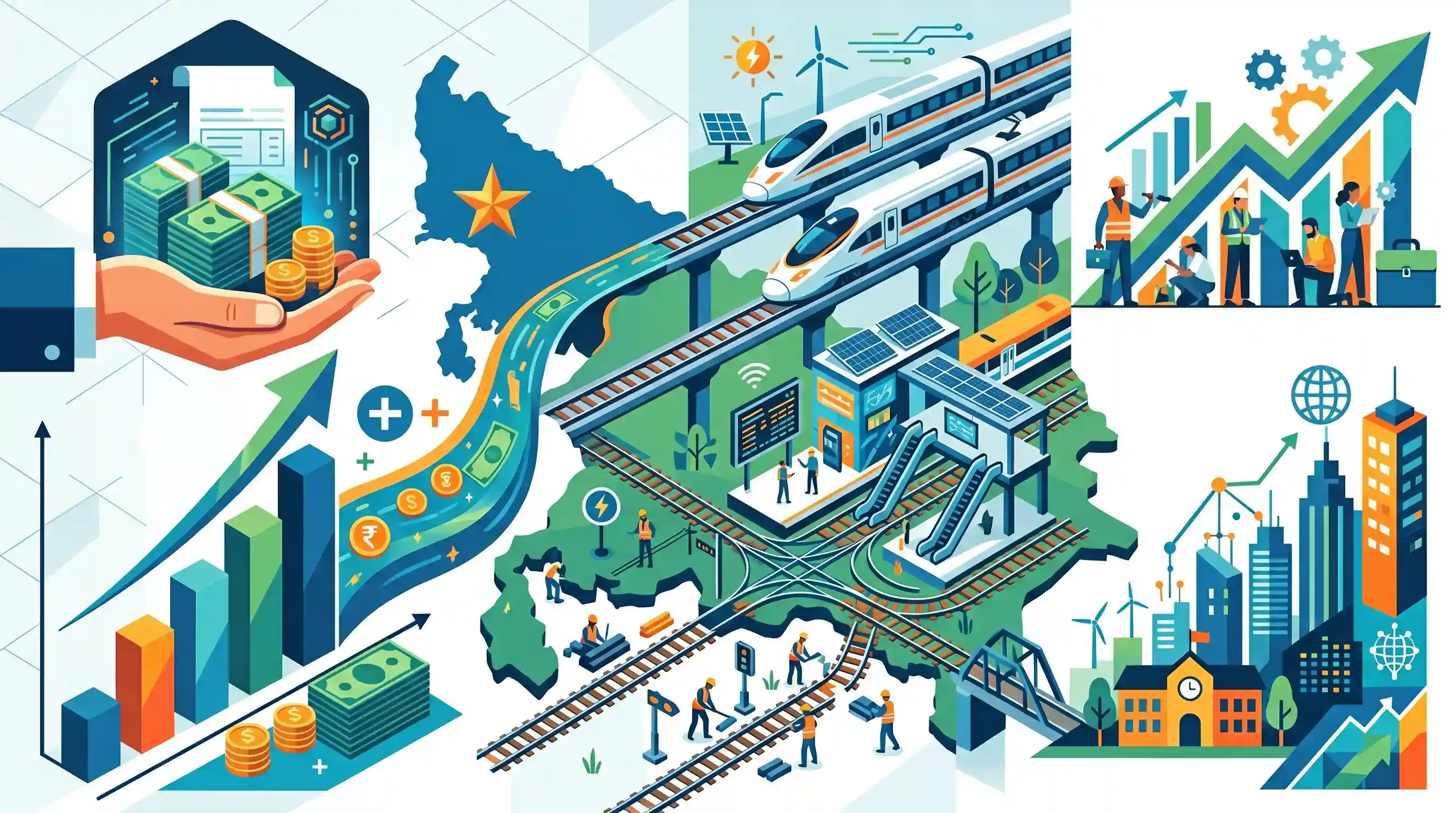
The Union Budget 2026 has marked a significant milestone for Uttar Pradesh by granting it the highest-ever allocation in the Railway Budget. The funds are directed toward modernizing railway infrastructure, upgrading stations, and improving overall connectivity in the state. Furthermore, the budget highlighted the announcement of two new high-speed rail (bullet train) projects, signaling the government's commitment to expanding modern, rapid transit systems. This approach underscores the government's broader economic strategy of leveraging substantial capital expenditure in the transport sector to stimulate long-term economic growth, create jobs, and ensure regional equity.
Key Points
- Uttar Pradesh has received the highest-ever allocation in the Railway Budget 2026, focusing on upgrading stations, tracks, and regional connectivity.
- The government announced two new high-speed rail (bullet train) projects, expanding India's rapid transit network ambitions.
- The massive capital allocation reflects a continued strategy to use transport infrastructure investment as a primary catalyst for economic growth and regional development.
- The budget emphasizes long-term asset creation by prioritizing capital expenditure over revenue expenditure in the railway sector.
Important Terms
Union Budget

The annual financial statement of India (Article 112), outlining estimated receipts and expenditures; since 2017, it has incorporated the previously separate Railway Budget.
UPSC context
GS Paper 2/3 (Budgeting); tests knowledge of constitutional provisions (Article 112) and the historical 2017 merger of the Railway and General budgets.
National Rail Plan (NRP) 2030
A strategic blueprint by Indian Railways to create a 'future-ready' system by 2030, aiming to increase rail's freight modal share from 27% to 45%.
UPSC context
GS Paper 3 (Infrastructure); crucial for questions on long-term transport planning, logistics efficiency, and sustainable economic growth.
Capital Expenditure (CapEx)
Funds used by the government to acquire, upgrade, and maintain physical assets like tracks and stations to increase the economy's long-term productive capacity.
UPSC context
GS Paper 3 (Economy); relevant for analyzing fiscal policy and the government's strategy of infrastructure-led development to stimulate growth.
High-Speed Rail (HSR)
A specialized rail system operating at speeds typically exceeding 250 km/h on dedicated tracks; India's first corridor links Mumbai and Ahmedabad.
UPSC context
GS Paper 3 (Technology/Infrastructure); tests awareness of mega-projects, technology transfer (e.g., Shinkansen), and regional connectivity frameworks.
Operating Ratio
A key financial metric representing the ratio of working expenses to gross earnings; a lower ratio indicates higher financial efficiency for the Railways.
UPSC context
GS Paper 3 (Economy); used to evaluate the commercial viability and financial health of public sector undertakings like Indian Railways.
Amrit Bharat Station Scheme
A policy launched to modernize 1,000+ railway stations, focusing on long-term master planning, improved passenger amenities, and multi-modal integration.
UPSC context
GS Paper 3 (Infrastructure); tests knowledge of specific government schemes for upgrading public utilities and urban transport hubs.
Prelims Trap
The Railway Budget is presented and passed separately from the Union Budget.
The Railway Budget was merged with the General Budget in 2017-18 (Bibek Debroy Committee). Media still uses the term "Railway Budget" colloquially, but it is now passed within the Union Budget.
Static Concepts Connected
What distinguishes Capital Expenditure (Capex) from Revenue Expenditure?
- Capital Expenditure: Expenditure that either creates physical/financial assets (e.g., new tracks, bullet trains) or reduces government liabilities.
- Revenue Expenditure: Expenditure incurred for the normal running of government departments (e.g., salaries, pensions, track maintenance) without creating new assets.
What are the core objectives of the National Rail Plan (NRP) 2030?
- Freight Share Target: To increase the modal share of Railways in freight transport to 45% (from the current ~27%) to significantly reduce national logistics costs.
- Future-Ready Capacity: To create infrastructure capacity ahead of demand by 2030, ensuring it can cater to future passenger and freight growth up to 2050.
Cross-Topic Patterns
High-Speed Rail & PPP viability
Bullet train projects demand massive capital and complex land acquisition, making Public-Private Partnership (PPP) models critical. UPSC often links infrastructure financing directly to land reform constraints.
Capex and Regional Equity
Massive transport allocations to populous states highlight the shift toward using infrastructure capex as a primary tool to address regional economic disparities and stimulate localized job creation.

National Rail Plan 2030 freight targets (45%) combined with Capex vs Revenue expenditure definitions will likely form a 2026 Prelims MCQ.
Linked PYQs · 5
Linked PYQs · 5
- 2022MainsGS3
Why is Public Private Partnership (PPP) required in infrastructural projects ? Examine the role of PPP model in the redevelopment of Railway Stations in India.
- 2021MainsGS3
“Investment in infrastructure is essential for more rapid and inclusive economic growth.” Discuss in the light of India's experience.
- 2021MainsGS3
Distinguish between Capital Budget and Revenue Budget. Explain the components of both these Budgets.
- 2025PrelimsGS1
Consider the following statements : I. Indian Railways have prepared a National Rail Plan (NRP) to create a 'future ready' railway system by 2028. II. 'Kavach' is an Automatic Train Protection system developed in collaboration with Germany. III. 'Kavach' system consists of RFID tags fitted on track in station section. Which of the statements given above are not correct?
- 2023PrelimsGS1
Consider the following infrastructure sectors: 1. Affordable housing 2. Mass rapid transport 3. Health care 4. Renewable energy On how many of the above does UNOPS Sustainable Investments in Infrastructure and Innovation (S3i) initiative focus for its investments?
