Emergency Quota Revision in Modernized Train Services
Source:Indian Express ↗
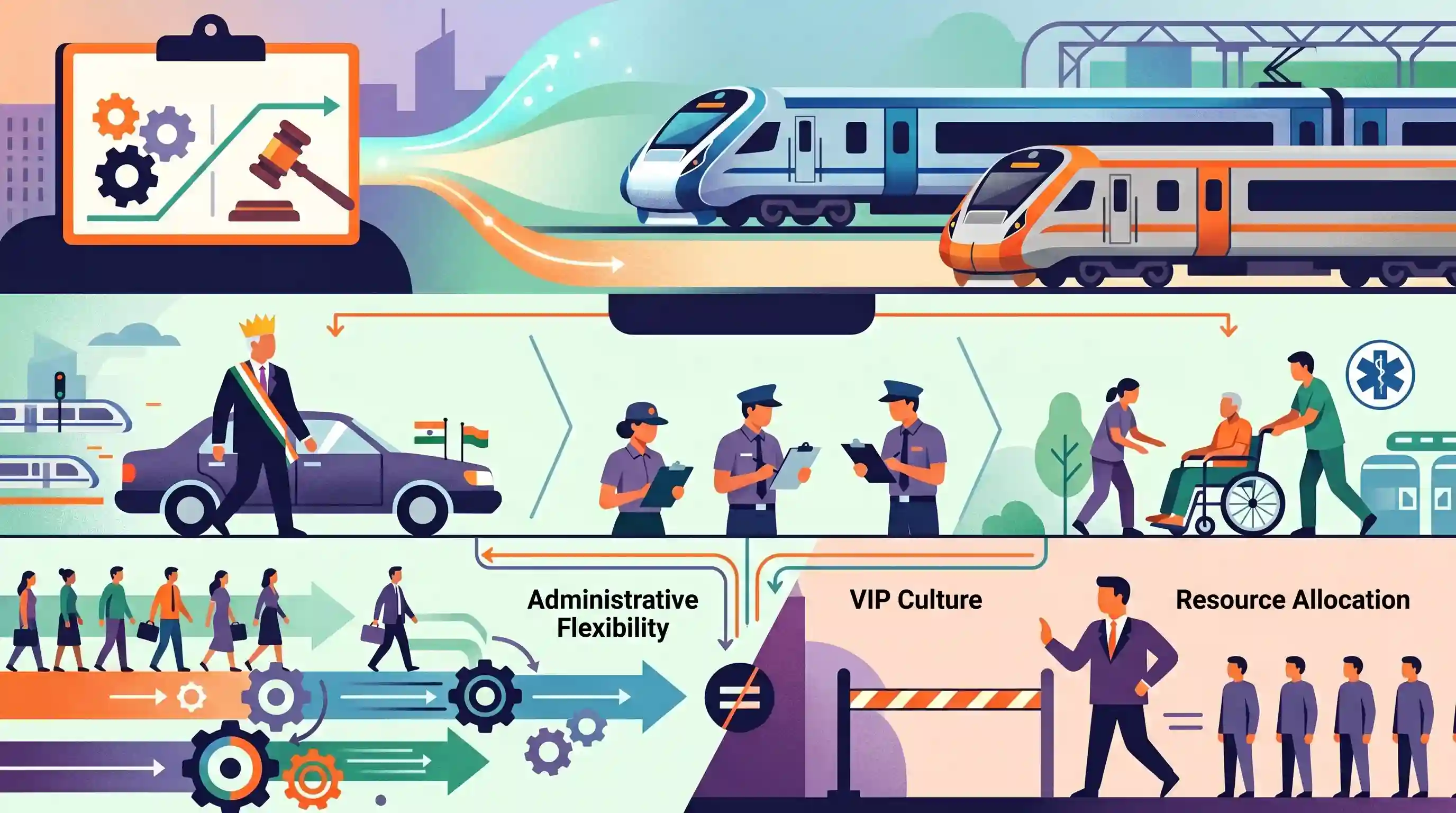
Why It Matters
It illustrates the administrative mechanisms governing India's modernized railway infrastructure, highlighting how public utilities balance mass accessibility with emergency and VIP provisions.
Summary
The Railway Board has revised its ticketing quota rules to introduce an Emergency Quota (EQ) for the upcoming Vande Bharat Sleeper and Amrit Bharat-II trains. Commonly referred to as the 'Headquarters Quota', this provision is utilized to accommodate the last-minute travel requirements of VIPs, railway officials, and individuals with genuine medical emergencies. Expanding this quota to the newly modernized premium and mass-transit fleets ensures administrative flexibility but also touches upon broader governance themes regarding equitable resource allocation and VIP culture in public utilities.
Key Points
- The Railway Board has directed the inclusion of an Emergency Quota (EQ) in the upcoming Vande Bharat Sleeper and Amrit Bharat-II trains.
- The Emergency Quota, traditionally known as 'Headquarters Quota', allows for last-minute berth allocations for VIPs, railway officials, and passengers facing medical emergencies.
- Vande Bharat Sleeper is the new premium overnight variant of the semi-high-speed train network, while Amrit Bharat-II is an upgraded non-AC mass-transit service featuring push-pull technology.
- The extension of EQ standardizes emergency and VIP seat allocations across modernized train services, highlighting the administrative balancing of operational flexibility with equitable access to public transport.
Important Terms
Railway Board

The apex administrative body of Indian Railways, functioning as a statutory authority that formulates policy and oversees the technical and financial management of the national transporter.
UPSC context
GS-II: Governance and Statutory Bodies; tests understanding of administrative structures and civil service reforms like the IRMS.
Vande Bharat Sleeper
A modernized, indigenous semi-high-speed sleeper train designed for overnight long-distance travel, featuring advanced safety systems like Kavach and high-speed trial capabilities up to 180 km/h.
UPSC context
GS-III: Infrastructure and Make in India; tests knowledge of technological self-reliance in transport.
Amrit Bharat-II
A high-speed, non-air-conditioned "push-pull" train category designed for affordable, long-distance mass transit, catering primarily to low- and middle-income passengers with upgraded amenities.
UPSC context
GS-III: Inclusive Growth and Infrastructure; focuses on equitable resource allocation and affordable public connectivity.
Emergency Quota (EQ)
A limited reservation of berths (Headquarters Quota) for high-ranking officials, ministers, and genuine medical or family emergencies, managed by Zonal/Divisional headquarters based on urgency and status.
UPSC context
GS-II/IV: Governance and Ethics; concerns discretionary powers, transparency in public service delivery, and the debate on VIP culture.
Prelims Trap
"The Emergency Quota is a statutory allocation strictly limited to medical emergencies and marginalized groups."
EQ is an administrative system ('Headquarters Quota') heavily utilized by VIPs and officials based on the Warrant of Precedence, not just a statutory medical/marginalized provision.
Static Concepts Connected
What is 'push-pull' technology used in Amrit Bharat trains?
- Dual Locomotives: Features two 6,000 HP locomotives—one at the front pulling, and one at the rear pushing.
- Enhanced Speed: Enables faster acceleration and deceleration, significantly saving travel time on curves and bridges.
- Reduced Turnaround: Eliminates the need to detach and attach engines at terminal stations, saving turnaround time.
How does the KAVACH system function in modern Indian trains?
- ATP Technology: An indigenously developed, SIL-4 certified Automatic Train Protection (ATP) system.
- RFID Tracking: Utilizes RFID tags on tracks and ultra-high frequency radio communication to track train positions.
- Collision Avoidance: Automatically applies brakes if a loco pilot passes a Signal at Danger (SPAD) to prevent collisions.
Cross-Topic Patterns
Warrant of Precedence + Resource Allocation
The Emergency Quota heavily utilizes the Table of Precedence to prioritize VIPs. This links a GS-3 infrastructure topic directly to static GS-2 Polity trivia regarding the hierarchy of state functionaries.
Mass Transit Upgrades + VIP Culture
Extending 'Headquarters Quota' to modernized fleets serves as a strong GS-2 Mains example of the tension between equitable public resource distribution and lingering bureaucratic privileges in public utilities.

Expect Prelims 2026 to fuse transport tech (push-pull, KAVACH) with administrative governance tools (Warrant of Precedence) in one MCQ.
Linked PYQs · 2
Linked PYQs · 2
- 2025PrelimsGS1
Consider the following statements : I. Indian Railways have prepared a National Rail Plan (NRP) to create a 'future ready' railway system by 2028. II. 'Kavach' is an Automatic Train Protection system developed in collaboration with Germany. III. 'Kavach' system consists of RFID tags fitted on track in station section. Which of the statements given above are not correct?
- 2022MainsGS3
Why is Public Private Partnership (PPP) required in infrastructural projects ? Examine the role of PPP model in the redevelopment of Railway Stations in India.
