Railway Board Mandates Stricter Vetting for Infrastructure DPRs
Source:Indian Express ↗
Why It Matters
Effective project planning and execution are fundamental to infrastructure development. Understanding the causes of cost and time overruns (like faulty DPRs) and the governance measures to rectify them is crucial for GS-3 topics covering infrastructure and investment models.
Summary
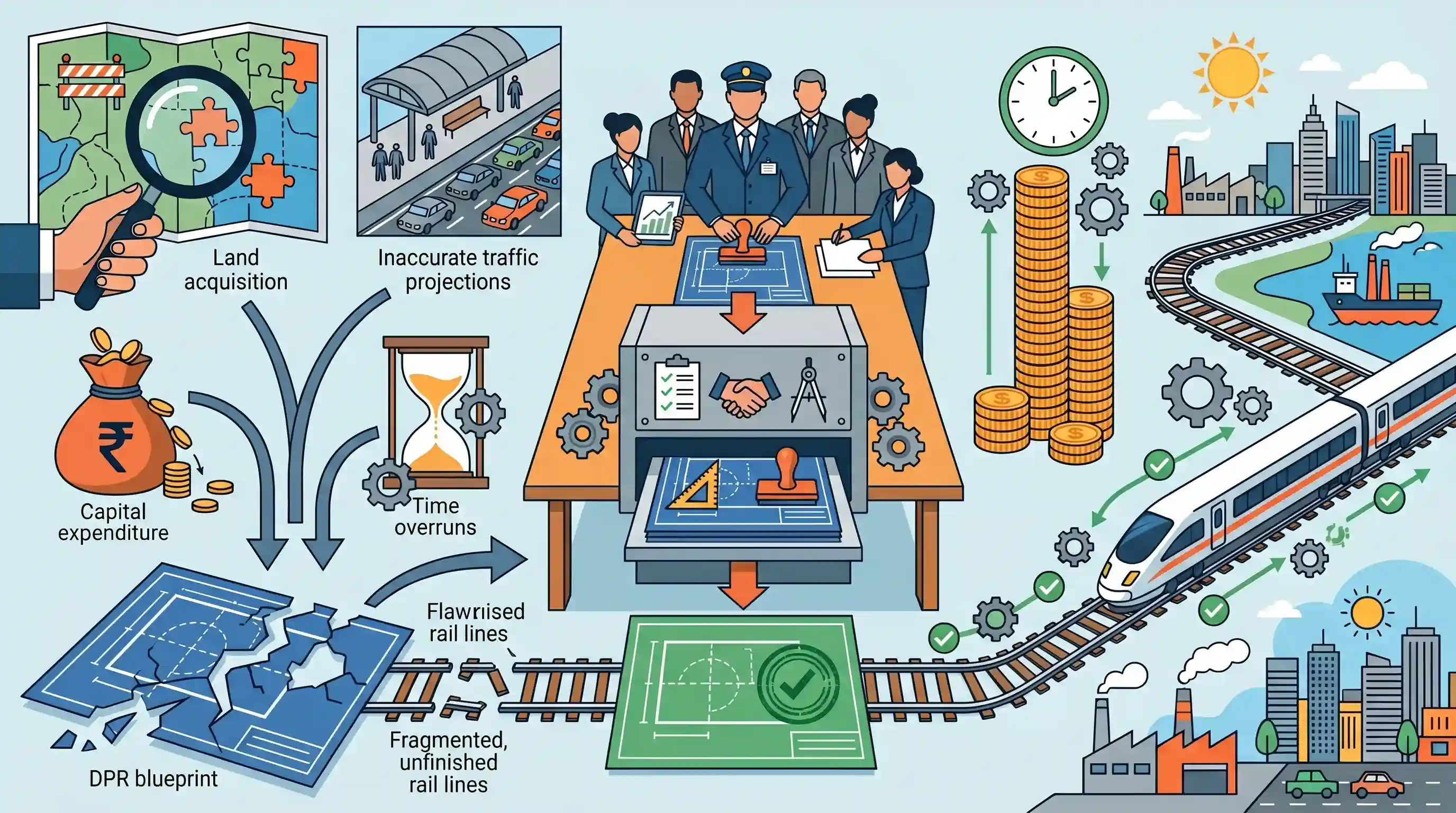
The Railway Board has identified significant lapses in the preparation of Detailed Project Reports (DPRs) for large-scale railway infrastructure projects, citing them as a primary cause for subsequent time and cost overruns. Deficiencies in feasibility studies, inadequate land acquisition details, and inaccurate traffic projections were highlighted as key areas of concern. To address these systemic issues, the Board has mandated stricter vetting procedures for all future DPRs prior to project approval. This policy shift aims to ensure robust project governance, enhance capital expenditure efficiency, and facilitate the timely completion of critical infrastructure projects.
Key Points
- The Railway Board has flagged significant deficiencies in the preparation of Detailed Project Reports (DPRs) for large-scale railway projects.
- Lapses in DPRs, such as inadequate land acquisition planning, faulty traffic projections, and poor cost estimations, often lead to severe time and cost overruns.
- A stricter, multi-layered vetting process has been mandated for all future large project DPRs to ensure better execution readiness and financial viability.
- The Board stressed the need for accurate geotechnical investigations and realistic forecasting before approving capital-intensive infrastructure projects.
- This move is intended to optimize public capital expenditure and ensure the timely delivery of critical infrastructure.
Important Terms
Railway Board

The apex decision-making body of Indian Railways, functioning under the Ministry of Railways. It oversees policy formulation, financial planning, and operational efficiency, led by a Chairman and CEO.
UPSC context
GS Paper 2 & 3: Key statutory-administrative body; tests understanding of infrastructure governance and institutional frameworks.
Detailed Project Report (DPR)
A comprehensive document detailing a project's design, cost estimates, technical specifications, and feasibility. It serves as the primary blueprint for appraisal, approval, and execution of infrastructure works.
UPSC context
GS Paper 3: Infrastructure and Investment Models; critical for evaluating project management and public expenditure efficiency.
Cost Overrun
The excess of actual project costs over the original sanctioned budget. In Indian Railways, this often stems from poor planning, land acquisition delays, and inaccurate traffic projections.
UPSC context
GS Paper 3: Economic Development and Budgeting; highlights inefficiencies in capital deployment and fiscal prudence.
Project Appraisal (Vetting)
The process of evaluating a project's technical, financial, and economic viability before final approval. It is used to mitigate risks like time delays and financial mismanagement.
UPSC context
GS Paper 3: Government budgeting and infrastructure; tests knowledge of oversight mechanisms in project lifecycle management.
Capital Expenditure (Capex)
Government spending on creating long-term physical or financial assets, such as tracks and stations. It is a vital driver of economic growth and multi-modal connectivity in India.
UPSC context
GS Paper 3: Indian Economy and Budgeting; fundamental for understanding fiscal policy and infrastructure development.
Feasibility Study
An assessment of the practicality and likelihood of success of a proposed project, examining technical constraints, land requirements, and potential traffic or revenue.
UPSC context
GS Paper 3: Infrastructure; essential for early-stage risk mitigation and informed decision-making in large-scale investments.
Prelims Trap
PM Gati Shakti's Network Planning Group (NPG) provides final financial clearance for infrastructure projects.
NPG evaluates projects for multi-modal integration and logistical efficiency. Final financial approval remains with the Cabinet Committee on Economic Affairs (CCEA) or the Finance Ministry.
Static Concepts Connected
What is the institutional framework under the PM Gati Shakti National Master Plan?
- EGoS: An Empowered Group of Secretaries headed by the Cabinet Secretary monitors and reviews the overall implementation of the Master Plan.
- NPG: The Network Planning Group, comprising planning heads from infrastructure ministries, ensures integrated, multi-modal vetting of project DPRs.
- TSU: A Technical Support Unit provides spatial planning tools (GIS) and subject matter expertise to assist the NPG.
What are the major structural reforms proposed by the Bibek Debroy Committee (2015)?
- Independent Regulator: Recommended establishing the Rail Development Authority (RDA) for independent tariff determination and ensuring fair competition.
- Commercial Accounting: Suggested transitioning to a commercial accounting system to accurately gauge unit costs and returns on investment.
- Decentralization: Advocated delegating greater financial and operational decision-making powers to General Managers and Divisional Railway Managers.
Cross-Topic Patterns
MoSPI's Infrastructure Monitoring
MoSPI's Flash Report monitors Central Sector Infrastructure Projects costing ₹150 crore and above, making it a critical metric for assessing Capex efficiency and identifying systemic time or cost overruns.
Public Expenditure Multiplier
Optimizing Capital Expenditure (Capex) through robust Detailed Project Reports minimizes stranded assets, directly enhancing the fiscal multiplier effect crucial for long-term macroeconomic growth.

Expect a multi-statement question combining PM Gati Shakti's NPG role, MoSPI’s project monitoring criteria, and causes of Capex overruns.
Linked PYQs · 3
Linked PYQs · 3
- 2022MainsGS3
Why is Public Private Partnership (PPP) required in infrastructural projects ? Examine the role of PPP model in the redevelopment of Railway Stations in India.
- 2021MainsGS3
“Investment in infrastructure is essential for more rapid and inclusive economic growth.” Discuss in the light of India's experience.
- 2014MainsGS3
Explain how Private Public Partnership arrangements, in long gestation infrastructure projects, can transfer unsustainable liabilities to the future. What arrangements need to be put in place to ensure that successive generations' capacities are not compromised?
