Rail Road Integrated Photovoltaics for Clean Energy
Source:Indian Express ↗
આ શા માટે મહત્વનું છે
As India scales up its renewable energy targets and expands transport infrastructure, integrating solar technology into existing corridors (RIPV) offers a novel solution to land scarcity and clean energy generation, making it a critical topic for GS3 Infrastructure and Energy sections.
સારાંશ
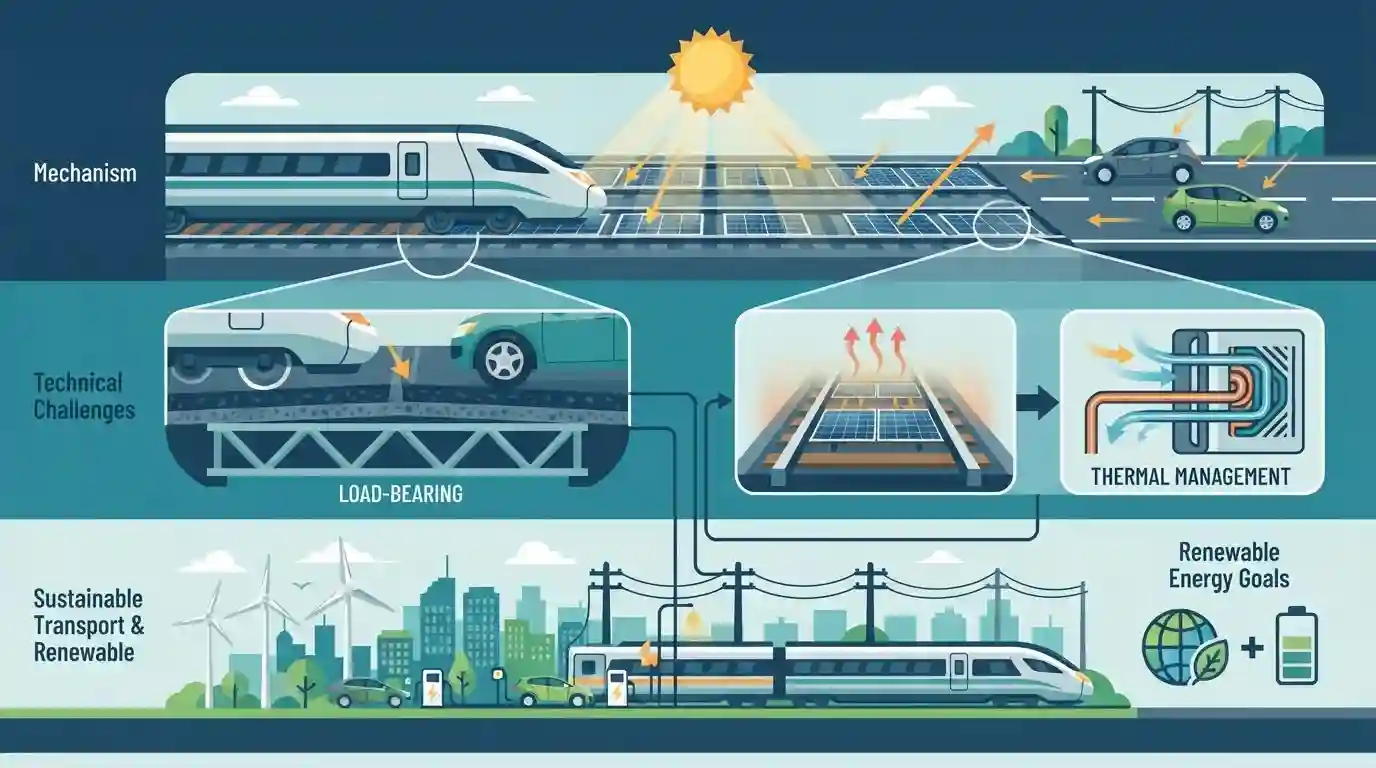
The article explains Rail-Road Integrated Photovoltaics (RIPV), an innovative clean energy technology that integrates solar panels into rail and road infrastructure to generate electricity while optimizing land use. It highlights the mechanism, technical challenges like load-bearing and thermal management, and its relevance to sustainable transport and renewable energy goals.
મુખ્ય મુદ્દા
- Rail-Road Integrated Photovoltaics (RIPV) is an emerging technology that embeds solar panels directly into transportation infrastructure such as railways and roads.
- RIPV maximizes land-use efficiency by utilizing existing transport corridors for clean energy generation without requiring dedicated land acquisitions.
- Key engineering challenges include mechanical stress from heavy vehicular or train loads, thermal management, maintenance accessibility, and durability under varying weather conditions.
- Such innovations support India's ambitious targets for renewable energy capacity expansion and carbon neutrality.
મહત્વપૂર્ણ શબ્દો
PM Surya Ghar Muft Bijli Yojana

A flagship Government of India scheme aimed at providing up to 300 units of free electricity monthly to one crore households through rooftop solar installations with capital subsidies.
UPSC context
Important for GS Paper III (Energy, Infrastructure, and Government Schemes). Tests understanding of decentralized clean energy policies.
Ministry of New and Renewable Energy
The nodal ministry of the Government of India responsible for all matters relating to research, development, policy formulation, and promotion of new and renewable energy.
UPSC context
Important for GS Paper II & III (Governance and Renewable Energy Sector). Tests knowledge of institutional frameworks for green transitions.
પ્રિલિમ્સ ટ્રેપ
RIPV requires massive dedicated land acquisitions along rural highways.
RIPV does not require dedicated land acquisition; it utilizes existing transport rights-of-way, bypassing traditional land acquisition hurdles.
સંલગ્ન સ્થિર ખ્યાલો
What are the primary institutional initiatives and targets for India's renewable energy and railway decarbonization?
- 500 GW Target: India targets 500 GW of non-fossil electricity capacity by 2030, alongside achieving net-zero carbon emissions by 2070.
- Net-Zero Railways: Indian Railways aims to achieve net-zero carbon emitter status by 2030 through electrification and renewable energy sourcing.
- Rooftop Scheme: PM Surya Ghar Muft Bijli Yojana promotes rooftop solar installation for households to offset grid demand and subsidize power.
આંતર-વિષય પેટર્ન
Land Acquisition vs. Renewable Energy Corridors
Both sectors face massive land acquisition friction, making right-of-way dual-use infrastructure (like solar highways and tracks) critical for India's 500 GW non-fossil target.
Indian Railways Decarbonization and Green Energy
Railways' net-zero by 2030 goal relies heavily on institutional green-energy procurement, shifting from external purchasing to on-premise distributed generation.

Expect statement-based questions combining renewable energy land constraints with innovative dual-use tech like RIPV and floating solar.
સંલગ્ન PYQ · 3
સંલગ્ન PYQ · 3
- 2022MainsGS3
Do you think India will meet 50 percent of its energy needs from renewable energy by 2030 ? Justify your answer. How will the shift of subsidies from fossil fuels to renewables help achieve the above objective ? Explain.
- 2025PrelimsGS1
Consider the following statements about 'PM Surya Ghar Muft Bijli Yojana': I. It targets installation of one crore solar rooftop panels in the residential sector. II. The Ministry of New and Renewable Energy aims to impart training on installation, operation, maintenance and repairs of solar rooftop systems at grassroot levels. III. It aims to create more than three lakhs skilled manpower through fresh skilling, and up-skilling, under scheme component of capacity building. Which of the statements given above are correct?
- 2022PrelimsGS1
Consider the following statements: 1. Gujarat has the largest solar park in India. 2. Kerala has a fully solar powered International Airport. 3. Goa has the largest floating solar photovoltaic project in India. Which of the statements given above is/are correct?
