Indian Railways MRP Reduction on Rail Neer After GST Revision
Source:Indian Express ↗
Why It Matters
Provides a practical example of how GST rate rationalization impacts consumer inflation and demonstrates the functioning of public sector undertakings (IRCTC) in delivering basic passenger amenities.
Summary
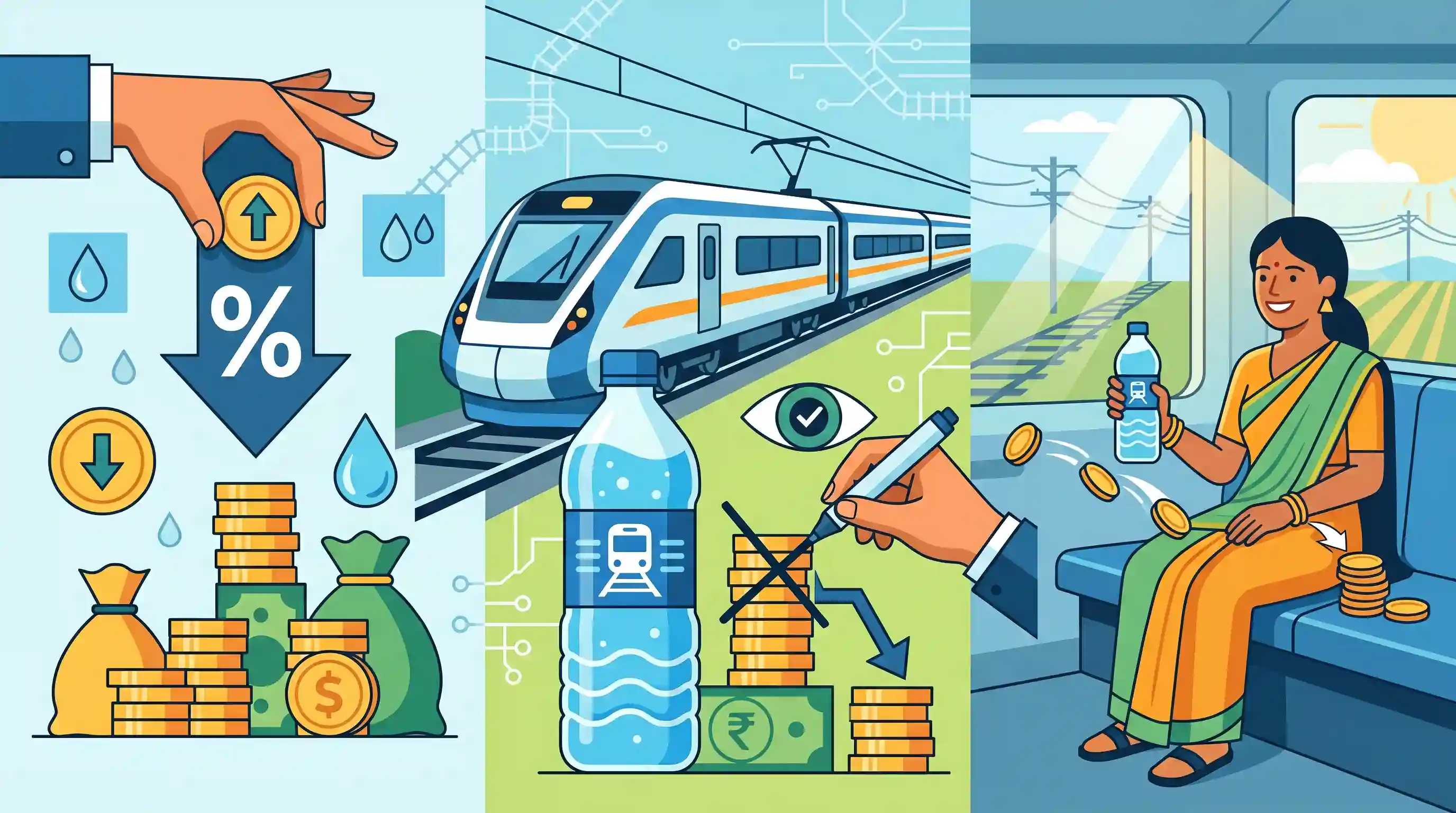
Following a reduction in the Goods and Services Tax (GST) rate on packaged drinking water, Indian Railways has slashed the Maximum Retail Price (MRP) of its in-house brand, Rail Neer. The move ensures that the benefit of the lower tax burden is directly passed on to consumers. Produced and distributed by IRCTC, the price revision highlights the real-world impact of GST rationalization on passenger amenities and everyday consumer goods.
Key Points
- The Maximum Retail Price (MRP) of Rail Neer, the packaged drinking water of Indian Railways, has been reduced.
- The price cut follows a reduction in the applicable Goods and Services Tax (GST) rate on packaged drinking water.
- The decision ensures that the benefits of lower indirect taxes are passed down to passengers, aligning with anti-profiteering principles.
- Rail Neer is managed and supplied by the Indian Railway Catering and Tourism Corporation (IRCTC) as a key passenger amenity.
Important Terms
Goods and Services Tax (GST)

A comprehensive indirect tax levied on the supply of goods and services across India, replacing multiple central and state taxes to create a unified national market.
UPSC context
GS Paper III: Indian Economy; tests understanding of indirect tax structure, resource mobilization, and economic integration.
GST Council
A constitutional body (Article 279A) chaired by the Union Finance Minister, responsible for making recommendations to the Union and States on GST rates, exemptions, and laws.
UPSC context
GS Paper II: Constitutional Bodies & GS Paper III: Fiscal Federalism; tests knowledge of cooperative federalism in tax governance.
IRCTC
A public sector undertaking (PSU) under the Ministry of Railways that manages catering, online ticketing, and tourism services, including the production of "Rail Neer" bottled water.
UPSC context
GS Paper III: Infrastructure (Railways); tests understanding of the role of PSUs in public service delivery and passenger amenities.
Rate Rationalization
The process of simplifying the GST tax structure by merging or adjusting tax slabs (e.g., the move toward a two-tier 5% and 18% system) to reduce complexity and litigation.
UPSC context
GS Paper III: Indian Economy; tests awareness of ongoing tax reforms and their impact on inflation and consumption.
Anti-Profiteering
A legal framework or policy ensuring that businesses pass on the benefits of reduced tax rates or input tax credits to consumers through lower prices.
UPSC context
GS Paper III: Indian Economy; tests knowledge of consumer protection mechanisms within the GST regime.
Prelims Trap
"The National Anti-Profiteering Authority (NAA) ensures GST rate cut benefits are passed to consumers."
The NAA was dissolved in December 2022. All GST anti-profiteering functions and complaints are now handled by the Competition Commission of India (CCI).
Static Concepts Connected
What is the anti-profiteering mechanism under the GST regime?
- Legal mandate: Governed by Section 171 of the CGST Act, requiring businesses to pass on tax reduction or input tax credit benefits directly to consumers via price cuts.
- Enforcement body: The Competition Commission of India (CCI) took over these investigative and enforcement functions in December 2022, replacing the National Anti-Profiteering Authority (NAA).
What criteria must a CPSE meet to attain 'Navratna' status?
- Prerequisite status: The enterprise must already hold Miniratna Category-I status and be classified as a Schedule 'A' CPSE.
- Performance rating: Must secure an 'Excellent' or 'Very Good' rating under its Memorandum of Understanding (MoU) with the government in 3 of the last 5 years.
- Composite score: Must score at least 60 out of 100 on six quantitative financial indicators, such as net profit to net worth and earnings per share.
Cross-Topic Patterns
CCI's expanding regulatory footprint
The CCI now regulates both traditional antitrust issues (monopolies/cartels) and GST anti-profiteering, reflecting a shift toward consolidated market and consumer protection under a single statutory body.
Captive markets and CPSE profitability
IRCTC's exclusive control over Rail Neer distribution highlights how Navratna CPSEs often sustain their financial metrics through state-backed monopolistic access to vast public infrastructure networks.

Expect a Prelims question testing the shift of GST anti-profiteering enforcement from the dissolved NAA to the CCI.
Linked PYQs · 5
Linked PYQs · 5
- 2017PrelimsGS1
What is/are the most likely advantages of implementing 'Goods and Services Tax (GST)'? 1. It will replace multiple taxes collected by multiple authorities and will thus create a single market in India. 2. It will drastically reduce the 'Current Account Deficit' of India and will enable it to increase its foreign exchange reserves. 3. It will enormously increase the growth and size of economy of India and will enable it to overtake China in the near future. Select the correct answer using the code given below:
- 2018PrelimsGS1
Consider the following items : 1. Cereal grains hulled 2. Chicken eggs cooked 3. Fish processed and canned 4. Newspapers containing advertising material Which of the above items is/are exempted under GST (Goods and Services Tax)?
- 2019MainsGS3
Enumerate the indirect taxes which have been subsumed in the Goods and Services Tax (GST) in India. Also, comment on the revenue implications of the GST introduced in India since July 2017.
- 2013MainsGS3
Discuss the rationale for introducing Goods and Services Tax (GST) in India. Bring out critically the reasons for the delay in roll out for its regime.
- 2022MainsGS3
Why is Public Private Partnership (PPP) required in infrastructural projects ? Examine the role of PPP model in the redevelopment of Railway Stations in India.
