Parliamentarian flags free speech concerns in IT Act amendments
Source:The Hindu ↗
Why It Matters
This development highlights the ongoing tension between regulating digital platforms/social media and safeguarding fundamental rights (Article 19). It also serves as a prime example of the issues surrounding delegated legislation, where executive rules may bypass parliamentary oversight, a critical concept in UPSC Polity and Governance.
Summary
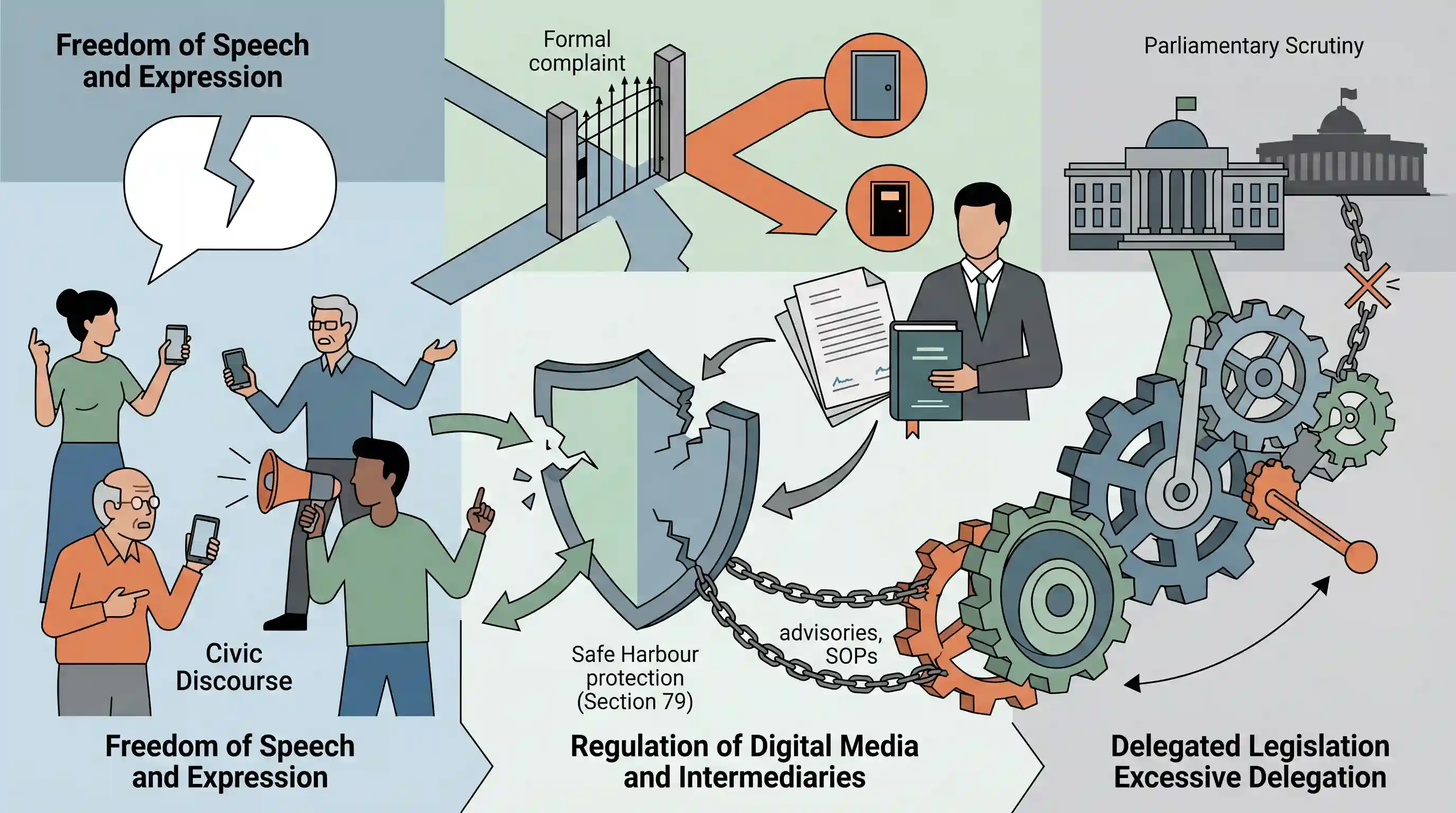
Raichur MP G. Kumar Naik has formally raised concerns with the Union Minister for Electronics and IT regarding the proposed amendments to the Information Technology (Intermediary Guidelines and Digital Media Ethics Code) Rules. The MP argues that broadening the definition of user-generated news could stifle civic discourse by subjecting everyday users to publisher-level compliance. Furthermore, the amendments aim to make intermediaries' 'safe harbour' protections (under Section 79 of the IT Act) conditional on government advisories and SOPs, and empower the Ministry to bypass formal complaints for committee referrals. These changes are criticized for risking 'excessive delegation' of power to the executive without adequate parliamentary scrutiny, potentially impinging on the freedom of speech.
Key Points
- Raichur MP G. Kumar Naik opposed the draft IT (Intermediary Guidelines and Digital Media Ethics Code) Second Amendment Rules, 2026, citing threats to free expression and democratic participation.
- The proposed expansion of rules could extend a publisher-oriented regulatory framework to ordinary user-generated news and current affairs content.
- Amendments to Rule 14(2) would allow the IT Ministry to directly refer matters to the Inter-Departmental Committee without requiring a prior complaint, widening executive discretion.
- Proposed Rule 3(4) conditions intermediaries' 'safe harbour' protections (under Section 79 of the IT Act) on compliance with government advisories and SOPs.
- These changes raise constitutional concerns over 'excessive delegation' because government SOPs and advisories do not undergo parliamentary scrutiny.
Important Terms
Information Technology Act, 2000

India's primary law for cybercrime and e-commerce, providing legal recognition for electronic transactions and signatures, and empowering the government to block content or intercept information for national security and public order.
UPSC context
GS Papers II (Governance) and III (Internal Security); foundational for digital regulation, cybercrime prevention, and e-governance frameworks.
Information Technology (Intermediary Guidelines and Digital Media Ethics Code) Rules, 2021
Subordinate legislation mandating "due diligence" for social media platforms, OTT services, and digital news publishers, including a three-tier grievance redressal mechanism and information traceability requirements.
UPSC context
GS Papers II (Statutory/Regulatory Bodies) and III (Internal Security); tests understanding of digital media ethics and content moderation policies.
Section 79 of the IT Act
A provision granting conditional immunity (safe harbour) to digital intermediaries from legal liability for third-party content, provided they follow prescribed due diligence and comply with lawful government or court orders.
UPSC context
GS Papers II (Polity/Judiciary) and III (Internal Security); critical for debates on freedom of speech and platform accountability.
Excessive Delegation
A constitutional doctrine holding that the legislature cannot abdicate its "essential legislative functions" to the executive without providing clear guiding principles, ensuring delegated legislation does not exceed permissible limits.
UPSC context
GS Paper II (Polity/Separation of Powers); tests the limits of executive rule-making power and parliamentary oversight.
Intermediary
Entities defined under Section 2(1)(w) that receive, store, or transmit electronic records on behalf of others, including internet service providers, social media platforms, and e-commerce sites.
UPSC context
GS Paper III (Technology/Governance); essential for discussing the liability and regulation of global tech firms in India's digital ecosystem.
Inter-Departmental Committee
A Level III oversight mechanism under the 2021 IT Rules that hears grievances and recommends actions against digital publishers, such as content blocking, to ensure compliance with the Code of Ethics.
UPSC context
GS Paper II (Governance/Executive Powers); relevant for examining executive oversight of digital news and potential impacts on media freedom.
Prelims Trap
"Under Section 79 of the IT Act, digital platforms enjoy absolute legal immunity for any third-party content."
Safe harbour is conditional, not absolute. Intermediaries lose this protection if they fail to observe mandated 'due diligence' or if they initiate or modify the transmission.
Static Concepts Connected
What constitutes "Excessive Delegation" in law-making?
- Essential functions: The legislature cannot delegate its 'essential legislative functions', such as determining the core legislative policy or principles, to the executive branch.
- Ultra Vires: If delegated rules exceed the boundaries defined by the parent Act, courts can strike them down as 'ultra vires'.
- Parliamentary Scrutiny: The Parliamentary Committee on Subordinate Legislation reviews rules framed by the executive to ensure they align with the parent Act and do not bypass Parliament.
What is the 'Safe Harbour' principle under the IT Act, 2000?
- General Immunity: Section 79 provides that network service providers are not legally liable for any third-party information or data made available by them.
- Passive Conduit: The protection applies only if the platform acts merely as a conduit and does not initiate, select the receiver, or modify the information contained in the transmission.
- Conditional on Diligence: The intermediary must strictly observe 'due diligence' guidelines prescribed by the Central Government to retain this immunity.
Cross-Topic Patterns
Delegated legislation + Free Speech
Tying intermediary 'safe harbour' to executive SOPs directly links the administrative law concept of 'excessive delegation' with constitutional free speech protections, a prime GS2 analytical theme.
Global tech regulation + Section 230
India's tightening of Section 79 mirrors the global shift away from absolute intermediary immunity (e.g., US Section 230) toward strict accountability, active policing, and publisher-like compliance.

Expect a mixed Prelims question testing Sec 79 'Safe Harbour' conditions alongside the role of the Committee on Subordinate Legislation.
Linked PYQs · 3
Linked PYQs · 3
- 2024MainsGS3
Social media and encrypting messaging services pose a serious security challenge. What measures have been adopted at various levels to address the security implications of social media? Also suggest any other remedies to address the problem.
- 2014MainsGS2
What do you understand by the concept "freedom of speech and expression"? Does it cover hate speech also ? Why do the films in India stand on a slightly different plane from other forms of expression ? Discuss.
- 2016MainsGS3
Use of Internet and social media by non-state actors for subversive activities is a major security concern. How have these been misused in the recent past? Suggest effective guidelines to curb the above threat.
