Post-Matric Scholarship Delays for Marginalised Students
Source:The Hindu ↗
Why It Matters
The article provides concrete examples of implementation deficits in essential welfare schemes (post-matric scholarships and hostel facilities) aimed at marginalized communities. It is highly relevant for GS Paper 2 questions that ask candidates to critically evaluate the performance of government initiatives for vulnerable sections and the impact of administrative/digital bottlenecks on equitable education and social justice.
Summary
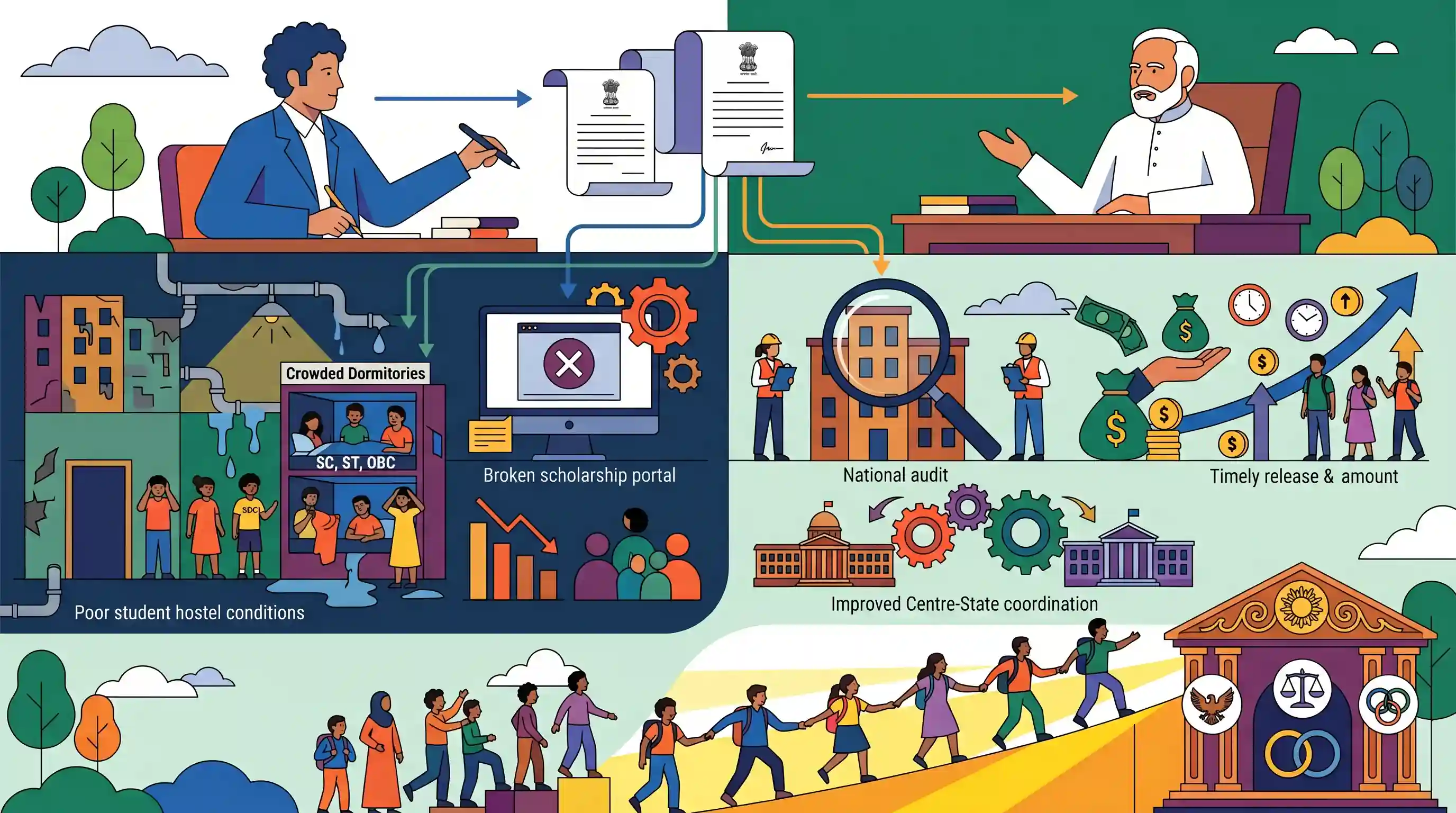
Leader of Opposition Rahul Gandhi has written to Prime Minister Narendra Modi expressing deep concern over poor living conditions in student hostels and significant delays in the disbursement of post-matriculation scholarships for marginalized communities. Citing the Ambedkar Hostel in Darbhanga as an example of severe infrastructural neglect, Gandhi highlighted that administrative failures, such as non-functional scholarship portals and drastically reduced beneficiary numbers, are hampering equitable access to education. He demanded a comprehensive national audit of these hostels, timely release of funds, increased scholarship amounts, and improved Centre-State coordination to ensure social justice for SC, ST, OBC, and minority students.
Key Points
- Leader of Opposition Rahul Gandhi wrote to the Prime Minister highlighting the 'deplorable' living conditions in hostels for marginalized students (SC, ST, EBC, OBC, and minorities).
- Citing the Ambedkar Hostel in Darbhanga (Bihar), Gandhi noted severe overcrowding, unhygienic conditions, and the absence of basic amenities like internet, library, and mess facilities.
- He flagged major systemic failures in the post-matriculation scholarship system, noting that the scholarship portal for Bihar was non-functional for three years, leading to zero beneficiaries in 2021-22.
- Data indicates a drastic drop in scholarship recipients, with the number of Dalit students receiving aid falling from 1.36 lakh in FY23 to just 0.69 lakh in FY24.
- Demands include an urgent audit of all such hostels, timely disbursement of scholarships, increased scholarship amounts, and better coordination between the Centre and State governments.
Important Terms
Post-Matric Scholarship Scheme

A centrally sponsored financial assistance program for SC, ST, and OBC students pursuing education beyond Class 10, aimed at improving higher education enrollment and equity.
UPSC context
GS-II: Welfare schemes for vulnerable sections; tests knowledge of specific social sector initiatives and their implementation challenges.
Leader of Opposition (LoP)
A statutory post in the Lok Sabha/Rajya Sabha held by the leader of the largest opposition party (minimum 10% seats), providing a formal check on government power.
UPSC context
GS-II: Parliamentary functioning; tests roles in statutory appointments (CBI, CVC) and the concept of a 'Shadow Cabinet'.
Article 46 of the Constitution
A Directive Principle of State Policy (Part IV) mandating the State to promote the educational and economic interests of SCs, STs, and other weaker sections.
UPSC context
GS-II: Indian Constitution; tests foundational mandates for social justice and affirmative action in education.
Centrally Sponsored Scheme (CSS)
Government schemes funded jointly by the Union and States (e.g., 60:40 ratio) but implemented by State governments to achieve national development goals.
UPSC context
GS-II: Governance/Federalism; tests understanding of fiscal relations and administrative coordination between the Centre and States.
Social Justice
The principle of ensuring equitable distribution of resources and opportunities, aimed at the upliftment of historically marginalized communities like SCs, STs, and OBCs.
UPSC context
GS-II: Social Justice; tests the conceptual framework behind affirmative action and protective discrimination policies.
National Scholarship Portal (NSP)
A digital platform under the National e-Governance Plan serving as a single-window interface for applying to and disbursing various government scholarship schemes.
UPSC context
GS-II: E-governance; tests the role of digital infrastructure in improving transparency and efficiency in welfare delivery.
Prelims Trap
The Post-Matric Scholarship Scheme for SCs is a Central Sector Scheme with 100% Central funding.
It is a Centrally Sponsored Scheme (60:40). However, hostel construction under the merged PM-AJAY scheme receives 100% central assistance, making the two highly confusable.
Static Concepts Connected
Which Constitutional provisions mandate the State to support marginalized students' education?
- Article 15(4): Empowers the State to make special provisions for the advancement of socially and educationally backward classes or SC/STs.
- Article 46: A Directive Principle instructing the State to promote the educational and economic interests of weaker sections, particularly SCs and STs.
What are the core components of the PM-AJAY scheme?
- Scheme Merger: Amalgamated three previous schemes: Special Central Assistance to SCSP, Babu Jagjivan Ram Chhatrawas Yojana (hostels), and PM Adarsh Gram Yojana.
- Hostel Funding: Provides 100% central assistance for the construction of hostels for SC students to boost the Gross Enrolment Ratio (GER) in higher education.
Cross-Topic Patterns
Digital exclusion in welfare schemes
Non-functional scholarship portals echo past issues in MGNREGA and PDS, where mandatory ICT/digital hurdles led to the exclusion of genuine beneficiaries.
Fiscal federalism and CSS delays
Delays in the 60:40 funding for scholarships highlight systemic Centre-State coordination failures, a recurring mains theme alongside schemes like Ayushman Bharat and PM-POSHAN.

Expect a Prelims question differentiating between Central Sector vs Centrally Sponsored schemes targeting SC/ST education, like PM-AJAY.
Linked PYQs · 3
Linked PYQs · 3
- 2019MainsGS2
Performance of welfare schemes that are implemented for vulnerable sections is not so effective due to absence of their awareness and active involvement at all stages of policy process. Discuss.
- 2023MainsGS2
“Development and welfare schemes for the vulnerable, by its nature, are discriminatory in approach.” Do you agree? Give reasons for your answer.
- 2021MainsGS2
Has digital illiteracy, particularly in rural areas, coupled with lack of Information and Communication Technology (ICT) accessibility hindered socio-economic development? Examine with justification.
