Opposition Demands Special Parliament Session on National Security
Source:The Hindu ↗
Why It Matters
The demand highlights the role of the opposition in enforcing parliamentary accountability over the executive on national security matters. Furthermore, a foreign head of state announcing a bilateral ceasefire raises critical questions about India's diplomatic sovereignty and the shifting stance on third-party mediation in India-Pakistan relations.
Summary
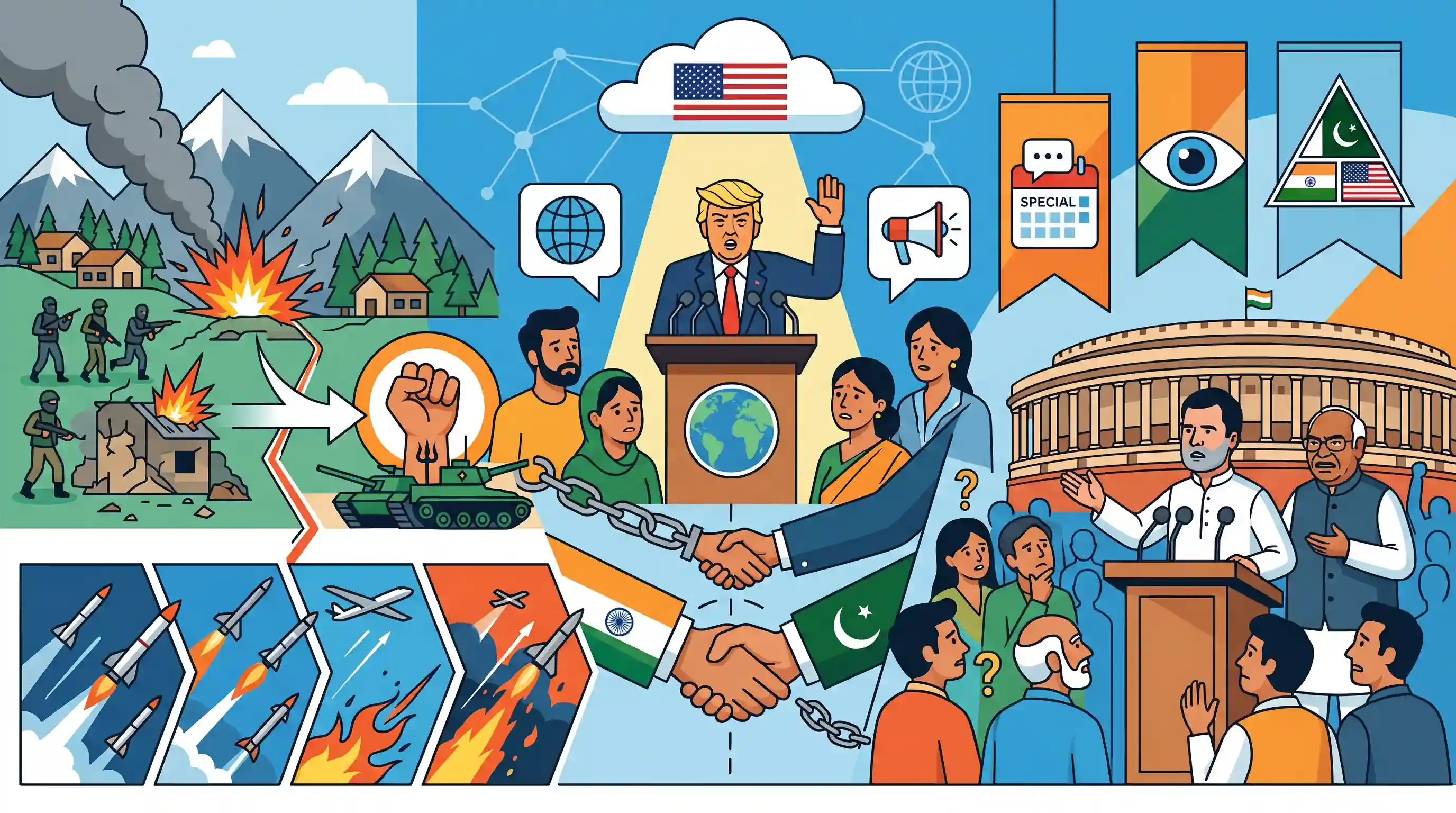
Opposition leaders Rahul Gandhi and Mallikarjun Kharge have demanded a special session of Parliament to discuss recent critical national security developments, specifically the Pahalgam terror attack and India's retaliatory 'Operation Sindoor'. The opposition also seeks to debate the subsequent India-Pakistan ceasefire, which has drawn political controversy after being preemptively announced by US President Donald Trump, raising questions about third-party involvement in bilateral affairs. The ceasefire halts all military actions following four days of intense cross-border drone and missile strikes.
Key Points
- Opposition leaders have formally requested the Prime Minister to convene a special parliamentary session to discuss recent national security developments.
- The demand centers on debating the Pahalgam terror attack and India's military response, codenamed Operation Sindoor.
- Political scrutiny has intensified over the new India-Pakistan ceasefire agreement because it was first announced by US President Donald Trump before official confirmation by New Delhi.
- The ceasefire halts all military actions across land, air, and sea after four days of intense cross-border drone and missile strikes.
Important Terms
Operation Sindoor

A multi-domain Indian military offensive launched in May 2025 targeting terrorist infrastructure in Pakistan and PoK, retaliating for the Pahalgam terror attack.
UPSC context
GS Paper III (Internal Security/Security Forces); tests understanding of surgical strikes, deterrence, and retaliatory military doctrines.
India-Pakistan ceasefire (2025)
An agreement reached in May 2025 to halt four days of intense cross-border missile and drone strikes between India and Pakistan following Operation Sindoor.
UPSC context
GS Paper II (International Relations); tests knowledge of bilateral conflict management and the role of the DGMO hotline.
Special Session of Parliament
A parliamentary meeting convened by the President (under Article 85) for urgent or specific national business outside the regular Budget, Monsoon, and Winter sessions.
UPSC context
GS Paper II (Polity/Parliamentary Functioning); tests constitutional provisions, Article 85, and the executive's power to summon.
Indus Waters Treaty (IWT)
A 1960 water-sharing treaty between India and Pakistan, suspended by India in 2025 following the Pahalgam terror attack, citing security concerns.
UPSC context
GS Paper II (Bilateral Agreements); tests transboundary water governance and its use as a strategic lever in diplomacy.
Pahalgam attack (2025)
A devastating terror attack in April 2025 at Baisaran Valley, J&K, killing 26 people, which triggered a major military escalation and Operation Sindoor.
UPSC context
GS Paper III (Internal Security); tests knowledge of cross-border terrorism and threats to regional stability in Jammu & Kashmir.
Third-party Mediation
Diplomatic intervention by an external state to resolve bilateral disputes, historically rejected by India in the context of Kashmir under the Simla Agreement.
UPSC context
GS Paper II (International Relations); tests understanding of India's strategic autonomy and bilateralism versus external interventionism.
Prelims Trap
The term "Special Session" is explicitly defined in the Constitution for national emergencies.
The Constitution does not mention or define a 'Special Session'. Article 85 merely allows the President to summon Parliament, which then operates under standard parliamentary rules unless specifically altered.
Static Concepts Connected
What is the constitutional basis for a Special Session of Parliament?
- No explicit mention: The Constitution does not define a "Special Session". It is purely a political term for a session convened outside the traditional three-session schedule.
- Article 85(1): The President summons the session on the recommendation of the Cabinet Committee on Parliamentary Affairs (CCPA).
- Standard Rules: Special sessions are governed by the standard rules of procedure for both Houses unless specific rules are explicitly suspended.
Why does India legally reject third-party mediation in disputes with Pakistan?
- Simla Agreement 1972: Under this treaty, India and Pakistan formally committed to resolving their differences by peaceful means through strictly direct bilateral negotiations.
- Diplomatic precedent: India uses this established bilateralism clause to categorically reject uninvited mediation offers by foreign leaders or organizations.
- DGMO-level mechanism: Unlike formal peace treaties, LoC ceasefires are temporary suspensions of hostilities, typically managed via DGMO-level understandings, reinforcing the bilateral mechanism.
Cross-Topic Patterns
Drone warfare + Internal Security
Operation Sindoor highlights a shift to "below-threshold" asymmetric warfare using UAVs. This links GS3 border management directly with the need for indigenous layered air defense grids like Akashteer.
US Mediation + Simla Agreement
The preemptive US announcement of the ceasefire creates an IR friction point, challenging India's strict adherence to the bilateralism doctrine established post-1971.

Expect 2026 Prelims to mix Article 85(1) 'special sessions' with DGMO-level LoC ceasefire mechanisms and the 1972 Simla Agreement.
Linked PYQs · 4
Linked PYQs · 4
- 2017MainsGS2
The Indian Constitution has provisions for holding joint session of the two Houses of the Parliament. Enumerate the occasions when this would normally happen and also the occasions when it cannot, with reason thereof.
- 2015MainsGS2
Terrorist activities and mutual distrust have clouded India-Pakistan relations. To what extent the use of soft power like sports and cultural exchanges could help generate goodwill between the two countries? Discuss with suitable examples.
- 2020MainsGS3
Analyze internal security threats and transborder crimes along Myanmar, Bangladesh and Pakistan borders including Line of Control (LoC). Also discuss the role played by various security forces in this regard.
- 2019MainsGS2
‘What introduces friction into the ties between India and the United States is that Washington is still unable to find for India a position in its global strategy, which would satisfy India's national self-esteem and ambitions.’ Explain with suitable examples.
