Rule 349 and Parliamentary Privilege Debates in Lok Sabha
Source:Indian Express ↗
Why It Matters
It provides a real-world example of how the Rules of Procedure in the Lok Sabha (specifically Rule 349) are invoked to regulate parliamentary debate and authenticate documents, making it relevant for Polity. It also touches upon the strategic sensitivities of the India-China LAC standoff.
Summary
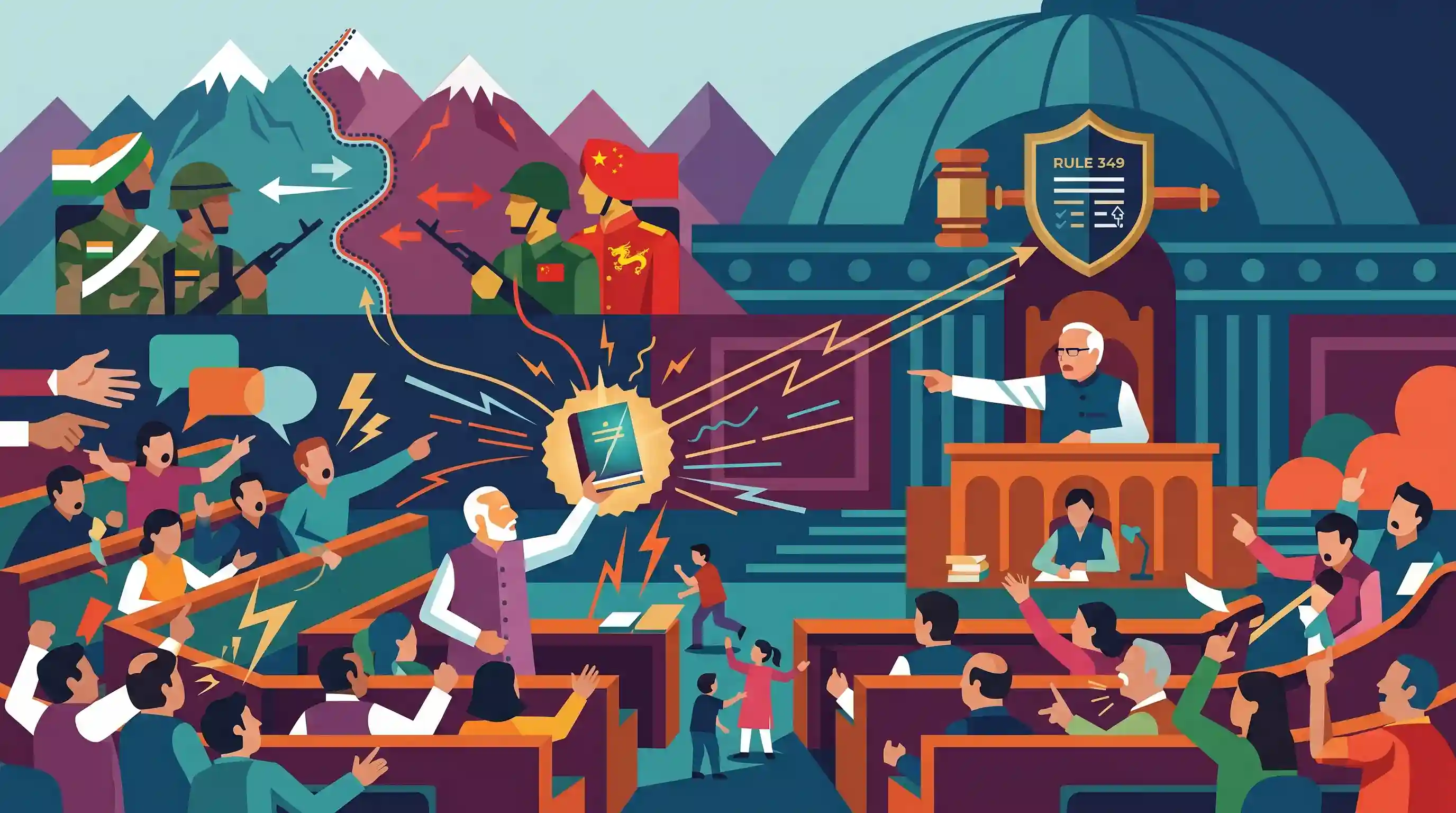
Rahul Gandhi's citation of an unpublished memoir by former Army Chief General MM Naravane regarding the India-China standoff caused a major uproar in the Lok Sabha. The controversy centered on Rule 349 of the Lok Sabha's Rules of Procedure, which governs the conduct of members and restricts the reading of unverified or external documents not officially part of the House business. The episode highlights the intersection of parliamentary privileges, the procedural authority of the Speaker, and the ongoing political sensitivity of the border dispute with China.
Key Points
- Leader of Opposition Rahul Gandhi sparked an uproar in the Lok Sabha by referencing an unpublished memoir by former Army Chief General MM Naravane regarding the India-China border standoff.
- The reference triggered a controversy surrounding Rule 349 of the Rules of Procedure and Conduct of Business in Lok Sabha, which governs the conduct of MPs while the House is sitting.
- Rule 349 restricts members from reading external books, newspapers, or letters that are not directly connected to the business of the House, and governs the quotation of unauthenticated or unpublished documents.
- The incident underscores the tension between parliamentary privilege (freedom of speech) and procedural rules enforced by the Speaker, while also reviving political debate over the LAC border situation.
Important Terms
Rule 349 (Lok Sabha)

Specific regulation in the Lok Sabha's handbook prohibiting members from reading books, newspapers, or letters during sessions unless directly relevant to the House's immediate business.
UPSC context
GS Paper II: Parliament—Conduct of Business. Tests understanding of floor management and disciplinary rules for MPs.
Article 118
Constitutional provision empowering each House of Parliament to frame its own rules to regulate its procedure and the conduct of its business.
UPSC context
GS Paper II: Indian Constitution. Fundamental to the autonomy and independence of the legislative branch.
Rules of Procedure and Conduct of Business in Lok Sabha
The official codified manual governing every aspect of Lok Sabha proceedings, from question hour to debates, formulated under the authority of Article 118.
UPSC context
GS Paper II: Parliament and State Legislatures. Essential for questions on legislative process and parliamentary oversight.
Speaker of the Lok Sabha
The highest authority in the Lok Sabha responsible for interpreting and enforcing parliamentary rules, maintaining order, and deciding the admissibility of documents.
UPSC context
GS Paper II: Constitutional Offices. Focuses on the Speaker's quasi-judicial powers and role in parliamentary discipline.
Line of Actual Control (LAC)
The notional demarcation line that separates Indian-controlled territory from Chinese-controlled territory, often a flashpoint for military and diplomatic tensions.
UPSC context
GS Paper II: International Relations/India-China. GS Paper III: Security challenges and their management in border areas.
Prelims Trap
Article 105 grants absolute freedom of speech to MPs, immune from restrictions by ordinary laws or parliamentary rules of procedure.
Article 105 explicitly makes MPs' freedom of speech subject to other Constitutional provisions (like Art 121 on judges) and the Rules of Procedure of Parliament.
Static Concepts Connected
How is an MP's Freedom of Speech in Parliament constitutionally restricted?
- Constitutional caveat: Under Article 105(1), an MP's freedom of speech is explicitly subject to constitutional provisions and the internal rules regulating parliamentary procedure.
- Judicial restrictions: Article 121 explicitly prohibits Parliament from discussing the conduct of Supreme Court or High Court judges, except during official removal motions.
- Procedural rules: The Speaker enforces Rules of Procedure (like Rule 353) requiring prior notice before an MP can make defamatory allegations on the floor.
What specific Lok Sabha rules govern the use of external documents?
- Rule 349: Prohibits MPs from reading external books, newspapers, or letters while the House is sitting, unless directly connected to the business.
- Rule 369: Mandates that any paper or document an MP wishes to lay on the Table must be duly authenticated by them.
- Speaker's discretion: The Speaker holds the final interpretive authority to block unverified, unauthenticated, or unpublished materials from being quoted.
Cross-Topic Patterns
Defense memoirs & Official Secrets
Unpublished memoirs by former defense personnel routinely test the boundaries of the Official Secrets Act, sparking debates on executive transparency versus national security.
Parliamentary Privilege vs House Procedure
UPSC frequently links the theoretical concept of Parliamentary Privilege (Article 105) with the practical application of the Rules of Procedure managed exclusively by the Speaker.

Expect a 2026 Prelims statement testing whether Art 105 freedom of speech in Parliament is absolute or subject to internal House Rules.
Linked PYQs · 4
Linked PYQs · 4
- 2022PrelimsGS1
With reference to Deputy Speaker of Lok Sabha, consider the following statements: 1. As per the Rules of Procedure and Conduct of Business in Lok Sabha, the election of Deputy Speaker shall be held on such date as the Speaker may fix. 2. There is a mandatory provision that the election of a candidate as Deputy Speaker of Lok Sabha shall be from either the principal opposition party or the ruling party. 3. The Deputy Speaker has the same power as of the Speaker when presiding over the sitting of the House and no appeal lies against his rulings. 4. The well established parliamentary practice regarding the appointment of Deputy Speaker is that the motion is moved by the Speaker and duly seconded by the Prime Minister. Which of the statements given above are correct?
- 2024PrelimsGS1
With reference to the Speaker of the Lok Sabha, consider the following statements : While any resolution for the removal of the Speaker of the Lok Sabha is under consideration 1. He/She shall not preside. 2. He/She shall not have the right to speak. 3. He/She shall not be entitled to vote on the resolution in the first instance. Which of the statements given above is/are correct?
- 2020MainsGS2
Once a Speaker, Always a Speaker' ! Do you think this practice should be adopted to impart objectivity to the office of the Speaker of Lok Sabha ? What could be its implications for the robust functioning of parliamentary business in India?
- 2014MainsGS2
With respect to the South China sea, maritime territorial disputes and rising tension affirm the need for safeguarding maritime security to ensure freedom of navigation and over flight throughout the region. In this context, discuss the bilateral issues between India and China.
