Political Parties Intensify Hill Outreach Ahead Of 2027 Polls
Source:new-indian-express ↗
Why It Matters
This article provides a real-world perspective on state-level electoral strategy, the geographical division of Kumaon and Garhwal, demographic groups like veterans, and the governance of statutory temple committees (such as the Badri-Kedar Temple Committee established under the Shri Badrinath-Shri Kedarnath Temples Act, 1939). These are recurrent themes in the UKPSC GS1 paper.
Summary
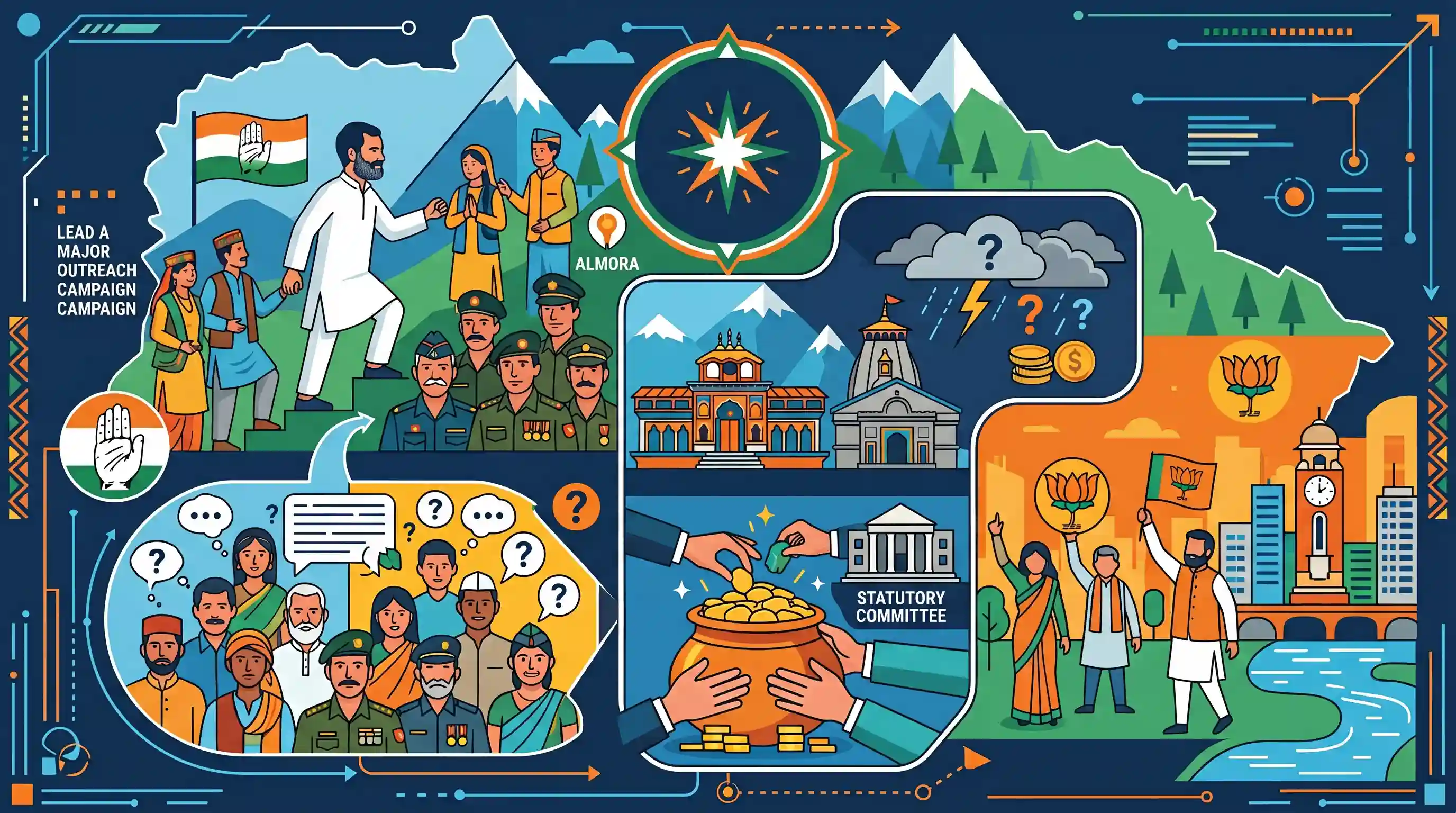
The article details the early escalation of campaigning in Uttarakhand ahead of the 2027 Assembly elections. High-stakes dynamics have led Congress leader Rahul Gandhi to initiate a major outreach campaign targeting the hill districts of the Garhwal and Kumaon divisions (e.g., Almora) and focusing on the state's veteran (ex-servicemen) population. This contrasts with the BJP's focus on the plains of Dehradun and Haridwar. Local political issues, such as allegations of donation mismanagement within the Badri-Kedar Temple Committee (BKTC) and the fallout of regional controversies, are shaping the early political narratives in the state.
Key Points
- Electoral Battle 2027: High stakes in Uttarakhand have triggered early political campaigning, with Congress initiating a hill outreach to counter the BJP's consecutive victories in 2017 and 2022.
- Geographical Stratification: While the BJP has concentrated its initial campaigns in the plains (Dehradun and Haridwar), the Congress is focusing on the mountain districts of the Garhwal and Kumaon regions (such as Almora) to rebuild its grassroots base.
- Veteran Demographic Strategy: Outreach to ex-servicemen (veterans) is a core component of the Congress strategy in Uttarakhand, which is historically a significant and influential voting base often aligned with the BJP.
- BKTC Governance Controversy: Political debate has intensified over the administration of the Badri-Kedar Temple Committee (BKTC), with opposition allegations regarding the mismanagement and political utilization of temple donations.
- Organizational Shake-ups: To mitigate political damage, the BJP transferred state General Secretary Ajay Kumar to Rajasthan ahead of the escalating campaigns, while Congress restructured its leadership under regional veterans like Ganesh Godiyal.
Important Terms
Shri Badrinath-Shri Kedarnath Temples Act, 1939

A legislative act originally passed to provide structured administration, governance, and management for the prestigious Badrinath and Kedarnath temples, alongside their respective endowments.
UPSC context
GS Paper II (Polity & Governance): Tests state legislations, statutory control of religious endowments, and secular administration.
Badri-Kedar Temple Committee (BKTC)
A statutory body constituted under the 1939 Act to oversee the administrative, financial, and day-to-day management of the Badrinath and Kedarnath shrines in Uttarakhand.
UPSC context
GS Paper II (Governance): Tests state-appointed committees, temple governance controversies, and administrative transparency.
104th Constitutional Amendment Act, 2020
A constitutional amendment extending legislative seat reservations for SCs and STs in the Lok Sabha and State Assemblies until 2030, while ending Anglo-Indian nominated seats.
UPSC context
GS Paper II (Polity & Constitution): Tests constitutional amendments, electoral reservations, and representation of marginalized groups.
Uttarakhand Legislative Assembly
The unicameral state legislature of Uttarakhand, comprising 70 directly elected members, responsible for enacting state-level laws and exercising democratic oversight.
UPSC context
GS Paper II (State Legislature): Tests structure, functioning, and legislative powers of state assemblies.
Uttarakhand Tourism Development Board (UTDB)
A statutory advisory, regulatory, and licensing authority chaired by Uttarakhand's Tourism Minister, responsible for eco-friendly tourism planning and private sector integration.
UPSC context
GS Paper III (Economic Development): Tests tourism-led economic growth, statutory boards, and sustainable regional development.
Prelims Trap
The State cannot constitutionally administer or regulate the financial and secular management of public temples under Article 26.
Article 25(2)(a) explicitly empowers the State to regulate secular, economic, or financial activities associated with religious practices, validating statutory boards like the BKTC.
Static Concepts Connected
How does the Constitution govern state control over religious institutions?
- Secular regulation: The state can legally control economic, financial, and administrative affairs of religious places.
- Essential practices: The state cannot interfere with core rituals, doctrines, or purely religious practices.
- Statutory boards: Creation of state-run boards (e.g., BKTC) for temple administration is constitutionally valid.
What changes did the 104th Constitutional Amendment Act introduce?
- Anglo-Indian nomination: It abolished the reservation and nomination of Anglo-Indians in the Lok Sabha and State Legislative Assemblies.
- SC/ST reservation: It extended the reservation of seats for SCs and STs in legislatures for an additional ten years.
- Article 333 impact: It deactivated active nominations by Governors, establishing purely elected legislative strengths in assemblies like Uttarakhand.
Cross-Topic Patterns
Temple governance and secularism
The legal administration of religious shrines by state-run boards links GS-2 freedom of religion with GS-1 cultural heritage preservation.
Demographic divergence and voting patterns
Uttarakhand’s vast contrast in sex ratios and migration patterns between hills and plains directly dictates target-demographic political strategies.

State control of temple boards under Article 26 and Article 333's post-104th Amendment status are high-probability 2026 Prelims topics.
Linked PYQs · 5
Linked PYQs · 5
- 2024UKPSC_PRELIMSGS1
Between which of the following two kingdoms the battle of 'Tamadhaund' was fought ?
- 2025UKPSC_PRELIMSGS1
Which of the following groups of districts of Uttarakhand is correct in descending order of sex-ratio according to the Census of India 2011?
- 2024UKPSC_PRELIMSGS1
How many of the following women M.L.A.s were there in the first Legislative Assembly of Uttarakhand ?
- 2016UKPSC_PRELIMSGS1
How many nominated members are there in the Legislative Assembly of Uttarakhand (2016)?
- 2024UKPSC_PRELIMSGS1
UTDB is established in Uttarakhand to promote:
