Ruling Party Accuses Opposition Leader of Conspiring to Create Anarchy
Source:The Hindu ↗
Why It Matters
The article highlights contemporary debates around national security, the alleged role of foreign entities and non-state actors in domestic politics, and the challenges of maintaining democratic stability amidst politically polarized narratives and disinformation.
Summary
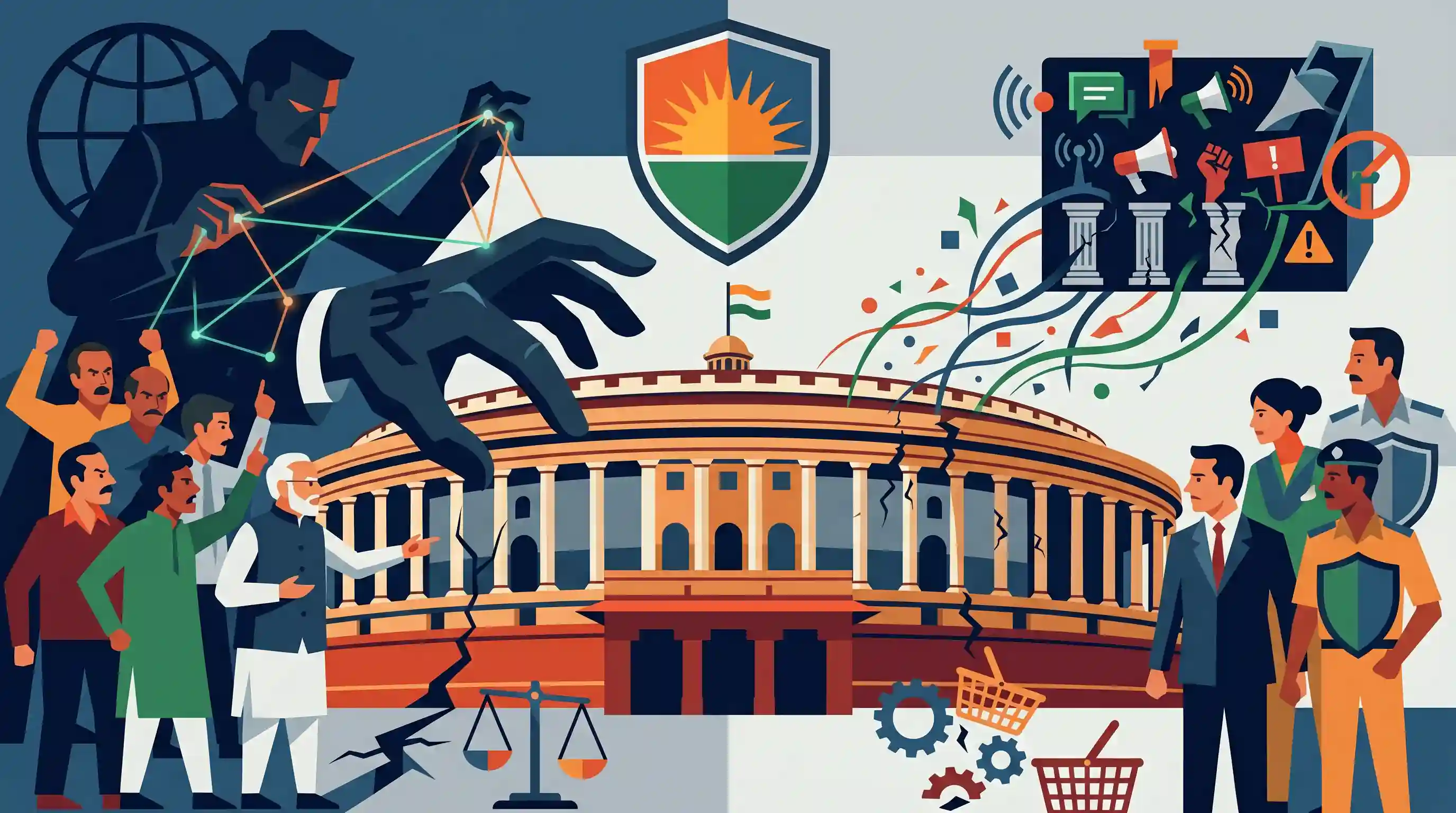
The Bharatiya Janata Party (BJP) has accused Congress leader Rahul Gandhi of orchestrating a conspiracy to destabilise the Narendra Modi government and incite "anarchy" in India. The accusations arose after reports emerged that Gandhi, during a party meeting, predicted the government's collapse within a year due to economic discontent. Senior BJP leaders, including Piyush Goyal and Sambit Patra, claimed this was part of a larger plot involving the opposition, a "Toolkit Gang," and foreign entities like George Soros. They alleged that the Congress, unable to win democratically, is attempting to subvert constitutional institutions and seeking external interference, while reaffirming the resilience of Indian democracy against such subversive efforts.
Key Points
- BJP leaders accused Congress leader Rahul Gandhi of conspiring to destabilise the Narendra Modi government and create anarchy in the country.
- The allegations were based on reports that Gandhi claimed the Modi government would fall within a year due to growing economic discontent.
- Union Minister Piyush Goyal and other BJP leaders alleged the involvement of a "Toolkit Gang" and foreign entities in a broader conspiracy to incite violence.
- BJP leaders specifically linked the purported remarks to external patrons like George Soros and accused the Congress of seeking foreign interference in India\'s internal affairs.
- The BJP asserted that India\'s democracy and constitutional institutions remain strong and cannot be undermined by such attempts at subversion.
Important Terms
BJP (Bharatiya Janata Party)

The principal national political party in India's current government, characterized by its right-wing ideology, Hindutva, and focus on centralized governance and economic nationalism.
UPSC context
GS Paper II: Political Parties. Relevant for studying the structure, functioning, and ideological shifts in India’s multi-party system.
Indian National Congress (INC)
India’s oldest political party, which led the freedom struggle and historically dominated post-independence politics, advocating for secularism, social democracy, and a welfare state.
UPSC context
GS Paper II: Political Parties. Tests understanding of the role of opposition and the evolution of the party system.
INDIA Bloc
The Indian National Developmental Inclusive Alliance; a major opposition coalition of over 20 parties formed to challenge the ruling NDA in the 2024 General Elections.
UPSC context
GS Paper II: Federalism & Elections. Central to discussing coalition politics and the consolidation of opposition forces in a democracy.
Toolkit
A digital document outlining strategies for social media campaigns or protests. In Indian security discourse, it often refers to alleged coordinated disinformation or foreign-backed influence operations.
UPSC context
GS Paper III: Internal Security. Pertains to challenges from communication networks, social media, and psychological/information warfare.
Foreign Interference
Covert or overt attempts by external nations, organizations, or individuals to influence a country's sovereign democratic processes, elections, or domestic policy.
UPSC context
GS Paper II/III: Security & Sovereignty. Concerns strategic autonomy and the impact of non-state actors on national stability.
Non-State Actors
Entities with significant global influence—such as NGOs, multinational corporations, or billionaire philanthropists—that operate independently of any sovereign state's direct control.
UPSC context
GS Paper III: Internal Security. Tests the role of external actors in creating internal unrest or influencing democratic discourse.
Prelims Trap
"Under FCRA, political parties can receive foreign contributions if they obtain prior permission from the Ministry of Home Affairs."
Section 3 of the FCRA explicitly and absolutely prohibits political parties, election candidates, and legislators from accepting foreign contributions. Government approval cannot override this ban.
Static Concepts Connected
How does the FCRA restrict foreign funding for political entities in India?
- Absolute prohibition: Political parties, election candidates, and members of legislatures (MPs/MLAs) are completely barred from receiving any foreign contributions to protect democratic sovereignty.
- Political nature clause: The Central Government can designate specific organizations as being of a "political nature," thereby blocking their access to foreign funds to prevent indirect political subversion.
How do non-state actors utilize 'cognitive warfare' to challenge internal security?
- Disinformation networks: Deploying digital 'toolkits' and algorithmic manipulation to spread disinformation, amplify domestic social fault lines, and erode public trust in constitutional institutions.
- Covert financing: Funneling untraceable funds to exploit socio-economic grievances, sustaining prolonged civil unrest or protests to induce 'anarchy' without conventional armed conflict.
Cross-Topic Patterns
Toolkits: Free speech vs. subversion
The deployment of digital toolkits for coordinated protests blurs the line between legitimate democratic dissent (Article 19) and organized information warfare orchestrated by external non-state actors.
Economic inequality breeding internal instability
The narrative of economic discontent being leveraged to incite anarchy underscores the classic GS-3 linkage: socio-economic deprivation and inequality act as primary catalysts for internal security challenges.

Expect a multi-statement Prelims question on FCRA's Section 3 prohibitions, or a GS3 Mains question on cognitive warfare by non-state actors.
Linked PYQs · 3
Linked PYQs · 3
- 2021MainsGS3
Analyse the multidimensional challenges posed by external state and non-state actors, to the internal security of India. Also discuss measures required to be taken to combat these threats.
- 2016MainsGS3
Use of Internet and social media by non-state actors for subversive activities is a major security concern. How have these been misused in the recent past? Suggest effective guidelines to curb the above threat.
- 2024MainsGS3
Social media and encrypting messaging services pose a serious security challenge. What measures have been adopted at various levels to address the security implications of social media? Also suggest any other remedies to address the problem.
