Rahul Gandhi Addresses Universities in Peru and Chile on Global Order
Source:The Hindu ↗
Why It Matters
The article touches upon critical GS2 and GS3 themes: the qualitative reform of India's education system to foster inclusivity and scientific temper, and the macroeconomic imperative to develop a democratic alternative for global manufacturing and supply chains. It also highlights the growing importance of India's diplomatic and strategic engagements with Latin American countries in the context of a multipolar world.
Summary
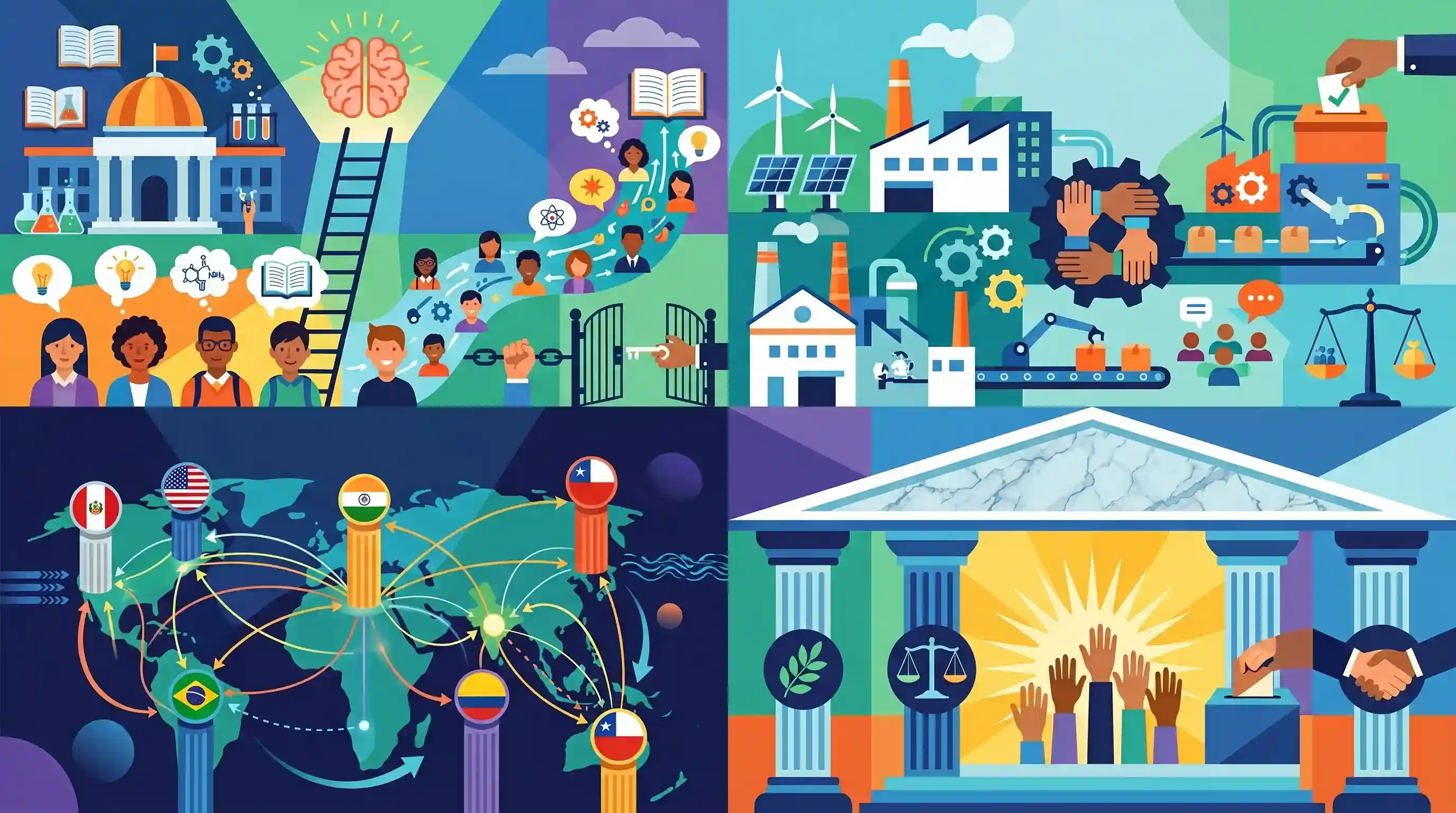
During a week-long visit to South American nations, including Colombia, Brazil, Peru, and Chile, Congress leader Rahul Gandhi addressed university students, focusing on education, democracy, and geopolitics. He stressed the need for an education system in India that fosters scientific temper, encourages critical thinking, and embraces the nation's diversity, ensuring education remains a foundation of freedom rather than a privilege. Furthermore, he articulated the necessity for India to develop an alternative manufacturing model rooted in a democratic framework, proposing international partnerships with countries like the US or Peru to navigate the complexities of a multipolar world.
Key Points
- Leader of the Opposition Rahul Gandhi recently completed a week-long visit to South American nations, addressing students at top universities in Peru and Chile.
- He advocated for an Indian education system that promotes scientific temper, critical thinking, and diversity, warning against education becoming a privilege for a few.
- He highlighted the need to build an alternative manufacturing system within a democratic setup, contrasting with non-democratic manufacturing hubs, and suggested partnerships with nations like the US or Peru.
- The overarching themes of his dialogues encompassed the future of education, strengthening democracy, geopolitics, and India’s strategic trajectory in a multipolar world.
Important Terms
Scientific Temper

A constitutional duty (Article 51A(h)) advocating for an attitude of logical, rational thinking, and the spirit of inquiry to counter superstition and dogma.
UPSC context
GS Paper 2 (Polity) and Paper 4 (Ethics). Tests knowledge of Fundamental Duties and rational public policy.
Multipolar World
A global system where power is distributed among several major actors (e.g., India, EU, China, US) rather than dominated by one or two superpowers.
UPSC context
GS Paper 2 (International Relations). Crucial for understanding India's strategic autonomy and multi-alignment strategy.
Leader of Opposition (LoP)
A statutory post in India's Parliament (Act of 1977) held by the leader of the largest opposition party with at least 10% of total seats.
UPSC context
GS Paper 2 (Polity). Tests understanding of parliamentary oversight and the role of the shadows cabinet.
Alternative Manufacturing Model
A proposed industrial strategy prioritizing production within a democratic setup, focusing on MSMEs and international partnerships to avoid authoritarian supply chain dependencies.
UPSC context
GS Paper 3 (Economy). Relevant for discussions on 'Make in India' and reducing dependency on the China-centric model.
Strategic Autonomy
The ability of a nation to pursue its own foreign policy and national interests without being forced into alliances or constrained by external powers.
UPSC context
GS Paper 2 (International Relations). A core tenet of Indian diplomacy used to navigate global power rivalries.
Educational Inclusivity
Policy focus on making higher education accessible to marginalized groups, including SCs, STs, and OBCs, while reflecting diverse histories and traditions.
UPSC context
GS Paper 2 (Social Justice). Tests knowledge of affirmative action and educational reforms for underrepresented communities.
Pontifical Catholic University of Peru
A private research university in Lima, Peru, which hosted Rahul Gandhi for dialogues on education and geopolitics in October 2025.
UPSC context
Current Affairs (International). Significant as a platform for India's opposition to engage in Global South diplomacy.
University of Chile
Chile's oldest and most prestigious university, where the Leader of Opposition discussed democratic value systems and multipolar diplomacy in 2025.
UPSC context
Current Affairs (International). Highlights institutional engagement between India and South American academic/political circles.
Prelims Trap
"Peru is a key member of the 'Lithium Triangle' alongside Chile and Bolivia."
The Lithium Triangle consists of Argentina, Bolivia, and Chile. Peru is highly rich in copper and silver, but it is not part of the Lithium Triangle.
Static Concepts Connected
What is the 'Lithium Triangle' and its strategic significance?
- Core members: Argentina, Bolivia, and Chile form the triangle, holding over half of the world's known lithium resources.
- Extraction method: Lithium in this region is primarily extracted from brine pools in salt flats (salars), unlike the hard-rock mining common in Australia.
- India's interest: Securing these supplies is vital for India's electric vehicle (EV) transition, battery storage ecosystem, and overall strategic autonomy in clean energy.
How does the Indian Constitution address 'Scientific Temper'?
- Article 51A(h): Article 51A(h) lists it as a Fundamental Duty "to develop the scientific temper, humanism and the spirit of inquiry and reform."
- 42nd Amendment: These duties were added to the Constitution by the 42nd Amendment Act (1976) based on the Swaran Singh Committee's recommendations.
- Non-justiciable nature: While non-justiciable, it serves as a guiding principle for judicial interpretation and for state policies aiming to modernize the education sector.
Cross-Topic Patterns
Friend-shoring + China Plus One
Global supply chain diversification is increasingly favoring "friend-shoring," making India's democratic framework a tangible geopolitical asset for manufacturing over authoritarian hubs.
Critical minerals + Latin America
India's diplomatic outreach to South America is pivoting from standard South-South cooperation to strategically securing critical minerals (like lithium and copper) essential for its energy transition.

Expect a mapping question on the Lithium Triangle/Andean nations or a polity statement linking Art 51A(h) to education policies in 2026.
Linked PYQs · 4
Linked PYQs · 4
- 2022MainsGS2
The Right of Children to Free and Compulsory Education Act, 2009 remains inadequate in promoting incentive-based system for children's education without generating awareness about the importance of schooling. Analyse.
- 2023MainsGS3
Faster economic growth requires increased share of the manufacturing sector in GDP, particularly of MSMEs. Comment on the present policies of the Government in this regard.
- 2017MainsGS3
Account for the failure of manufacturing sector in achieving the goal of labour-intensive exports. Suggest measures for more labour-intensive rather than capital-intensive exports.
- 2025MainsGS3
Discuss the rationale of the Production Linked Incentive (PLI) scheme. What are its achievements? In what way can the functioning and outcomes of the scheme be improved?
