Election Commission Scrutiny of Electoral Roll Transparency
Source:Indian Express ↗
Why It Matters
Understanding the mechanisms ensuring the integrity of electoral rolls is vital for UPSC aspirants studying the functioning of the Election Commission of India and the procedural guarantees of free and fair elections, which is a core component of the GS2 syllabus on constitutional bodies and electoral reforms.
Summary
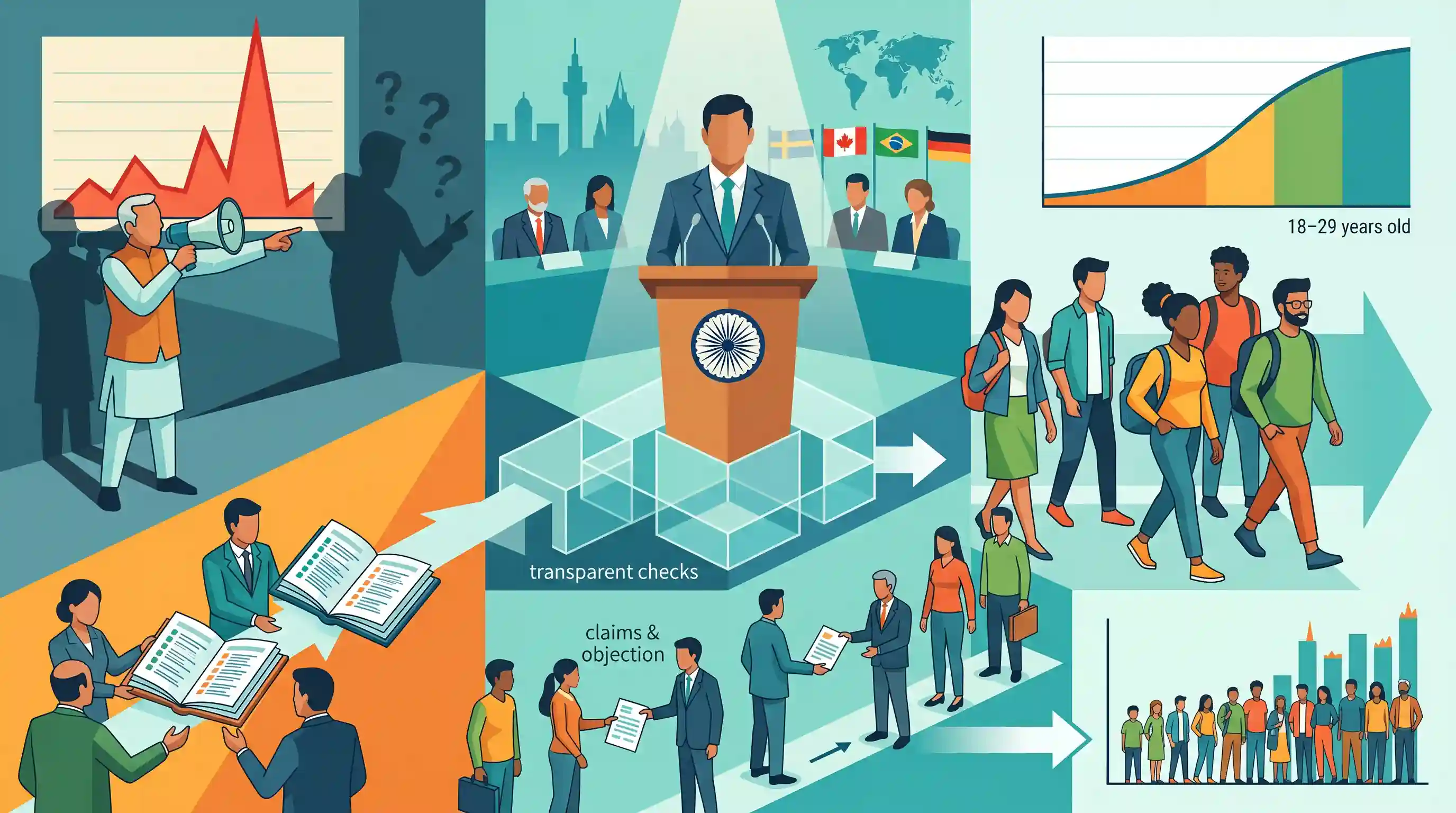
Chief Election Commissioner Gyanesh Kumar asserted that India's electoral roll preparation is among the most transparent and rigorous globally, speaking at the Stockholm International Conference on Electoral Integrity. His comments came in response to allegations from Congress leader Rahul Gandhi concerning a suspicious increase in voter numbers during the Maharashtra Assembly elections. Kumar detailed the extensive checks and balances in place, including the sharing of rolls with political parties and provisions for claims and objections. The Election Commission attributed the voter increase in Maharashtra to a normal demographic influx of young voters aged 18-29.
Key Points
- Chief Election Commissioner Gyanesh Kumar defended the transparency of India's electoral roll process at the Stockholm International Conference on Electoral Integrity.
- He stated that the electoral roll preparation involves multiple layers of scrutiny and is shared with recognized political parties annually and before elections.
- The remarks were a rebuttal to allegations by Congress leader Rahul Gandhi regarding an unexplained spike of 40.91 lakh voters in Maharashtra.
- The Election Commission clarified that the increase in electors was normal and predominantly consisted of young voters aged 18-29.
- The process relies on a robust system of claims, objections, and appeals, closely monitored by political parties, candidates, and EC observers.
Important Terms
Election Commission of India (ECI)

An autonomous constitutional body (Article 324) responsible for administering national and state elections. It ensures free and fair polls through voter registration, managing polling, and enforcing the Model Code of Conduct.
UPSC context
GS Paper II (Constitutional Bodies); tests knowledge of electoral administration and constitutional safeguards for democracy.
Representation of the People Act (RPA)
The legal framework (Acts of 1950 and 1951) governing Indian elections. They regulate the preparation of electoral rolls, seat allocation, candidate qualifications, corrupt practices, and the conduct of polls.
UPSC context
GS Paper II (Salient features of RPA); fundamental for understanding the statutory rules of the democratic process.
International IDEA
A Stockholm-based intergovernmental organization with UN observer status that supports democratic institutions worldwide. India is a founding member and currently shares its electoral expertise on this platform.
UPSC context
GS Paper II (International Institutions); relevant for global democratic norms and India’s role in international governance.
Chief Election Commissioner (CEC)
The head of the three-member Election Commission of India. Appointed by the President, the CEC oversees the electoral machinery and holds a status equivalent to a Supreme Court judge.
UPSC context
GS Paper II (Constitutional Offices); focuses on appointment procedures, independence, and roles in managing world's largest elections.
Electoral Integrity
International standards for elections based on universal suffrage, political equality, and transparency. It ensures that the electoral cycle is professional, impartial, and commands public trust.
UPSC context
GS Paper II/IV (Governance & Ethics); pertains to the credibility of democratic outcomes and institutional accountability.
Electoral Roll
The official list of eligible voters in a constituency. In India, it is periodically revised to include young voters and remove duplicates, ensuring a transparent and inclusive voting process.
UPSC context
GS Paper II (Elections); tests understanding of voter registration transparency and technical electoral reforms.
Prelims Trap
The preparation and revision of electoral rolls are governed by the Representation of the People Act, 1951.
Aspirants often mix up the two RPAs. The preparation of electoral rolls and delimitation falls strictly under RPA 1950, while RPA 1951 governs the actual conduct of elections.
Static Concepts Connected
What distinguishes RPA 1950 from RPA 1951 regarding Indian elections?
- RPA 1950: Deals with the delimitation of constituencies, allocation of seats, and the preparation/revision of electoral rolls.
- RPA 1951: Governs the actual conduct of elections, qualifications and disqualifications of members, and outlines corrupt electoral practices.
- Registration Rules 1960: Provides the detailed procedural mechanisms, such as Forms 6 and 7, for legally enforcing voter registration and handling objections.
What are the core Constitutional safeguards for electoral rolls?
- Article 324: Vests the plenary power of superintendence, direction, and control over the preparation of electoral rolls entirely in the Election Commission.
- Article 325: Mandates a single, general electoral roll for every territorial constituency, strictly prohibiting exclusion based on religion, race, caste, or sex.
- Article 326: Establishes universal adult suffrage, granting the right to be registered as a voter to all citizens aged 18 and above.
Cross-Topic Patterns
Voter roll spikes vs. Migration data
Allegations of unnatural voter surges often intersect with internal migration themes. The EC routinely reconciles youth voter influxes using demographic indicators and census data to verify legitimate demographic shifts.
ECI's global soft power at International IDEA
India leverages the massive scale of its electoral management to project soft power globally, actively participating in forums like International IDEA and the Association of World Election Bodies (A-WEB).

Expect a 2026 Prelims statement explicitly swapping the functions of RPA 1950 (electoral rolls) with RPA 1951 (conduct of elections).
Linked PYQs · 4
Linked PYQs · 4
- 2022MainsGS2
Discuss the role of the Election Commission of India in the light of the evolution of the Model Code of Conduct.
- 2024MainsGS2
Examine the need for electoral reforms as suggested by various committees with particular reference to "one nation one election" principle.
- 2017PrelimsGS1
Consider the following statements: 1. The Election Commission of India is a five-member body. 2. Union Ministry of Home Affairs decides the election schedule for the conduct of both general elections and bye-elections. 3. Election Commission resolves the disputes relating to splits/mergers of recognised political parties. Which of the statements given above is/are correct?
- 2001PrelimsGS1
Consider the following statements regarding the political parties in India: I. The Representation of the People Act, 1951 provides for the registration of political parties. II. Registration of political parties is carried out by the Election Commission. III. A national level political party is one which is recognised in four or more States. IV. During the 1999 general elections, there were six National and 48 State level parties recognised by the Election Commission. Which of these statements are correct?
