India-US Maritime Incident and Diplomatic Challenges for India
Source:Indian Express ↗
Why It Matters
The incident underscores the diplomatic challenges India faces in navigating unilateral sanctions and military blockades by strategic partners like the US. It touches upon the imperative of protecting Indian citizens in conflict zones, safeguarding commercial maritime navigation, and managing domestic political pressures regarding foreign policy choices and sovereignty.
Summary
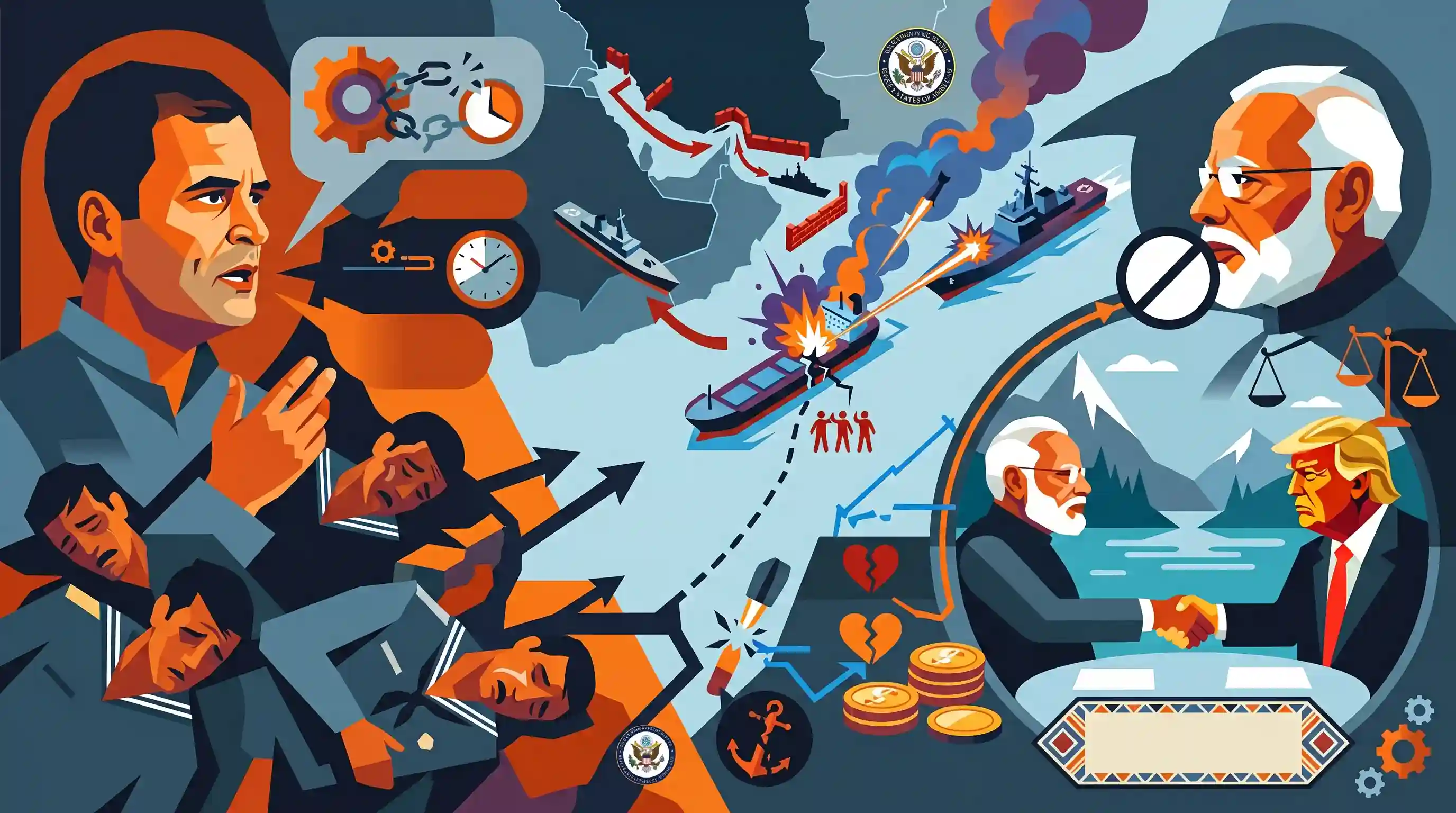
Rahul Gandhi strongly criticized Prime Minister Narendra Modi for remaining silent over the deaths of three Indian sailors in a US strike on a commercial vessel, the MT Settebello, in the Gulf region. The incident, which took place amid a US naval blockade on Iranian ports, saw the US State Department assert that violations of the blockade by commercial ships would not be tolerated. Gandhi accused the PM of acting subservient to the US and prioritizing impending trade discussions with President Donald Trump at the G7 Summit in Evian-les-Bains over securing justice and accountability for the Indian casualties. The incident highlights diplomatic tensions involving maritime security, the protection of Indian nationals, and India's strategic balancing of relations with the US against American actions in the Middle East.
Key Points
- Three Indian sailors were killed in a US military strike on the commercial vessel MT Settebello in the Gulf region on June 10, 2026.
- Congress leader Rahul Gandhi criticized PM Narendra Modi's silence on the incident, accusing the government of failing to demand accountability for Indian lives.
- Gandhi alleged that PM Modi is prioritizing trade negotiations with US President Donald Trump at the upcoming G7 Summit in France over seeking justice for the sailors.
- External Affairs Minister S Jaishankar discussed the incident with US Secretary of State Marco Rubio.
- The US defended the strike, maintaining that commercial vessels must comply with its naval blockade on Iranian ports and warning against violations.
Important Terms
G7 (Group of Seven)

An informal forum of seven of the world's most advanced economies (Canada, France, Germany, Italy, Japan, UK, US) coordinating on global economic, security, and energy policies.
UPSC context
GS Paper II: International Groups. Relevant for India's status as a partner and its role in shaping global governance.
Strategic Autonomy
A state’s ability to pursue national interests and make independent foreign policy decisions without being constrained by other powers or rigid bloc alignments.
UPSC context
GS Paper II: Indian Foreign Policy. Essential for India’s multi-aligned balancing act between the US, Russia, and Middle Eastern powers.
Freedom of Navigation (FON)
A principle of international law, codified in UNCLOS (Article 87), ensuring ships the right to traverse the high seas without interference from other states.
UPSC context
GS Paper II & III: International Relations and Security. Crucial for maritime trade and the Indo-Pacific strategic framework.
Naval Blockade
A military operation by a belligerent state to prevent all vessels from entering or leaving specific coastal areas or ports belonging to an enemy.
UPSC context
GS Paper II: International Law. Tests understanding of maritime sovereignty and the use of force in global geopolitics.
Protection of Indian Citizens Abroad
A policy and legal framework (e.g., Emigration Act 1983) ensuring the Indian government provides consular assistance and safety to its nationals residing or working abroad.
UPSC context
GS Paper II: Indian Diaspora/Bilateral Relations. Examines the state's obligations versus its strategic diplomatic goals during international crises.
US State Department
The executive department of the U.S. federal government responsible for the nation's foreign policy and international relations.
UPSC context
GS Paper II: Bilateral Relations. Key entity for negotiating India-US partnerships and managing diplomatic friction.
Prelims Trap
Unilateral naval blockades to enforce sanctions are recognized and authorized under UNCLOS.
UNCLOS does not authorize unilateral blockades to enforce domestic sanctions. Such blockades typically violate the fundamental principle of Freedom of Navigation on the high seas.
Static Concepts Connected
What are the passage rights granted to commercial vessels under UNCLOS?
- Innocent Passage: Ships can pass through territorial waters (up to 12nm) if the passage is continuous, expeditious, and not prejudicial to the coastal state's peace and security.
- Transit Passage: Applies to international straits (e.g., Strait of Hormuz), allowing unhindered navigation and overflight solely for continuous transit between high seas or EEZs.
- High Seas Freedom: Absolute freedom of navigation applies beyond national jurisdiction, where unilateral military blockades in peacetime generally violate international maritime law.
How does the G7 function and what is India's role?
- Informal Forum: It is an informal bloc of seven advanced economies (Canada, France, Germany, Italy, Japan, UK, US) and the EU, operating without a formal charter or secretariat.
- India's Status: India is not a permanent member but is frequently invited by the host nation as an "Outreach Country" or guest to participate in extended summit sessions.
Cross-Topic Patterns
UNCLOS + Middle East Chokepoints
US naval blockades near Iranian ports directly invoke map-based questions on the Strait of Hormuz and the legal definitions of transit passage in international straits.
Strategic Autonomy vs Unilateral Sanctions
India's need to balance trade negotiations at the G7 while protecting its diaspora and energy shipments against unilateral US actions is a classic Mains GS-2 theme.

Expect a multi-statement question combining UNCLOS transit passage rules, Middle East maritime chokepoints, and unilateral sanctions.
Linked PYQs · 4
Linked PYQs · 4
- 2018MainsGS2
In what ways would the ongoing US-Iran Nuclear Pact Controversy affect the national interest of India? How should India respond to this situation?
- 2012MainsGS2
How have the US sanctions against Iran affected India's bilateral relations with Iran?
- 2014MainsGS2
With respect to the South China sea, maritime territorial disputes and rising tension affirm the need for safeguarding maritime security to ensure freedom of navigation and over flight throughout the region. In this context, discuss the bilateral issues between India and China.
- 2025MainsGS2
"Energy security constitutes the dominant kingpin of India's foreign policy, and is linked with India's overarching influence in Middle Eastern countries.” How would you integrate energy security with India's foreign policy trajectories in the coming years?
