Opposition questions trade pact and border management
Source:The Hindu ↗
Why It Matters
The event highlights essential GS2 and GS3 themes, including the necessity of protecting domestic interests (agriculture, pharma) during bilateral trade negotiations, ensuring executive accountability through parliamentary mechanisms like the Opposition's right to speak, and managing complex border security challenges with China.
Summary
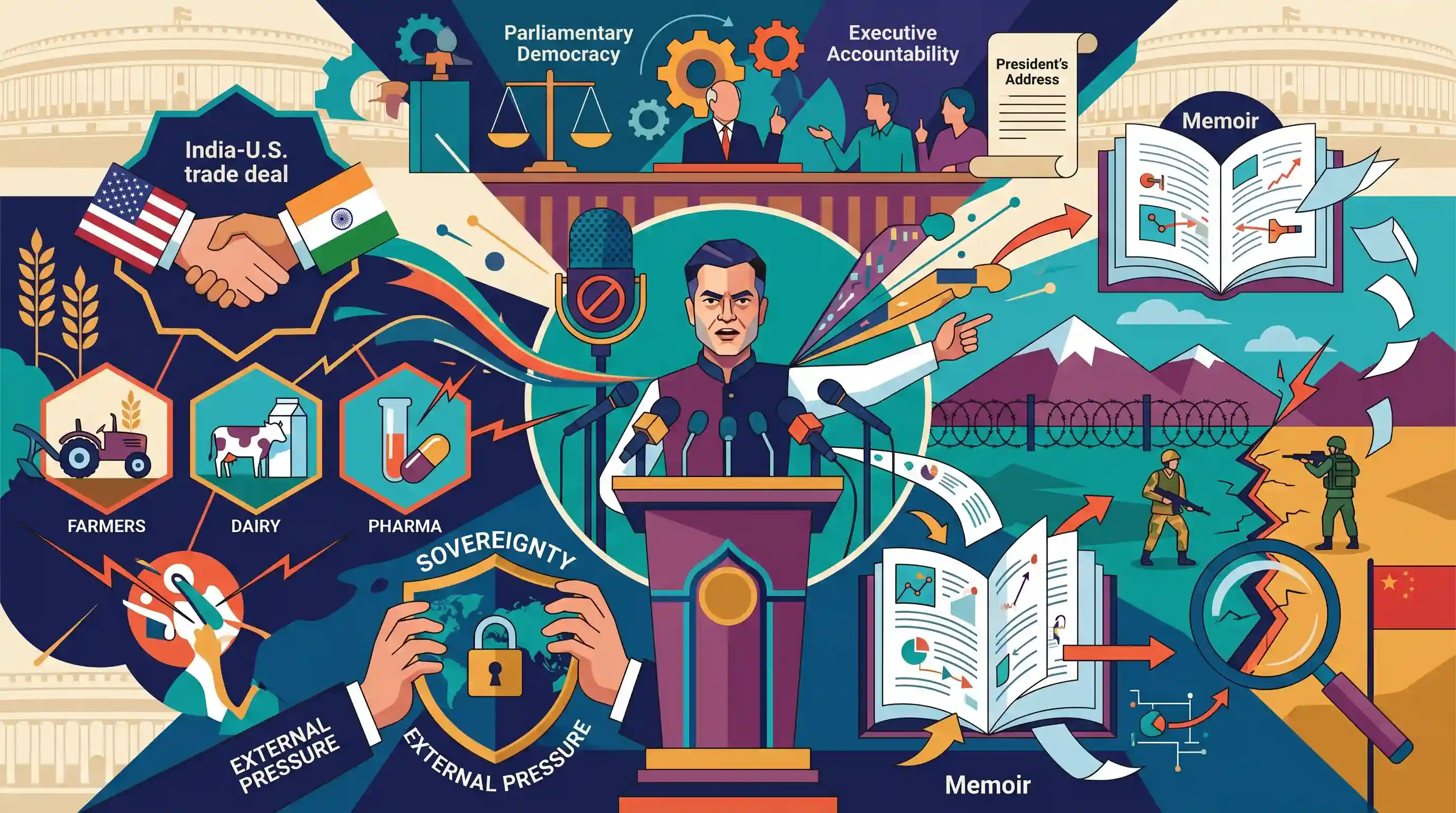
Leader of the Opposition Rahul Gandhi strongly criticized the proposed India-U.S. trade deal in the Lok Sabha, accusing Prime Minister Narendra Modi of compromising India's sovereign interests under external pressure. The Congress party warned that the deal could harm Indian farmers, the dairy sector, and the pharmaceutical industry. Beyond trade, the Opposition attacked the government's handling of the 2020 border standoff with China in eastern Ladakh, citing claims from an unpublished memoir by former Army Chief Gen. Manoj Naravane. Additionally, the Opposition raised serious concerns about parliamentary democracy and executive accountability, protesting that the LoP was denied the opportunity to speak on the President's address.
Key Points
- Leader of the Opposition Rahul Gandhi criticized the proposed India-U.S. trade deal, alleging it compromises the interests of Indian farmers, dairy producers, and the pharmaceutical industry.
- The Opposition suggested that the Prime Minister is acting under external pressure, citing ongoing U.S. issues involving Gautam Adani and the Epstein files.
- The government was also targeted over its border management with China, referencing former Army Chief Gen. Manoj Naravane's unpublished memoir about the 2020 eastern Ladakh standoff.
- Concerns over parliamentary functioning were raised after the Leader of the Opposition was reportedly blocked from speaking during the motion of thanks on the President's address.
Important Terms
India-U.S. trade deal

A proposed agreement to reduce tariffs and trade barriers between India and the USA, affecting sectors like dairy, agriculture, and pharmaceuticals.
UPSC context
GS II (International Relations) and GS III (Economy); tests impact of bilateral agreements on domestic industries.
Leader of the Opposition
A statutory post given to the leader of the largest opposition party (holding at least 10% seats), responsible for critiquing government policy and offering alternatives.
UPSC context
GS II (Polity); tests understanding of parliamentary oversight and roles in a democratic system.
Lok Sabha
The lower house of India's Parliament, consisting of directly elected representatives; it holds primary power over money bills and executive confidence.
UPSC context
GS II (Polity); foundational knowledge of legislative structure and democratic representation.
Executive Accountability
The constitutional obligation of the Council of Ministers to be answerable to the legislature (specifically the Lok Sabha) for its actions and policies.
UPSC context
GS II (Governance); tests the principle of collective responsibility and checks and balances.
President's Address
A mandatory address by the President under Article 87 at the year's first session, outlining the government's broad governance agenda and achievements.
UPSC context
GS II (Parliamentary Procedure); tests knowledge of Article 87 and the subsequent Motion of Thanks.
Prelims Trap
The office of the Leader of the Opposition is explicitly mandated by the Constitution.
The LoP is a statutory post defined under the 1977 Act. It is not explicitly mentioned in the Constitution.
Static Concepts Connected
What is the significance of the Motion of Thanks under Article 87?
- Constitutional mandate: Article 87 mandates the President's special address to both Houses assembled together at the start of the first session each year.
- Cabinet drafted: The address outlines the government's policies, programs, and past achievements, and is strictly drafted by the Union Cabinet.
- Confidence test: If the Motion of Thanks is defeated in the Lok Sabha, it amounts to a defeat of the government and necessitates resignation.
Why is the Depsang Plain strategically vital on the LAC?
- DBO Access: It provides India critical access to the Daulat Beg Oldie (DBO) advanced landing ground in the Sub-Sector North.
- DSDBO Road: Hostile presence in Depsang threatens the Darbuk-Shyok-DBO (DSDBO) military logistics road, which is vital for troop sustenance in eastern Ladakh.
Cross-Topic Patterns
Trade Deals vs. Domestic Livelihoods
Bilateral negotiations with the U.S. and EU constantly clash with India's need to protect sensitive primary sectors like dairy and agriculture, alongside intellectual property regimes for generic pharma.
LoP and Statutory Watchdogs
The Leader of the Opposition's power extends beyond parliamentary debates, acting as a mandatory check in selection committees for vital watchdogs like the CBI Director, CVC, CIC, and Lokpal.

Expect a 2026 prelims question pairing the statutory basis of the LoP with the conventions surrounding the Motion of Thanks.
Linked PYQs · 4
Linked PYQs · 4
- 2024MainsGS3
India has a long and troubled border with China and Pakistan fraught with contentious issues. Examine the conflicting issues and security challenges along the border. Also give out the development being undertaken in these areas under the Border Area Development Programme (BADP) and Border Infrastructure and Management (BIM) Scheme.
- 2021MainsGS2
To what extent, in your view, the Parliament is able to ensure accountability of the executive in India?
- 2019MainsGS2
Individual Parliamentarian's role as the national law maker is on a decline, which in turn, has adversely impacted the quality of debates and their outcome. Discuss.
- 2016MainsGS2
The broader aims and objectives of WTO are to manage and promote international trade in the era of globalization. But the Doha round of negotiations seem doomed due to differences between the developed and the developing countries." Discuss in the Indian perspective.
