Opposition Urges Centre to Defend Forest Rights Act in Supreme Court
Source:Indian Express ↗
Why It Matters
The Forest Rights Act, 2006, is a landmark legislation aimed at correcting historical injustices against forest-dwelling communities. Its effective implementation is crucial for balancing tribal welfare and land rights with forest conservation. The issue of arbitrary claim rejections and potential mass evictions highlights significant governance and human rights challenges, making it highly relevant for UPSC topics concerning social justice, vulnerable sections, and environmental governance.
Summary
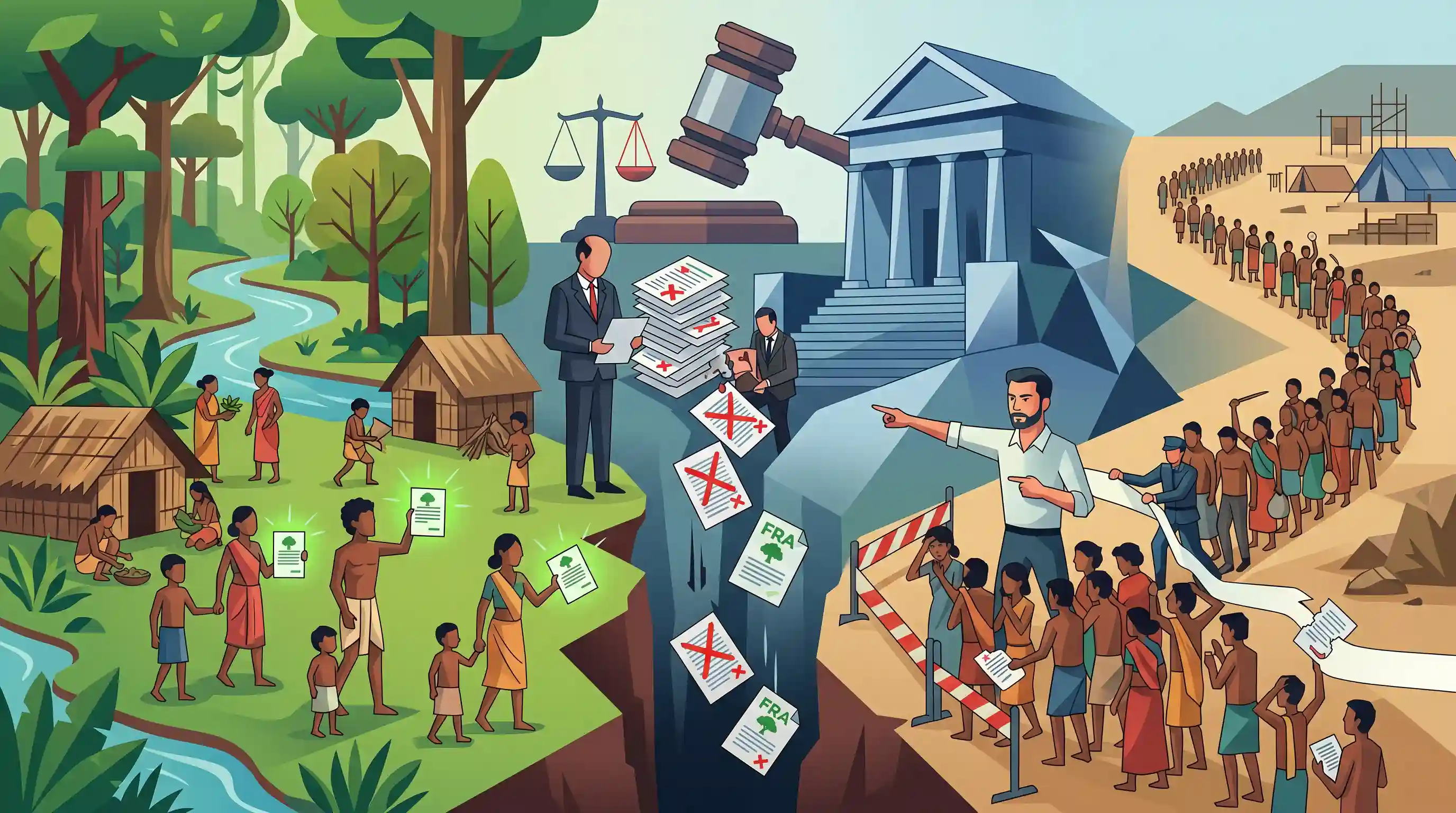
Congress leader Rahul Gandhi has criticized the Union government for allegedly neglecting the rights of tribal communities and failing to protect them from eviction. He urged the Centre to robustly defend the Forest Rights Act (FRA), 2006, during an upcoming Supreme Court hearing. Gandhi highlighted that the FRA was enacted to correct historical injustices and grant Adivasis rights over forest resources. However, arbitrary rejections of claims have placed lakhs of families at risk of displacement, following a paused 2019 Supreme Court order that had directed the eviction of those whose claims were denied.
Key Points
- Rahul Gandhi criticized the Union government for failing to protect the land rights of tribal communities and urged it to defend the Forest Rights Act (FRA) in the Supreme Court.
- He warned that lakhs of Adivasi families face the threat of eviction from their traditional lands due to the arbitrary rejection of their FRA claims without proper review.
- The Forest Rights Act was enacted in 2006 to rectify historical injustices and secure the rights of forest-dwelling communities over 'jal, jangal, and zameen' (water, forest, and land).
- A 2019 Supreme Court order had directed the eviction of individuals whose land claims were rejected, which was subsequently paused pending a comprehensive review.
Important Terms
Forest Rights Act (FRA), 2006

Legislation recognizing the legal rights of forest-dwelling Scheduled Tribes and traditional dwellers over forest land and resources they have inhabited for generations.
UPSC context
GS II (Vulnerable sections) and GS III (Environment). Tests social justice, tribal empowerment, and community-led conservation frameworks.
Individual Forest Rights (IFR)
Legal rights granted to individual forest-dwelling households to hold and cultivate forest land (up to 4 hectares) for their own habitation and livelihood.
UPSC context
GS II/III. Tests knowledge of land tenure security and livelihood protection for marginalized communities under social welfare legislation.
Community Forest Rights (CFR)
Collective rights allowing communities to access, use, manage, and dispose of minor forest produce and common resources within traditional village boundaries.
UPSC context
GS III. Relevant for biodiversity conservation and democratic decentralization, specifically how community management impacts ecological sustainability.
Gram Sabha
The primary democratic body of a village empowered by the FRA to initiate and verify claims for forest rights before administrative screening.
UPSC context
GS II. Tests concepts of grassroots democracy and the institutional framework for implementing forest rights and decentralizing governance.
Historical Injustice
The legislative acknowledgement that forest dwellers' rights were not adequately recorded during the colonial and post-colonial consolidation of state-owned forests.
UPSC context
GS II/Modern History. Tests the underlying philosophy of the FRA and the state's role in rectifying colonial-era policy failures.
Other Traditional Forest Dwellers (OTFD)
Non-Scheduled Tribe individuals or communities who have primarily resided in and depended on forest land for at least 75 years before 2005.
UPSC context
GS II. Essential for understanding the eligibility criteria and the inclusive nature of the FRA beyond just Scheduled Tribes.
Prelims Trap
The Gram Sabha is the final authority to approve forest rights claims, and MoEFCC is the nodal implementing ministry.
Gram Sabha initiates claims, but the District Level Committee (DLC) is the final authority. Also, the Ministry of Tribal Affairs (MoTA) is the nodal agency, not the Environment Ministry.
Static Concepts Connected
What is the 3-tier institutional mechanism for settling claims under the FRA?
- Gram Sabha: Empowered to initiate the process of determining the nature and extent of Individual Forest Rights (IFR) or Community Forest Rights (CFR).
- Sub-Divisional Committee: Examines the resolution passed by the Gram Sabha and prepares the record of forest rights for the district level.
- District Level Committee: The final statutory authority to approve or reject the forest rights claims. Its decision is binding and final.
What types of rights are recognized under the Forest Rights Act, 2006?
- Title Rights: Right to hold and live in forest land under individual or common occupation for habitation or self-cultivation for livelihood.
- Use Rights: Right of ownership, access to collect, use, and dispose of minor forest produce (MFP) which has been traditionally collected.
- Relief & Development: Rights in or over disputed lands, rights of settlement, and conversion of all forest villages into revenue villages.
- Forest Management Rights: Right to protect, regenerate, or conserve any community forest resource which they have been traditionally protecting for sustainable use.
Cross-Topic Patterns
FRA vs Wildlife Protection Act (WPA)
The tension between creating inviolate Critical Tiger Habitats (under WPA) and securing tribal land titles (under FRA) remains a perennial GS-3 Mains debate on 'Conservation vs. Development'.
Overlap between FRA and PESA Act
Both acts empower the Gram Sabha. However, PESA applies specifically to Scheduled Areas (Fifth Schedule), while FRA applies universally to all forest-dwelling communities across India.

2026 Prelims will likely feature a multi-statement question contrasting Gram Sabha powers under FRA vs PESA, and MoTA's nodal authority.
Linked PYQs · 3
Linked PYQs · 3
- 2013PrelimsGS1
Under the Scheduled Tribes and Other Traditional Forest Dwellers (Recognition of Forest Rights) Act, 2006, who shall be the authority to initiate the process for determining the nature and extent of individual or community forest rights or both?
- 2019PrelimsGS1
Consider the following statements: 1. As per recent amendment to the Indian Forest Act, 1927, forest dwellers have the right to fell the bamboos grown on forest areas. 2. As per the Scheduled Tribes and Other Traditional Forest Dwellers (Recognition of Forest Rights) Act, 2006, bamboo is a minor forest produce. 3. The Scheduled Tribes and Other Traditional Forest Dwellers (Recognition of Forest Rights) Act, 2006 allows ownership of minor forest produce to forest dwellers. Which of the statements given above is/are correct?
- 2021PrelimsGS1
At the national level, which ministry is the nodal agency to ensure effective implementation of the Scheduled Tribes and Other Traditional Forest Dwellers (Recognition of Forest Rights) Act, 2006?
