Make in India Manufacturing versus Assembly Debate and MSMEs
Source:Indian Express ↗
Why It Matters
The distinction between 'assembly' and 'manufacturing' (domestic value addition) is a central debate in evaluating schemes like Make in India and PLI. Furthermore, the interplay between large monopolies, MSME distress, and job creation forms the core of India's current macroeconomic and employment challenges, making it highly relevant for GS Paper 3.
Summary
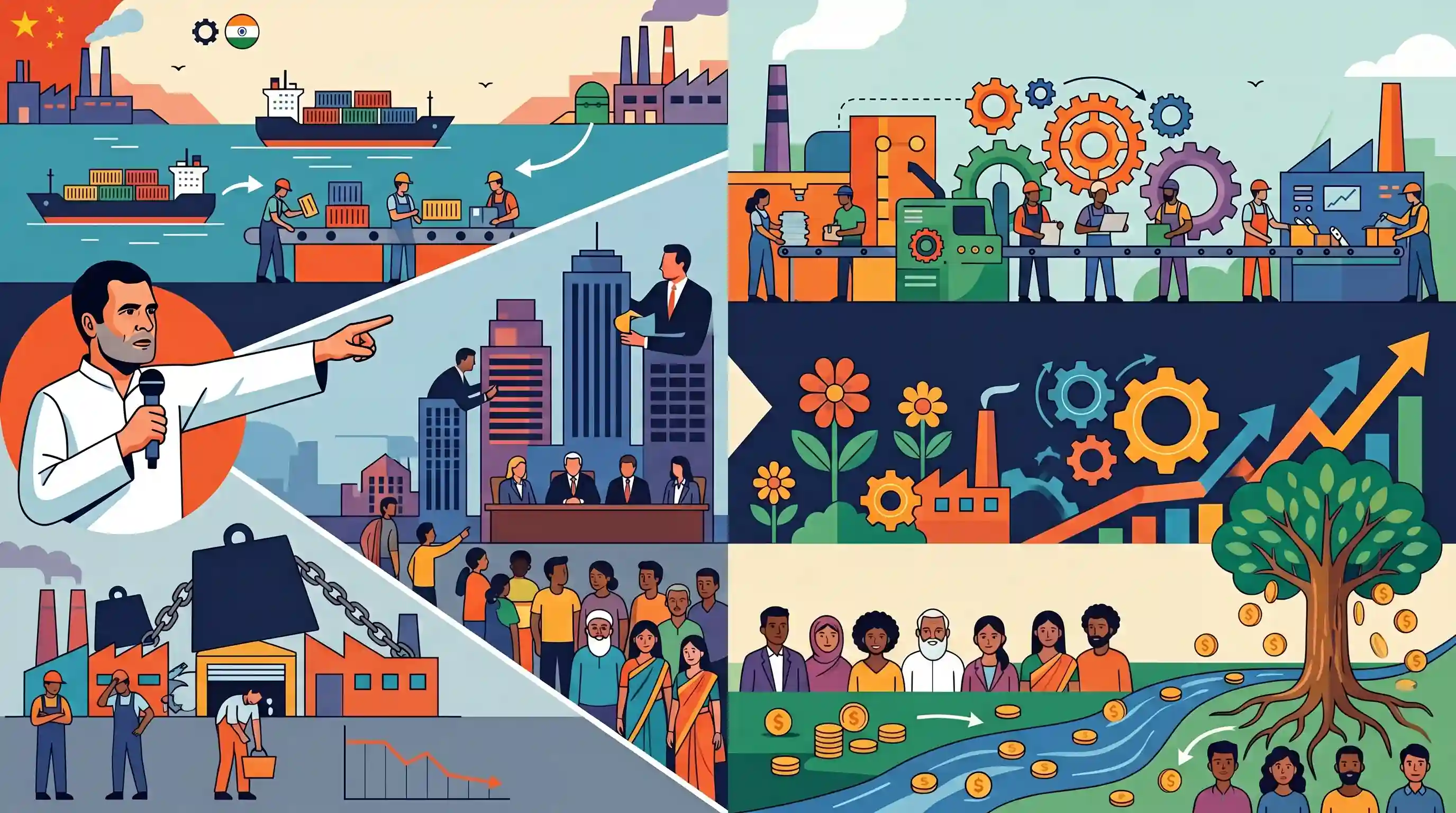
Leader of Opposition Rahul Gandhi recently critiqued the government's 'Make in India' initiative, arguing that it has largely been reduced to 'Assemble in India.' Speaking to business leaders, he emphasized the lack of domestic value addition, pointing out heavy reliance on Chinese imports for components. Gandhi linked the stagnation of job growth to the distress among Micro, Small, and Medium Enterprises (MSMEs), which he said are burdened by taxes and lack adequate policy support. Furthermore, he highlighted growing monopolies in key sectors and the acute under-representation of marginalized communities in corporate leadership, stressing that true economic manufacturing requires grassroots support and broad-based wealth distribution rather than focusing solely on large conglomerates.
Key Points
- Leader of Opposition Rahul Gandhi criticized the 'Make in India' initiative, stating it operates more like 'Assemble in India' due to high dependency on foreign parts, citing that 80% of components in Indian-assembled TVs are imported from China.
- He highlighted that true job creation requires strengthening MSMEs, which are currently struggling under heavy taxation and lack of government support, contrasting them with capital-intensive monopolies.
- He warned against the concentration of wealth and market power, noting that a few large corporations increasingly control critical infrastructure like ports, airports, and telecommunications.
- He raised concerns over the lack of social diversity in the corporate sector, pointing out that Dalits, Adivasis, and OBCs make up merely 1% of the management in India's top 200 companies.
Important Terms
Make in India

A 2014 initiative aiming to make India a global manufacturing hub, targeting a 25% GDP share for manufacturing and 100 million new jobs.
UPSC context
GS Paper 3: Industrial Policy; tests assessment of manufacturing reforms and self-reliance (Atmanirbhar Bharat).
Micro, Small and Medium Enterprises (MSMEs)
Businesses categorized by investment and turnover; they employ ~110 million people and contribute nearly 30% to India's GDP.
UPSC context
GS Paper 3: Economy; focuses on their role in employment, exports, and decentralized growth.
Assemble in India
A strategy to boost exports by focusing on the final assembly of products within global supply chains to create mass employment.
UPSC context
GS Paper 3: Economy/Exports; involves the debate over low-value vs high-value domestic manufacturing.
Inclusive Growth
Economic expansion that creates equitable opportunities for all, focusing on poverty reduction and broad-based wealth distribution.
UPSC context
GS Paper 3: Syllabus theme; tests strategies for socio-economic equity and reducing regional disparities.
Production Linked Incentive (PLI) Scheme
Incentives paid to domestic manufacturers based on incremental sales to encourage local production and reduce imports in key sectors.
UPSC context
GS Paper 3: Industrial Policy; central to discussions on manufacturing competitiveness and investment.
Jobless Growth
An economic condition where GDP grows while employment levels remain stagnant or decline, failing to absorb the growing workforce.
UPSC context
GS Paper 3: Employment; tests analysis of structural shifts and labor-market challenges in India.
Prelims Trap
The Government officially rejects the 'Assemble in India' model in favor of pure indigenous manufacturing under Atmanirbhar Bharat.
False. The Economic Survey 2019-20 actively advocated for "Assemble in India for the world" as a crucial strategy to integrate with Global Value Chains and boost job creation.
Static Concepts Connected
What is the revised composite classification criteria for MSMEs in India (2020)?
- Micro Enterprises: Investment in Plant & Machinery/Equipment up to Rs. 1 crore AND Annual Turnover up to Rs. 5 crore.
- Small Enterprises: Investment in Plant & Machinery/Equipment up to Rs. 10 crore AND Annual Turnover up to Rs. 50 crore.
- Medium Enterprises: Investment in Plant & Machinery/Equipment up to Rs. 50 crore AND Annual Turnover up to Rs. 250 crore.
How does the Production Linked Incentive (PLI) scheme promote domestic value addition?
- Incremental Sales Premium: It offers financial incentives (usually 4-6%) based purely on incremental sales of goods manufactured in India over a designated base year.
- Phased Localization: For several sectors (like electronics), PLI is tied to a Phased Manufacturing Programme (PMP) to gradually force companies to source components domestically rather than merely assembling.
Cross-Topic Patterns
GVC Integration vs Domestic Value Addition
The tension between importing cheap Chinese intermediates to scale exports (Global Value Chain integration) versus building deep-tier, sovereign manufacturing capabilities under Atmanirbhar Bharat.
Inclusive Growth & Corporate Governance
Marginalized under-representation in corporate boards links to ongoing GS2 debates on private sector affirmative action, ESG norms, and inclusive growth metrics.
Market Concentration and CCI Mandates
The political critique of monopolies directly touches upon the statutory role of the Competition Commission of India (CCI) in preventing the abuse of dominant market positions in infrastructure.

Expect a GS3 Mains question evaluating the 'Make in India' vs 'Assemble in India' debate, linking PLI outcomes to MSME job stagnation.
Linked PYQs · 4
Linked PYQs · 4
- 2025MainsGS3
Discuss the rationale of the Production Linked Incentive (PLI) scheme. What are its achievements? In what way can the functioning and outcomes of the scheme be improved?
- 2023MainsGS3
Faster economic growth requires increased share of the manufacturing sector in GDP, particularly of MSMEs. Comment on the present policies of the Government in this regard.
- 2017MainsGS3
Account for the failure of manufacturing sector in achieving the goal of labour-intensive exports. Suggest measures for more labour-intensive rather than capital-intensive exports.
- 2023PrelimsGS1
Consider the following statements: Statement-I: India accounts for 3.2% of global export of goods. Statement-II: Many local companies and some foreign companies operating in India have taken advantage of India's 'Production-linked Incentive' scheme. Which one of the following is correct in respect of the above statements?
