Caste Census Questionnaire Methodology Sparks Social Justice Debate
Source:The Hindu ↗
Why It Matters
The census methodology for capturing caste data has profound policy implications for reservations, affirmative action, and socio-economic planning. Debate over open-ended versus structured questionnaires highlights governance challenges in collecting accurate demographic data to serve constitutional mandates of social justice.
Summary
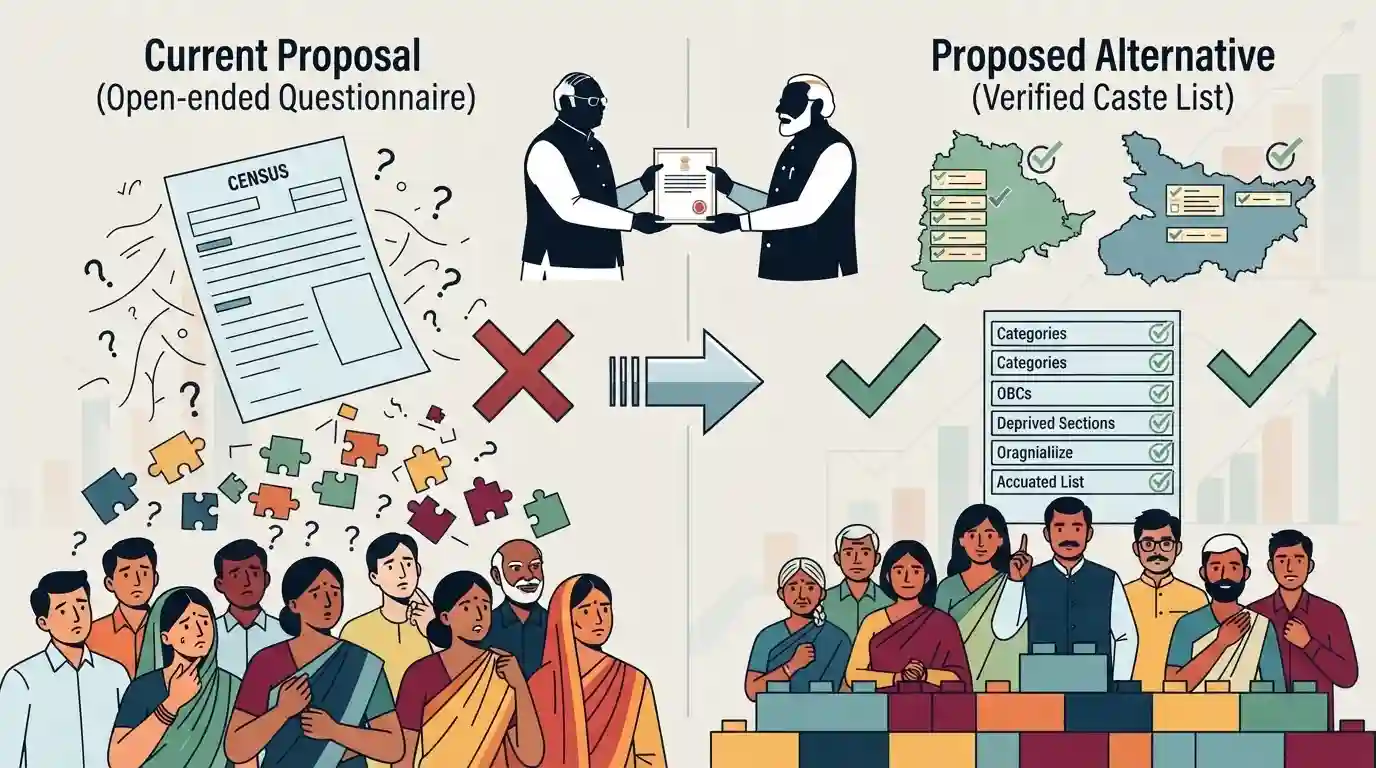
Congress President Mallikarjun Kharge and Leader of the Opposition Rahul Gandhi wrote a joint letter to Prime Minister Narendra Modi, urging the cancellation of the open-ended questionnaire format intended for caste enumeration in the upcoming Census. They argued that open-ended questions will result in fragmented and inaccurate data for OBCs and other deprived sections, recommending instead a pre-prepared, verified caste list modeled after the surveys in Telangana and Bihar to ensure robust social justice planning.
Key Points
- Congress leaders Mallikarjun Kharge and Rahul Gandhi wrote to Prime Minister Narendra Modi demanding a change in the upcoming Census methodology regarding caste enumeration.
- They requested the cancellation of the open-ended questionnaire format currently slated for collecting caste details, calling it highly flawed.
- They argued that open-ended questions will cause the same caste or sub-caste to be recorded under multiple names and spellings, resulting in scattered, unreliable, and fragmented demographic data.
- Such data deficiencies would systematically undermine the policy planning, affirmative action, and social justice targeted at OBCs and other marginalized sections.
- They suggested instead the implementation of a structured, pre-prepared, and verified caste list, citing the successful execution of caste-based surveys in Telangana and Bihar.
Important Terms
Caste Census

A systematic demographic survey collecting population data based on caste identity and socio-economic status. It maps social inequalities, providing empirical evidence to improve targeted welfare, affirmative action, and equitable resource distribution.
UPSC context
GS Paper 1 (Society) & GS Paper 2 (Social Justice). Tests debates on social equity, reservation limits, and data-driven governance.
Census of India
A comprehensive nationwide enumeration of demographic, economic, and social data conducted under the Census Act, 1948. It serves as the foundational database for policymaking, constituency delimitation, and welfare administration.
UPSC context
GS Paper 1 (Population) & GS Paper 2 (Governance). Tests administrative methodology, digital governance shifts, and demographic planning.
Other Backward Classes (OBCs)
A collective constitutional term for socially and educationally backward classes facing historical disadvantage, distinct from SCs/STs. Safeguarded under Articles 15 and 16, they receive 27% reservation in public employment and education.
UPSC context
GS Paper 2 (Social Justice). Tests understanding of affirmative action, constitutional protections, and ongoing debates over sub-categorization and quotas.
Prelims Trap
The Socio-Economic Caste Census (SECC) 2011 successfully published the exact national population of all OBCs.
While SECC 2011 collected caste data, it yielded 46 lakh unstandardised caste names. The Union government never officially published this raw caste data due to massive fragmentation and inaccuracies.
Static Concepts Connected
How does the SECC legally differ from the regular decadal Census?
- Legal Backing: The decadal Census is conducted under the Census Act of 1948, whereas the SECC does not share this exact statutory backing.
- Data Confidentiality: Regular Census data is strictly confidential under the Act. Conversely, SECC data is meant to be open for government departments to identify beneficiaries or restrict benefits.
- Core Objective: The Census provides a macro demographic snapshot, whereas the SECC is a targeted exercise to identify specific households for state welfare support.
What are the constitutional bases for identifying and sub-categorising backward classes?
- Article 340: Empowers the President to appoint a commission to investigate the conditions of socially and educationally backward classes (e.g., the Justice G. Rohini Commission).
- Articles 15(4) & 16(4): These articles enable the State to make special provisions and reservations in education and public employment for socially and educationally backward classes.
Cross-Topic Patterns
State-led Surveys vs. Union Census limits
States like Bihar invoke the Collection of Statistics Act to conduct 'surveys', since 'Census' is strictly a Union subject (Entry 69, List I). This tests federal limits in demographic data collection.
Rohini Commission & Quota Sub-categorisation
Data fragmentation directly undermines the Justice Rohini Commission's mandate, which aims to equitably redistribute the 27% OBC quota among thousands of historically marginalized sub-castes based on accurate population shares.

Expect a multi-statement question contrasting the statutory backing of the Union Census (Entry 69) with SECC and state-led caste surveys.
Linked PYQs · 1
Linked PYQs · 1
- 2022MainsGS2
Discuss the role of the National Commission for Backward Classes in the wake of its transformation from a statutory body to a constitutional body.
