India US Trade Framework and Strategic Autonomy Concerns
Source:Indian Express ↗
Why It Matters
The political discourse highlights significant structural issues in India's international trade negotiations. It touches upon critical UPSC themes such as navigating global protectionism, protecting vulnerable domestic sectors (agriculture and textiles) during bilateral agreements, ensuring data sovereignty in the digital age, and maintaining strategic autonomy in energy procurement amid external pressures.
Summary
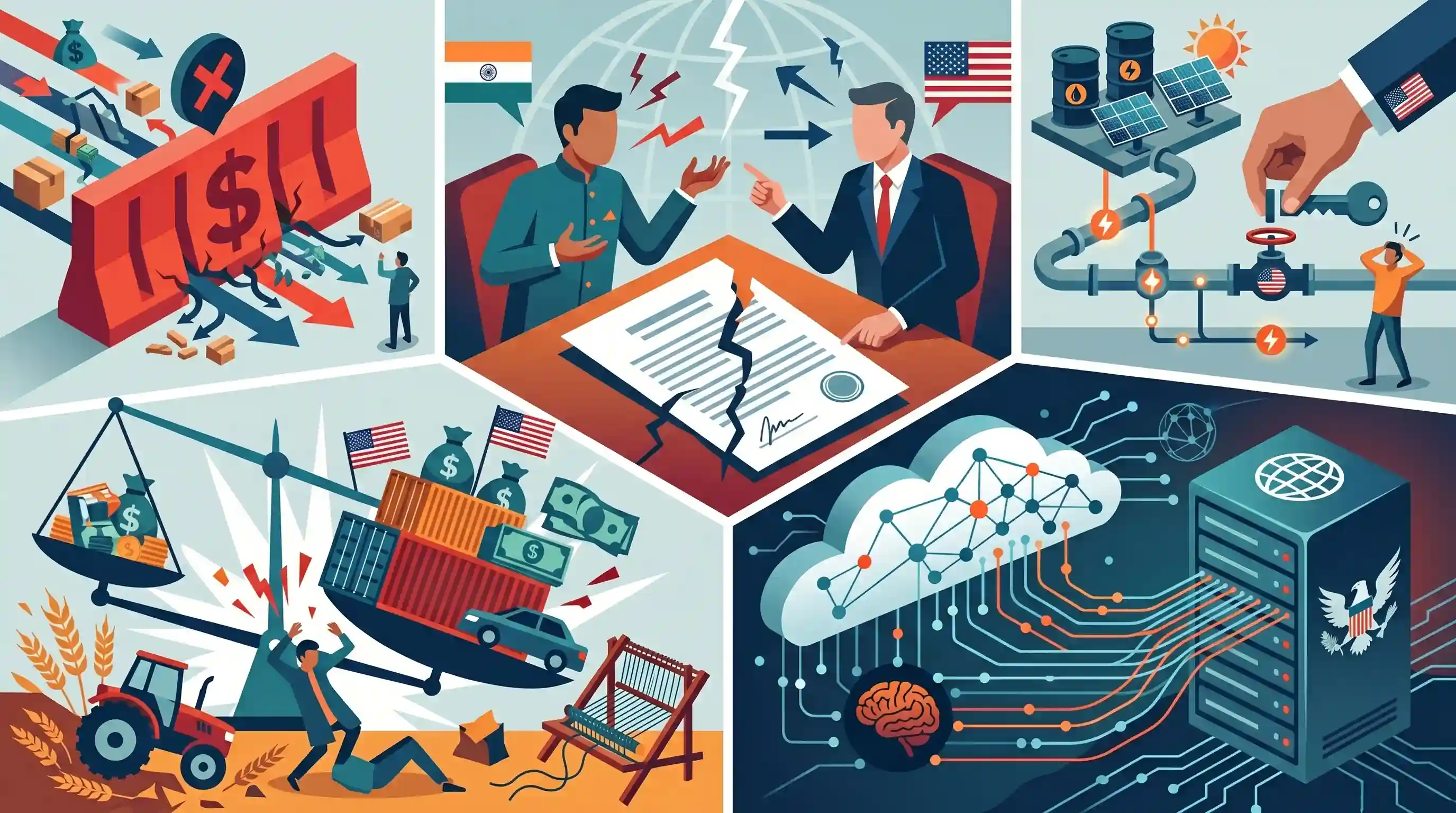
Rahul Gandhi strongly criticized Prime Minister Narendra Modi over India's perceived capitulation in the interim US-India trade framework, negotiated in the wake of US President Donald Trump's imposition of new 10% global tariffs. Gandhi alleged that the agreement opens the door to $100 billion in American imports, which would heavily damage India's agricultural and textile sectors. Furthermore, he warned that the deal compromises India's strategic autonomy by giving the US leverage over India's oil import choices—threatening energy security—and by forfeiting data control, potentially reducing India to a "data colony."
Key Points
- Congress leader Rahul Gandhi criticized PM Narendra Modi, claiming India "surrendered" to the US in the interim bilateral trade framework following Donald Trump's new 10% global tariffs.
- Gandhi alleged the framework allows $100 billion of American imports into India, which could threaten domestic agriculture by exposing farmers to massive US agribusinesses, and potentially wipe out the Indian textile industry.
- He raised data sovereignty concerns, arguing that India is forfeiting data control to the US and risking becoming a "data colony."
- Gandhi warned that the deal undermines India's energy security and strategic autonomy by allowing the US to dictate India's oil import choices.
Important Terms
Section 122 of the Trade Act of 1974

A U.S. law provision allowing the President to impose temporary import surcharges (up to 15%) for 150 days to address serious balance-of-payments deficits.
UPSC context
GS-II/III (International Relations/Economy); tests understanding of global trade laws and executive powers affecting Indian exports.
Strategic Autonomy
The doctrine of a nation taking independent foreign policy and security decisions based on national interest without being constrained by external pressures or alliance obligations.
UPSC context
GS-II (International Relations); central to India's foreign policy evolution from Non-Alignment to Multi-alignment.
Data Colony (Data Colonialism)
A conceptual framework where a nation's data is extracted and controlled by foreign entities/corporations, leading to a loss of digital sovereignty and economic value.
UPSC context
GS-III (IT & Cybersecurity); relevant to discussions on data localization, privacy, and the digital economy.
Energy Security
Ensuring the uninterrupted availability of energy sources at an affordable price while maintaining sovereign control over import choices and supply chains.
UPSC context
GS-III (Infrastructure/Energy); involves balancing import dependencies with strategic independence in the energy sector.
Trade Protectionism
Government policies that restrict international trade to help domestic industries, often through tariffs, quotas, or subsidies to discourage foreign competition.
UPSC context
GS-III (Economy); analyzes the impact of global trade barriers on India's GDP and domestic manufacturing (Atmanirbhar Bharat).
India-US Trade Agreement Framework
An evolving bilateral arrangement aimed at resolving tariff disputes and enhancing market access in sectors like agriculture, dairy, and digital trade.
UPSC context
GS-II (Bilateral Relations); covers critical negotiations impacting India’s primary and secondary sectors.
Prelims Trap
"India enforces strict data localization, mandating all digital data be processed domestically to prevent data colonialism."
The DPDP Act 2023 actually adopted a 'negative list' approach, permitting cross-border data flows to all jurisdictions except those specifically restricted by the Centre, abandoning strict localization.
Static Concepts Connected
How does the DPDP Act 2023 regulate cross-border data transfers?
- Negative List Approach: Allows the transfer of personal data outside India except to countries specifically blacklisted by the Central government (the negative list).
- Sectoral Exceptions: Specific sectoral regulators (like the RBI for payments data) can still enforce stricter data localization rules independent of the DPDP Act.
- Sovereignty Risks: While cross-border transfer is allowed, processing by foreign entities may subject Indian data to foreign surveillance laws, triggering sovereignty concerns.
What are the three pillars of the WTO Agreement on Agriculture (AoA)?
- Market Access: Requires the 'tariffication' of non-tariff barriers and commitments to progressively reduce customs duties on agricultural imports.
- Domestic Support: Categorizes subsidies into Green, Blue, and Amber boxes, mandating limits on trade-distorting (Amber Box) subsidies like MSP.
- Export Competition: Requires member nations to reduce direct export subsidies, though advanced economies historically benefited from massive agribusiness support before these rules.
Cross-Topic Patterns
Trade alliances vs. Energy Security
Pressures to restrict specific oil imports mirror earlier CAATSA threats, demonstrating how trade agreements are increasingly weaponized to limit India's multi-aligned energy procurement and strategic autonomy.
Data Colonialism in Free Trade
The "data colony" critique bridges GS-3 cybersecurity and GS-2 IR, paralleling debates at the WTO regarding e-commerce customs moratoriums and the Global South's digital market access.

US protectionism (tariffs) clashing with India's data sovereignty and agricultural defenses is highly likely to form a 15-marker in GS-2.
Linked PYQs · 4
Linked PYQs · 4
- 2025MainsGS3
What are the challenges before the Indian economy when the world is moving away from free trade and multilateralism to protectionism and bilateralism? How can these challenges be met?
- 2014MainsGS2
The aim of Information Technology Agreements (ITAs) is to lower all taxes and tariffs on information technology products by signatories to zero. What impact would such agreements have on India's interests?
- 2018MainsGS3
Data security has assumed significant importance in the digitized world due to rising cyber crimes. The Justice B. N. Srikrishna Committee Report addresses issues related to data security. What, in your view, are the strengths and weaknesses of the Report relating to protection of personal data in cyber space?
- 2023MainsGS3
What are the direct and indirect subsidies provided to farm sector in India? Discuss the issues raised by the World Trade Organization (WTO) in relation to agricultural subsidies.
