Supreme Court Plea on Election Commission Functions
Source:Indian Express ↗
Why It Matters
It highlights the vital constitutional dynamics between independent bodies like the Election Commission of India and the judiciary, addressing accountability and judicial review in electoral matters.
Summary
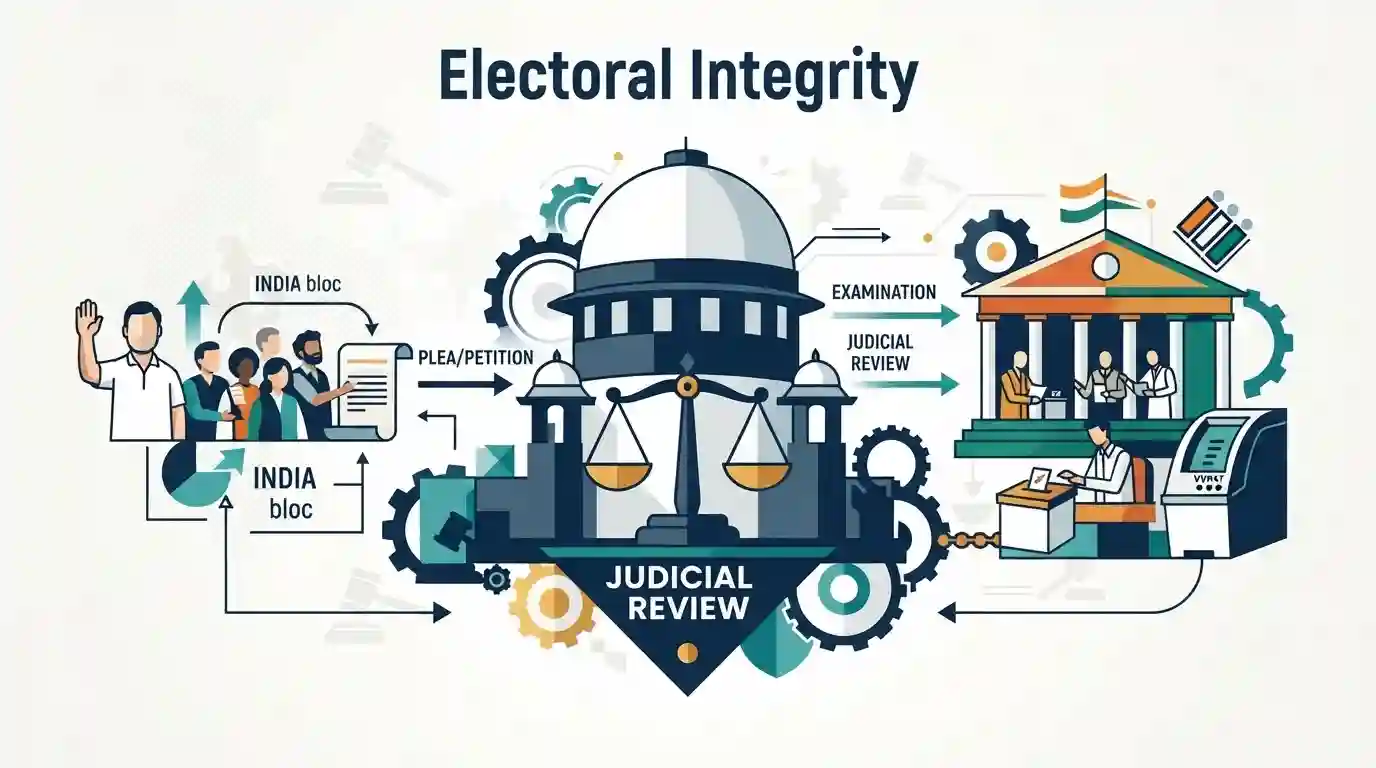
The Supreme Court has agreed to examine a plea filed by Congress leader Rahul Gandhi and the INDIA bloc questioning certain procedures and actions of the Election Commission. This brings to the fore crucial questions regarding the judicial review of independent constitutional bodies, electoral integrity, and the checks and balances inherent in India's democratic framework.
Key Points
- The Supreme Court agreed to hear a plea challenging the Election Commission's Special Intensive Revision (SIR) or related electoral roll issues raised by Rahul Gandhi and the INDIA bloc.
- The petition questions the administrative and procedural actions of the Election Commission, touching upon the scope of judicial review over constitutional bodies.
- Highlights the ongoing debates around electoral integrity, transparency, and the institutional checks and balances between constitutional functionaries and the judiciary.
Important Terms
Supreme Court of India

The apex judicial tribunal of India, empowered under Article 132-145 and Article 32 to interpret the Constitution, protect fundamental rights, and exercise judicial review over executive and legislative actions.
UPSC context
UPSC GS Paper II (Polity and Governance): Structure, organization, and functioning of the Judiciary and its powers of judicial review.
Election Commission of India
An autonomous constitutional authority established under Article 324 of the Constitution to administer elections to Lok Sabha, Rajya Sabha, State Legislative Assemblies, and offices of the President and Vice-President.
UPSC context
UPSC GS Paper II (Polity and Governance): Appointment to various constitutional posts, powers, functions, and responsibilities of constitutional bodies.
INDIA bloc
An opposition political coalition in India formed by various regional and national parties to challenge the ruling alliance in national elections.
UPSC context
UPSC GS Paper II (Polity and Governance / Representation of People's Act): Role of political parties, coalitions, and democratic accountability.
Prelims Trap
As an independent constitutional body under Article 324, the administrative and procedural decisions of the Election Commission of India are entirely immune to judicial review.
The ECI's administrative actions and electoral roll revisions are subject to judicial review by the Supreme Court, despite its independent constitutional status under Article 324.
Static Concepts Connected
What are the constitutional provisions governing the independence and powers of the Election Commission of India?
- Article 324:: Article 324 vests superintendence, direction, and control of elections in the ECI, an independent constitutional body.
- Tenure Safety:: Article 324(5) provides the Chief Election Commissioner security of tenure, removable only in like manner and grounds as a Supreme Court judge.
- Plenary Powers:: The Supreme Court has repeatedly held that ECI's plenary powers cannot override existing parliamentary laws but can fill legislative vacuums.
Cross-Topic Patterns
Judicial Review vs. Constitutional Autonomy
Judicial scrutiny of the ECI under Article 324 tests the delicate separation of powers between independent constitutional bodies and apex court judicial review.

Expect a statement-based prelims question on the plenary powers of the ECI under Article 324 vis-à-vis the scope of judicial review.
Linked PYQs · 1
Linked PYQs · 1
- 2022MainsGS2
Discuss the role of the Election Commission of India in the light of the evolution of the Model Code of Conduct.
