Tribal protests emerge against Ken Betwa river linking project
Source:tbs-news ↗
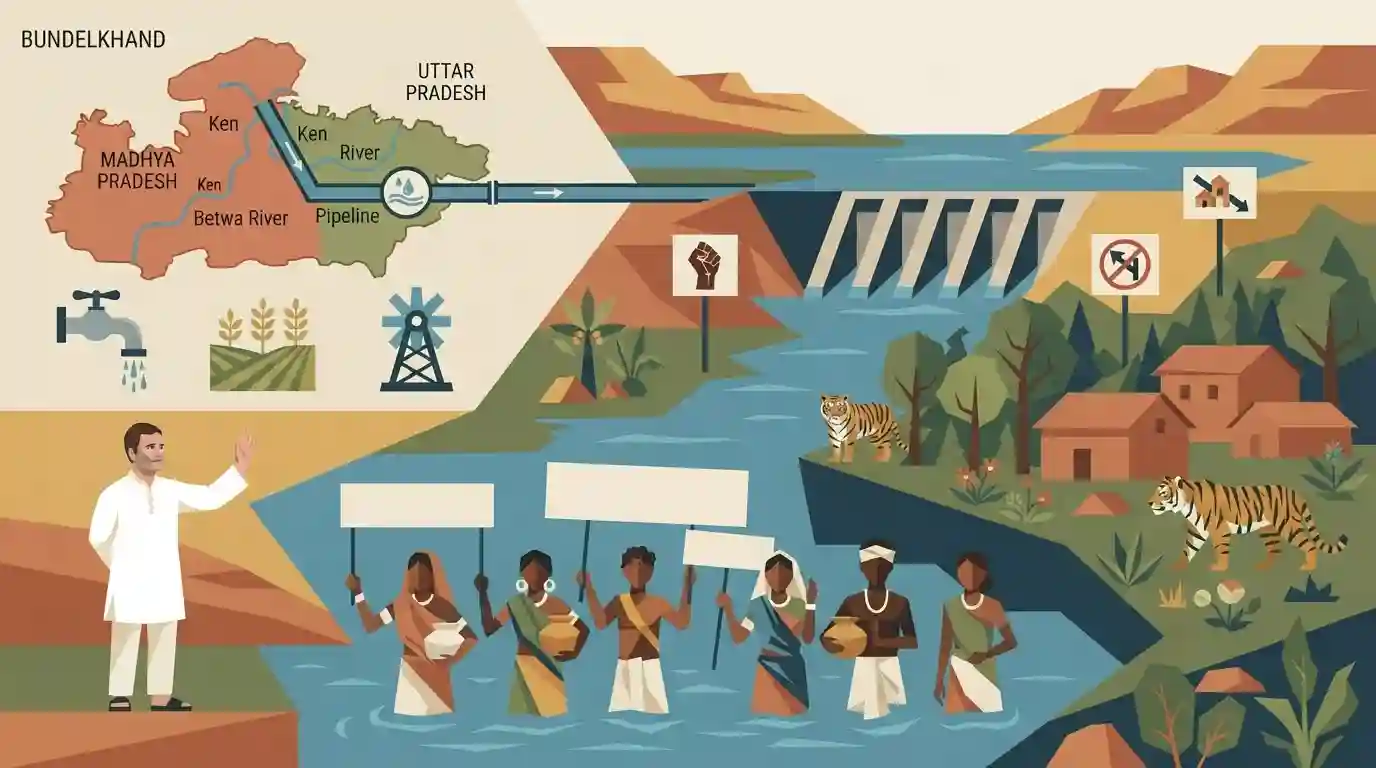
Why It Matters
The Ken-Betwa river interlinking project is India's first inter-basin transfer project and is highly relevant to MPPSC Prelims for questions concerning the geography of Madhya Pradesh (Ken and Betwa rivers), regional infrastructure in Bundelkhand, and the socio-economic impact of development on tribal populations and protected areas like the Panna Tiger Reserve.
Summary
Leader of Opposition Rahul Gandhi has pledged his support for tribal communities protesting against the Ken-Betwa river-linking project in Madhya Pradesh. This Rs 44,605 crore initiative is India's first inter-basin river-linking project, designed to irrigate 1.062 million hectares, provide drinking water, and generate 130 MW of hydropower in the parched Bundelkhand region spanning Madhya Pradesh and Uttar Pradesh. However, the project threatens to displace approximately 3,800 families and submerge significant portions of the Panna Tiger Reserve. In response, tribal residents in Chhatarpur district have initiated a 'water satyagraha', demanding fair compensation, land for rehabilitation, and access to basic amenities.
Key Points
- Leader of Opposition Rahul Gandhi has backed tribal communities in Madhya Pradesh protesting the Ken-Betwa river-linking project.
- The Rs 44,605 crore initiative is India's first inter-basin river-linking project, intended to benefit the parched Bundelkhand region.
- The project aims to irrigate 1.062 million hectares, supply drinking water, and generate 130 MW of hydropower.
- It is estimated to displace around 3,800 families and submerge parts of the Panna Tiger Reserve.
- Tribals in the Chhatarpur district are staging a 'water satyagraha', demanding fair compensation and adequate rehabilitation.
Important Terms
Ken-Betwa river-linking project

India's first inter-basin river-linking project under the National Perspective Plan, transferring surplus water from the Ken River in Madhya Pradesh to the Betwa River in Uttar Pradesh.
UPSC context
Crucial for GS-1 (Geography) and GS-3 (Environment), illustrating water management, inter-state cooperation, and ecological impacts.
Bundelkhand region
A drought-prone, semi-arid plateau spanning southern Uttar Pradesh and northern Madhya Pradesh, characterized by rocky terrain, erratic rainfall, and severe water scarcity.
UPSC context
Relevant for GS-1 (Geography) and GS-3 (Agriculture) regarding arid region challenges, frequent droughts, and water conservation strategies.
Panna Tiger Reserve
A vital tiger habitat and UNESCO Biosphere Reserve in Madhya Pradesh's Vindhyan range. The Ken River flows through it, and significant portions face submergence from the Ken-Betwa project.
UPSC context
Highly tested in Prelims and GS-3 (Environment) regarding protected areas, biodiversity, and development versus conservation debates.
Jal Satyagraha (Water Satyagraha)
A non-violent protest where demonstrators stand waist-deep in water to oppose forced displacement, land acquisition, or ecologically destructive infrastructure projects without adequate rehabilitation.
UPSC context
Important for GS-2 (Social Justice) involving tribal rights, rehabilitation policies, and grassroots democratic movements.
Interlinking of Rivers (ILR)
A large-scale civil engineering initiative aimed at transferring water from surplus river basins to water-deficit regions through a planned network of canals, reservoirs, and dams.
UPSC context
A frequent GS-1 and GS-3 topic testing the geographical, ecological, and socio-economic impacts of altering natural river basins.
Prelims Trap
The Ken-Betwa project transfers surplus water from the Betwa river basin to the water-deficit Ken river basin to irrigate the Bundelkhand region.
The project actually transfers surplus water from the Ken basin to the water-deficit Betwa basin. Both are right-bank tributaries of the Yamuna, not left-bank.
Static Concepts Connected
What is the National Perspective Plan (NPP) for water resources?
- Origin and Mandate: Formulated in 1980 to address regional water imbalances by transferring water from surplus to deficit basins.
- Two Components: Divided into the Himalayan Rivers Development Component (14 links) and the Peninsular Rivers Development Component (16 links).
- Implementing Agency: The National Water Development Agency (NWDA) carries out feasibility studies and prepares detailed project reports.
What are the key ecological features of the Panna Tiger Reserve?
- Geographical Location: Situated in the Vindhyan Hills of Madhya Pradesh, characterized by dry deciduous forests and deep gorges.
- Hydrological Lifeline: The Ken River flows south-to-north through the reserve, sustaining its rich wildlife and a dedicated Gharial Sanctuary.
- Global Recognition: Designated as a UNESCO Biosphere Reserve in 2020, representing the delicate central Indian plateau ecosystem.
Cross-Topic Patterns
Infrastructure vs. Tribal Rights
Examines the conflict between development and the PESA Act 1996, where tribal consent through Gram Sabhas is constitutionally mandated before land acquisition in Schedule V areas.
EIA and Environmental Jurisprudence
Analyses how river-linking impacts critical habitats, triggering legal battles under the Wildlife Protection Act and testing the "Ecological Public Trust" doctrine in Supreme Court rulings.

Ken-Betwa's physical geography (Yamuna tributaries, flow direction) and its impact on Panna reserve are highly probable 2026 prelims topics.
Linked PYQs · 4
Linked PYQs · 4
- 2021MPPSC_PRELIMSGS1
| List-I (Tributaries) | List-II (Rivers) | |---------------------|----------------| | A. Betwa | ii. Yamuna | | B. Kshipra | iii. Narmada | | C. Vainganga | iv. Godavari | | D. Tawa | i. Chambal | Codes:
- 2008MPPSC_PRELIMSGS1
Which of the following rivers does not fall into river Yamuna?
- 2020MPPSC_PRELIMSGS1
Betwa river originate from
- 2025MPPSC_PRELIMSGS1
How many total major and medium Integrated Tribal Development Projects are in existence in Madhya Pradesh in 2023-24?
