Anti Paper Leak Legislation and Student Protests
Source:Indian Express ↗
આ શા માટે મહત્વનું છે
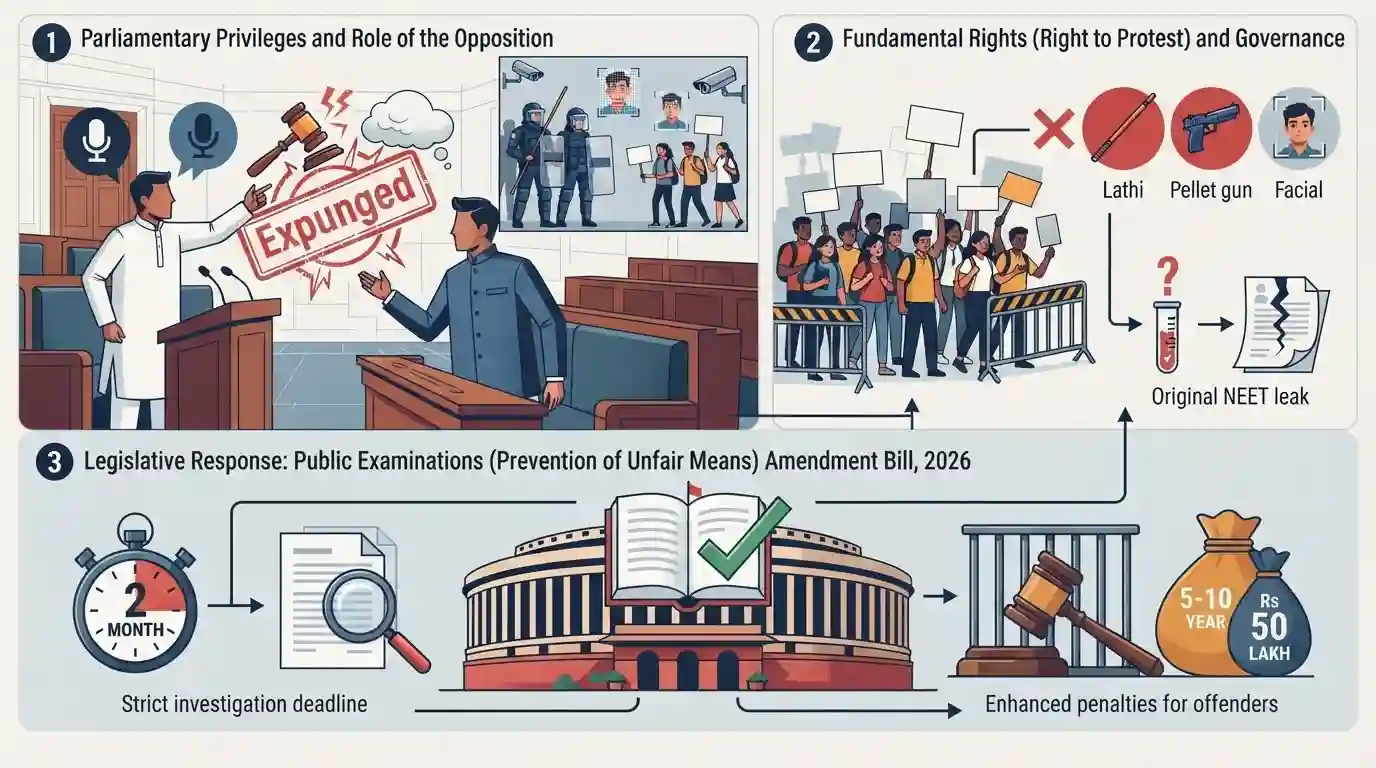
The article combines key GS2 themes: parliamentary proceedings (expunging remarks, role of LoP), civil liberties (right to peaceful protest vs. police use of surveillance tech like FRT), and critical governance measures (the new anti-paper leak legislation to restore faith in public exams). It provides contemporary examples for answers on Article 105 (Parliamentary privileges) and state responses to democratic protests.
સારાંશ
The article details the political fallout and legislative response following protests against the NEET paper leak. Leader of Opposition Rahul Gandhi heavily criticised Home Minister Amit Shah for the police crackdown on protesting students—which involved lathis, pellet guns, and facial recognition technology—demanding his resignation. Gandhi's remarks were expunged in the Lok Sabha, sparking debate over parliamentary privileges and freedom of speech. Amidst the protests, Parliament passed the Public Examinations (Prevention of Unfair Means) Amendment Bill, 2026. The new legislation aims to ensure exam integrity by setting a strict two-month investigation deadline for paper leaks and enhancing penalties to 5-10 years in prison alongside a Rs 50 lakh fine.
મુખ્ય મુદ્દા
- Leader of Opposition Rahul Gandhi demanded the resignation of Home Minister Amit Shah following police crackdowns on students protesting the NEET paper leak.
- Protesting students part of the 'Chalo Sansad' march faced police action involving lathi charges, nails, and surveillance technology like Facial Recognition Technology (FRT).
- Gandhi's remarks concerning the Home Minister were expunged from parliamentary records, raising issues of parliamentary privileges and freedom of speech within the House.
- Parliament passed the Public Examinations (Prevention of Unfair Means) Amendment Bill, 2026, introducing stricter penalties for exam malpractices.
- The 2026 Bill mandates a two-month deadline for investigating paper leaks and increases the punishment to 5-10 years imprisonment with a fine of Rs 50 lakh.
મહત્વપૂર્ણ શબ્દો
Public Examinations (Prevention of Unfair Means) Amendment Bill, 2026

A proposed 2026 legislation introducing stricter penalties, expanding the definition of unfair means, and setting a two-month investigation deadline to combat organized paper leaks and malpractices in public exams.
UPSC context
Crucial for GS Paper II (Governance); highlights legislative responses to systemic exam leaks and ensures accountability of national recruiting agencies.
Public Examinations (Prevention of Unfair Means) Act, 2024
Central legislation enacted to curb malpractices like question paper leaks and digital impersonation in national recruitment tests, imposing stringent punishments including heavy fines and imprisonment.
UPSC context
Relevant for GS Paper II (Government Policies); serves as the foundational framework to establish transparency, ethics, and merit in India's examination system.
National Eligibility cum Entrance Test (NEET)
A unified, nationwide standardized examination conducted by the National Testing Agency (NTA) for admission to undergraduate medical, dental, and AYUSH courses across India.
UPSC context
Important for GS Paper II (Education/Governance); paper leaks and frequent disruptions raise questions regarding institutional capability, federalism, and regulatory oversight.
Parliament
The supreme legislative body of India. Its members possess specific parliamentary privileges under Article 105, protecting their freedom of speech from external legal proceedings to ensure independent functioning.
UPSC context
Core GS Paper II topic (Polity); frequently tests the balance between fundamental rights, legislative privileges, and accountability of opposition leaders.
Lok Sabha
The lower house of India's bicameral Parliament. The Speaker exercises significant authority here, including the discretionary power to expunge unparliamentary or defamatory remarks from official legislative records.
UPSC context
Essential for GS Paper II (Parliamentary Conduct of Business); emphasizes the Speaker's powers, procedural rules, and the functioning of the legislature.
પ્રિલિમ્સ ટ્રેપ
The 10% seat requirement for the Leader of Opposition post is codified under the Salary and Allowances of Leaders of Opposition Act, 1977.
The 10% rule originates from a ruling by India's first Speaker G.V. Mavalankar, codified in Direction 121, not in the 1977 Act itself.
સંલગ્ન સ્થિર ખ્યાલો
How is parliamentary speech regulated under the Constitution and House Rules?
- Constitutional Immunity: Article 105(2) grants absolute legal immunity to MPs for statements made inside the House from court proceedings.
- Speaker's Discretion: Under Lok Sabha Rule 380, the Speaker has the discretionary power to order expungement of defamatory, indecent, or unparliamentary words.
What is the statutory and functional status of the Leader of Opposition (LoP)?
- Statutory Origin: Formally recognized under the Salary and Allowances of Leaders of Opposition in Parliament Act, 1977, carrying Cabinet Minister status (7th in Precedence).
- Panel Memberships: Acts as a vital member of high-level selection panels for statutory watchdogs like the Lokpal, CBI, CVC, and NHRC.
આંતર-વિષય પેટર્ન
FRT surveillance and Article 19
Police use of Facial Recognition Technology (FRT) during student protests intersects with privacy rights and the fundamental freedom to assemble peacefully under Article 19.
Centralized testing and cooperative federalism
Centralized examination controversies (like NEET) highlight friction between national standards and state autonomy in managing education under the Concurrent List.

Statutory basis of LoP, Speaker's Rule 380 powers, and selection panel roles are highly likely to feature in a 2026 multi-statement MCQ.
સંલગ્ન PYQ · 3
સંલગ્ન PYQ · 3
- 2014MainsGS2
The 'Powers, Privileges and Immunities of Parliament and its Members' as envisaged in Article 105 of the Constitution leave room for a large number of un-codified and un-enumerated privileges to continue. Assess the reasons for the absence of legal codification of the 'parliamentary privileges'. How can this problem be addressed ?
- 2023MainsGS3
Introduce the concept of Artificial Intelligence (AI). How does Al help clinical diagnosis? Do you perceive any threat to privacy of the individual in the use of Al in healthcare?
- 2023MainsGS2
Discuss the role of Presiding Officers of state legislatures in maintaining order and impartiality in conducting legislative work and in facilitating best democratic practices.
