Parliament witnesses uproar over India US trade agreement
Source:The Hindu ↗
Why It Matters
This development is crucial for UPSC aspirants as it bridges International Relations (FTAs, bilateral trade deals) with domestic polity (Parliamentary accountability, role of the Opposition). It highlights the domestic political sensitivities surrounding agricultural tariffs and the broader implications of trade agreements on national sovereignty and economic security.
Summary
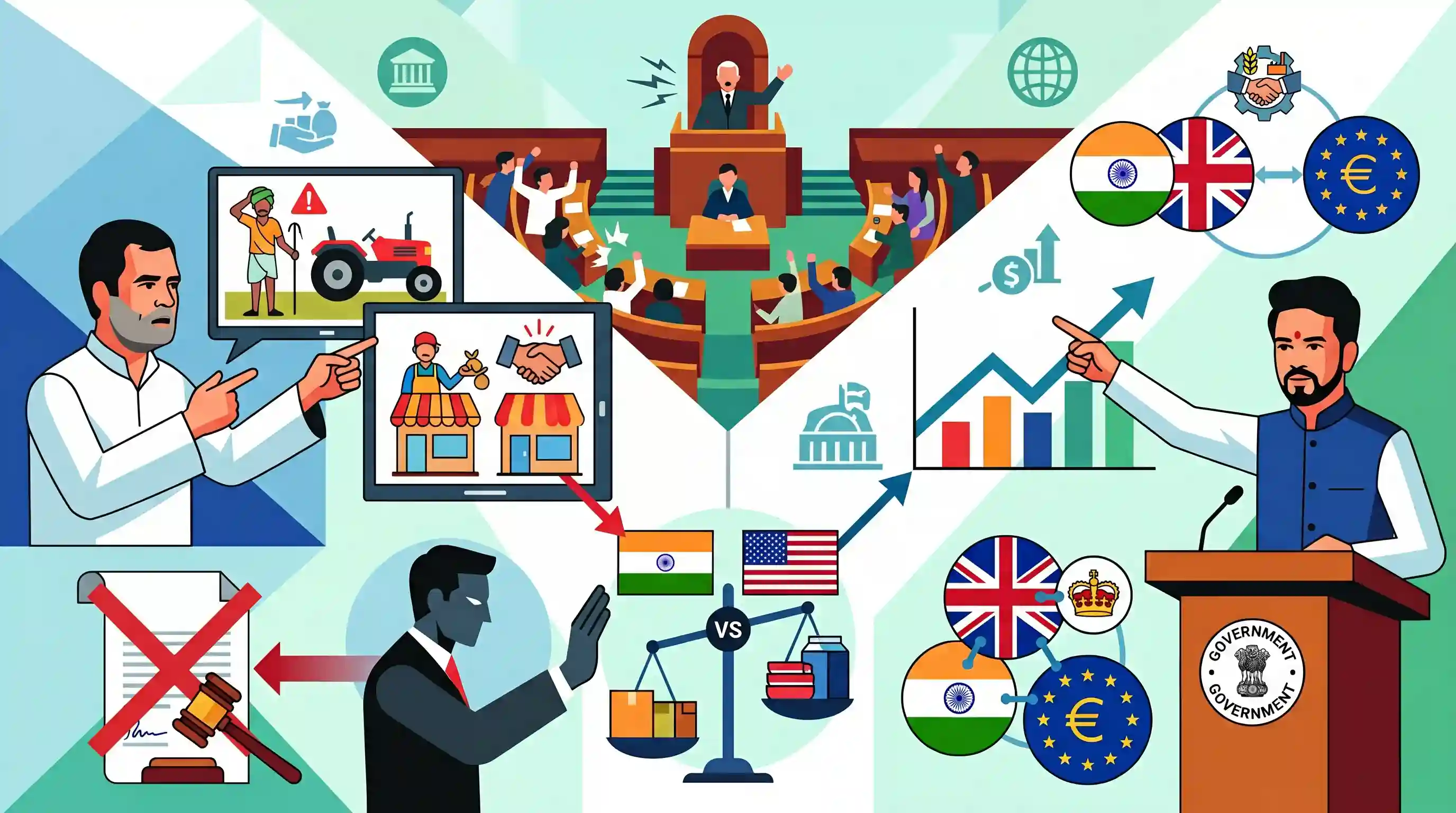
Leader of the Opposition Rahul Gandhi strongly criticized Prime Minister Narendra Modi over a newly signed India-US trade deal, alleging it compromises the interests of Indian farmers and small businesses in favor of US exporters. Gandhi insinuated that external pressures, citing the US indictment of Gautam Adani, influenced the government's capitulation on tariffs. In response, BJP MP Anurag Thakur defended the administration's trade policies, including FTAs with the UK and EU, and accused the Congress of harboring an 'anti-India mindset'. The heated exchange caused significant disruptions in the Lok Sabha, bringing to the fore the intersection of international trade policy, domestic economic priorities, and parliamentary accountability.
Key Points
- Rahul Gandhi accused PM Modi of compromising India's economic interests, specifically affecting farmers and small businesses, to sign a trade deal with the US.
- The Congress party alleged that the deal provides non-reciprocal tariff relief to US exporters, attributing the compromise to external pressures involving Gautam Adani's US indictment.
- BJP leader Anurag Thakur defended the government's track record on FTAs (citing agreements with the UK and EU) and labeled the Congress's opposition as reflecting an 'anti-India mindset'.
- The intense political face-off led to massive disruptions in the Lok Sabha, highlighting the role and challenges of parliamentary functioning in holding the executive accountable on international treaties.
Important Terms
India-US Bilateral Trade Agreement (BTA)

A strategic 2026 economic reset lowering U.S. tariffs on Indian goods to 18% in exchange for India reducing energy imports from Russia and easing market access for U.S. agricultural and tech sectors.
UPSC context
GS Paper II (International Relations); GS Paper III (Economy). Tests understanding of bilateral diplomacy, trade diversification, and strategic autonomy vs. economic interest.
Free Trade Agreements (FTAs)
Agreements between two or more countries to reduce or eliminate trade barriers (tariffs and quotas) to encourage the flow of goods and services across borders.
UPSC context
GS Paper III (Economy). Evaluates knowledge of trade policy, WTO compliance (Article XXIV of GATT), and the impact on domestic sectors like agriculture and MSMEs.
Lok Sabha
The lower house of India's Parliament where the executive is held accountable through debates, motions, and questions regarding major policy decisions like international trade deals.
UPSC context
GS Paper II (Polity). Tests understanding of the structure and functioning of Parliament and the executive's responsibility to the legislature.
Leader of the Opposition (LoP)
A statutory post held by the leader of the largest opposition party in either house, responsible for scrutinizing government policy and ensuring executive accountability in a parliamentary democracy.
UPSC context
GS Paper II (Polity). Tests knowledge of constitutional and statutory roles that provide checks and balances within the Indian parliamentary system.
Reciprocal Tariff
A trade policy where a country applies the same tariff rates on another country's imports that the other country applies on its own, aiming for parity in market access.
UPSC context
GS Paper III (Economy). Relevant for understanding transactional diplomacy, global trade wars, and the 'Most Favoured Nation' principle in international trade law.
Parliamentary Accountability
The constitutional principle where the Cabinet is collectively responsible to the Lok Sabha, exercised through parliamentary committees, debates on treaties, and questioning of ministerial decisions.
UPSC context
GS Paper II (Governance/Polity). Focuses on the oversight mechanisms of the legislature over executive-led foreign policy and international agreements.
Prelims Trap
"International trade agreements signed by the Executive require prior parliamentary ratification to become legally valid."
In India, the Executive negotiates and signs treaties under Article 73. Prior parliamentary approval is not required; Parliament's role comes via Article 253 to enact implementing laws.
Static Concepts Connected
What is the constitutional framework for international treaties in India?
- Executive Power (Art 73): Under Article 73, the Union Executive has the authority to negotiate and sign international treaties without requiring prior legislative approval.
- Legislative Role (Art 253): Under Article 253, Parliament holds the exclusive power to enact domestic legislation necessary to implement these international agreements.
How do developing countries protect sensitive domestic sectors in FTAs?
- Negative Lists: Items are placed on a 'negative list' to exclude them from tariff reduction commitments, shielding sectors like agriculture from subsidized imports.
- Non-Reciprocal Tariffs: Developing nations utilize Special and Differential Treatment (S&DT) to secure asymmetric tariff cuts, allowing them to lower duties slower than developed partners.
Cross-Topic Patterns
FTAs vs. Domestic Agriculture & MSP
Western pushes for market access in dairy, poultry, and GM crops consistently clash with India's domestic agricultural subsidies, MSP frameworks, and the political sensitivity of the farming sector.
Parliamentary disruptions & Executive Accountability
High-voltage political issues frequently derail Question Hour and Zero Hour, neutralizing the primary parliamentary procedural tools meant to enforce day-to-day executive accountability.

2026 Prelims will likely feature a multi-statement Polity question on the constitutional division of power regarding international treaties.
Linked PYQs · 3
Linked PYQs · 3
- 2014MainsGS2
The aim of Information Technology Agreements (ITAs) is to lower all taxes and tariffs on information technology products by signatories to zero. What impact would such agreements have on India's interests?
- 2021MainsGS2
To what extent, in your view, the Parliament is able to ensure accountability of the executive in India?
- 2023MainsGS3
What are the direct and indirect subsidies provided to farm sector in India? Discuss the issues raised by the World Trade Organization (WTO) in relation to agricultural subsidies.
