Right to Recall Proposal and Electoral Accountability
Source:Indian Express ↗
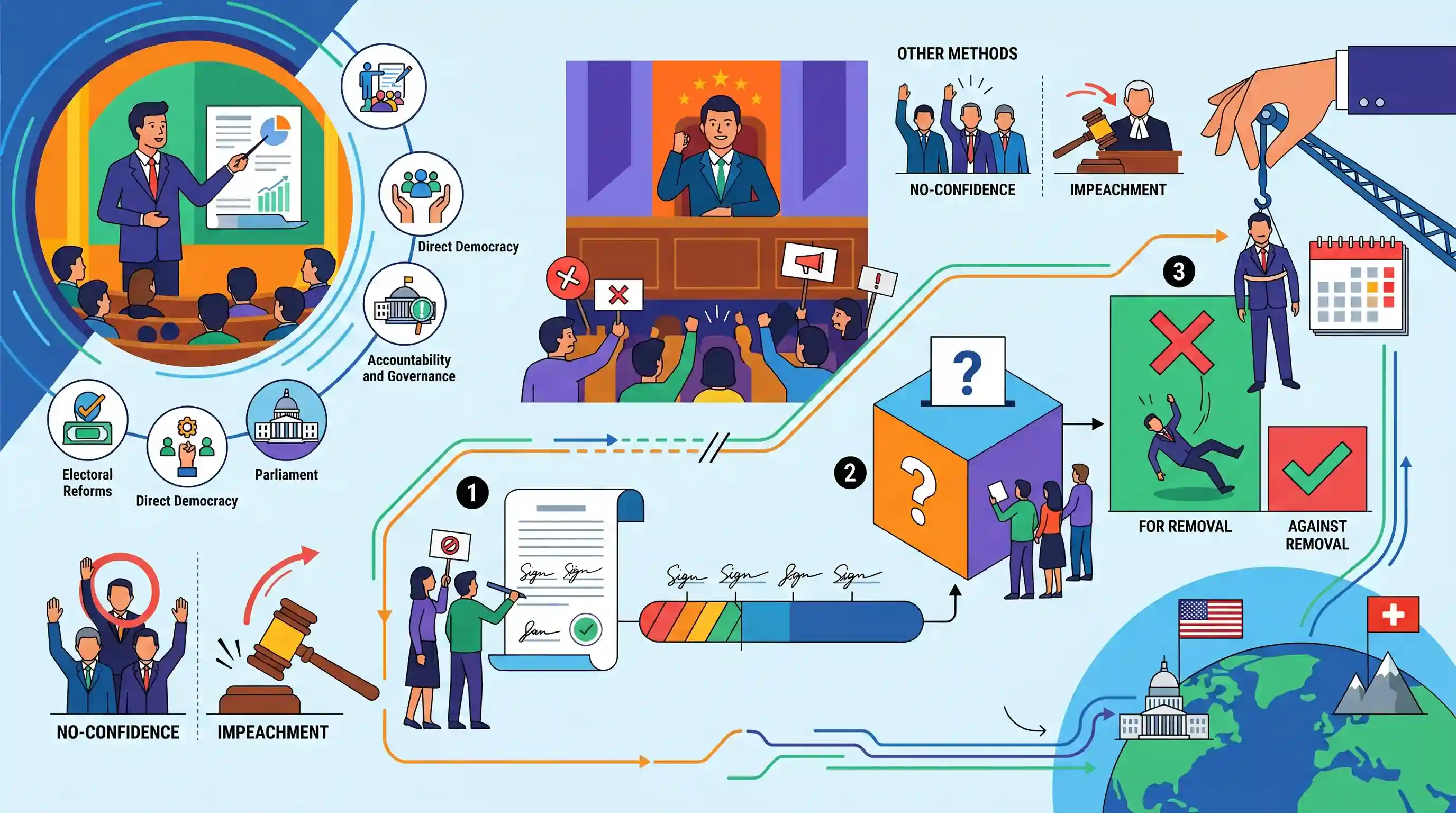
Why It Matters
The 'Right to Recall' is a significant concept under Electoral Reforms and Direct Democracy (GS-2 Polity). It questions the balance between representative democracy and direct voter empowerment, tying into broader debates on political accountability, anti-defection, and the Representation of the People Act.
Summary
AAP MP Raghav Chadha has proposed a 'Right to Recall' mechanism in Parliament, advocating for voters' power to remove non-performing or corrupt MPs and MLAs before their five-year term expires. Pointing to existing constitutional accountability measures like no-confidence motions and impeachment procedures for top officials, Chadha argues for direct democratic oversight. The proposal includes stringent safeguards to prevent misuse, such as an 18-month cooling-off period, a requirement for 35-40% of voters to initiate a petition, and a final recall vote requiring over 50% approval. The measure draws inspiration from similar democratic tools utilized in countries like the US and Switzerland.
Key Points
- AAP MP Raghav Chadha proposed a 'Right to Recall' mechanism during the Budget Session to allow voters to remove non-performing MPs and MLAs before their five-year terms end.
- The proposed system aims to establish accountability similar to no-confidence motions against governments and impeachment processes for constitutional functionaries.
- Proposed safeguards include an 18-month cooling-off period post-elections and requiring 35-40% of voters to sign a verified recall petition.
- A successful recall would mandate that over 50% of the electorate vote in favor of the representative's removal.
- The proposal draws parallels to recall provisions in other democratic nations like the US and Switzerland.
Important Terms
Right to Recall

A democratic mechanism allowing voters to remove an elected representative before their term expires through a direct vote or petition, based on non-performance or misconduct.
UPSC context
GS Paper 2 (Polity); relates to electoral reforms, accountability, and citizen-centric governance. Tested in both Prelims and Mains.
Representation of the People Act, 1951
The primary legislation governing elections in India; it currently provides for seat vacation only due to specific offenses or disqualification, not for general voter dissatisfaction.
UPSC context
GS Paper 2 (Polity); fundamental for understanding electoral laws and disqualification criteria for MPs and MLAs.
Direct Democracy
A form of governance where citizens directly participate in decision-making or removal of representatives (e.g., recall, referendum, initiative) rather than relying solely on periodic elections.
UPSC context
GS Paper 2; contrasts with India’s representative democracy; important for understanding global democratic models and potential Indian reforms.
Zero Hour
An informal parliamentary period immediately following Question Hour where members can raise matters of urgent public importance without prior notice.
UPSC context
GS Paper 2; parliamentary procedures; tested in Prelims to assess knowledge of Indian legislative innovations.
Constituent Assembly Debates
The body that drafted India's Constitution; it debated the Right to Recall, which was ultimately rejected by B.R. Ambedkar over concerns regarding political instability.
UPSC context
GS Paper 2; provides historical and philosophical underpinnings of constitutional provisions; vital for critical analysis in Mains.
Local Self-Government
Tiered governance (Panchayats/Municipalities) where some Indian states like Bihar and Madhya Pradesh have already implemented recall provisions for local heads like Sarpanchs.
UPSC context
GS Paper 2; 73rd and 74th Amendments; tests knowledge of decentralized governance and state-specific electoral innovations.
Prelims Trap
"The Right to Recall mechanism is entirely absent in the Indian democratic and electoral framework."
This is false. While MPs and MLAs cannot be recalled, several states (like MP, Bihar, and Haryana) have successfully implemented statutory Right to Recall provisions for local body representatives (Panchayats and Municipalities).
Static Concepts Connected
What are the four primary tools of direct democracy?
- Recall: A procedure allowing dissatisfied voters to formally remove an elected representative from office before their normal term expires.
- Referendum: A direct, typically binding vote by the electorate on a specific legislative or constitutional proposal referred to them.
- Initiative: The mechanism empowering ordinary citizens to formally propose a new law or policy directly to the legislature for consideration.
- Plebiscite: A vote to gauge public opinion on major issues of public importance, often used for resolving territorial or sovereignty disputes.
How can an MP's seat be vacated before term expiry under current laws?
- Constitutional Disqualification: Disqualification under Article 102 (e.g., holding an Office of Profit, unsound mind) or the 10th Schedule (Anti-Defection Law).
- RPA 1951 Grounds: Vacation due to conviction for specific offences, corrupt electoral practices, or failing to lodge election expenses.
- Absence or Resignation: Voluntary resignation accepted by the presiding officer, or absence from all House meetings for 60 consecutive days without permission.
Cross-Topic Patterns
Direct Democracy vs Constitutional Stability
The demand for Recall links to Constituent Assembly debates, where B.R. Ambedkar rejected it fearing political instability and victimisation of candidates via rivalries in India's infant democracy.
Private Member Bills & Electoral Reforms
Historical advocacy for Right to Recall showcases how Private Member Bills are used to spark national debates on RPA amendments, despite their near-zero passage rate.

Direct democracy tools (Recall, Initiative, Referendum) matched against their precise definitions is a highly probable 2026 Prelims question.
Linked PYQs · 4
Linked PYQs · 4
- 2024MainsGS2
Examine the need for electoral reforms as suggested by various committees with particular reference to "one nation one election" principle.
- 2022MainsGS2
Discuss the procedures to decide the disputes arising out of the election of a Member of the Parliament or State Legislature under The Representation of the People Act, 1951. What are the grounds on which the election of any returned candidate may be declared void ? What remedy is available to the aggrieved party against the decision ? Refer to the case laws.
- 2020MainsGS2
There is a need for simplification of procedure for disqualification of persons found guilty of corrupt practices under the Representation of Peoples Act". Comment.
- 2019PrelimsGS1
Consider the following statements: 1. The motion to impeach a Judge of the Supreme Court of India cannot be rejected by the Speaker of the Lok Sabha as per the Judges (Inquiry) Act, 1968. 2. The Constitution of India defines and gives details of what constitutes 'incapacity and proved misbehaviour' of the Judges of the Supreme Court of India. 3. The details of the process of impeachment of the Judges of the Supreme Court of India are given in the Judges (Inquiry) Act, 1968. 4. If the motion for the impeachment of a Judge is taken up for voting, the law requires the motion to be backed by each House of the Parliament and supported by a majority of total membership of that House and by not less than two-thirds of total members of that House present and voting. Which of the statements given above is/are correct?
