Fake consumer goods and expiry date tampering racket in Delhi
Source:Indian Express ↗
Why It Matters
This case exposes significant loopholes in the monitoring and disposal of expired consumer goods and pharmaceuticals, posing severe public health risks. It underscores the critical need for effective enforcement by regulatory authorities like the FSSAI and CDSCO to prevent adulteration and safeguard consumer rights.
Summary
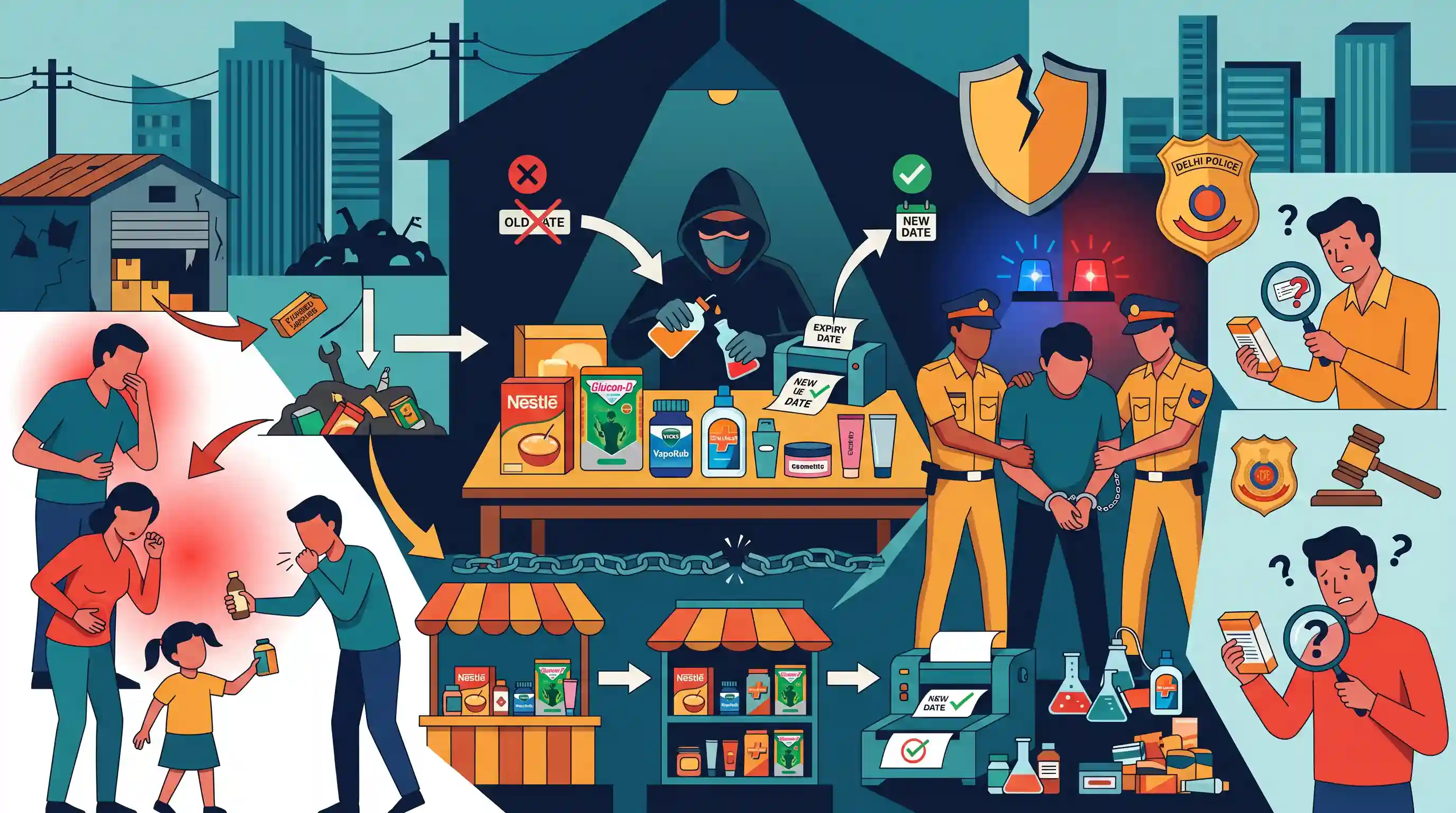
The Delhi Police Crime Branch has busted an organized racket in Delhi involved in altering the expiry dates of expired consumer products, cosmetics, and medicines, including popular brands like Nestle, Glucon-D, Vicks VapoRub, and Savlon. The operation involved erasing original expiry dates using chemical agents and printing fraudulent extended dates before redistributing the products into the open market. The raid led to the arrest of the primary accused and the seizure of raw materials and machinery used in the forgery. This incident highlights critical vulnerabilities in consumer protection and the supply chain, emphasizing the need for stricter regulatory enforcement by bodies like the FSSAI and drug controllers to safeguard public health against counterfeit and adulterated goods.
Key Points
- The Delhi Police Crime Branch uncovered an organized racket altering the expiry dates of various expired FMCG and medical products.
- Items recovered included popular brands such as Nestle Sugar Free, Glucon-D, Vicks VapoRub, Savlon, and Dabur products.
- The accused utilized chemicals to erase original expiry dates and reprinted fake extended dates for redistribution into the market.
- The incident highlights severe vulnerabilities in the supply chain and consumer safety regulations, posing significant risks to public health.
Important Terms
Delhi Police Crime Branch

Specialized investigative wing of the Delhi Police handling organized crime, interstate rackets, and serious offenses under the administrative control of the Ministry of Home Affairs.
UPSC context
GS Paper III: Internal Security; Governance/Law enforcement agencies and their mandate.
Food Safety and Standards Authority of India (FSSAI)
Autonomous statutory body established under the Food Safety and Standards Act, 2006, to consolidate food laws and set science-based standards for food articles.
UPSC context
GS Paper II/III: Regulatory bodies; Food safety and security standards in India.
Central Drugs Standard Control Organization (CDSCO)
India's national regulatory body for pharmaceuticals and medical devices under the Ministry of Health, responsible for drug approvals, standards, and quality control.
UPSC context
GS Paper II: Governance; Issues relating to development and management of Social Sector/Health.
Consumer Protection Act, 2019
Comprehensive legislation replacing the 1986 Act, introducing the Central Consumer Protection Authority, product liability, and strict penalties for selling adulterated or spurious goods.
UPSC context
GS Paper II: Government policies and interventions for development in various sectors.
Central Consumer Protection Authority (CCPA)
Statutory body formed under the Consumer Protection Act, 2019, to protect consumer rights, investigate violations, and order recalls of unsafe goods or services.
UPSC context
GS Paper II: Statutory, regulatory and various quasi-judicial bodies.
Food Adulteration
The intentional addition of inferior substances or alteration of food quality (e.g., expiry dates) making it harmful or substandard; listed under the Concurrent List.
UPSC context
GS Paper III: Agriculture/Food processing; GS Paper IV: Ethical responsibilities of businesses.
Counterfeit Goods
Fraudulent imitation or illegal manufacturing of branded products, classified as an 'unfair trade practice' with severe penalties under Indian consumer law.
UPSC context
GS Paper III: Intellectual Property Rights (IPR); Economy and Supply Chain Security.
Prelims Trap
"FSSAI is the sole authority regulating all packaged consumer health goods, including over-the-counter ointments like Vicks and antiseptics."
FSSAI regulates food and dietary supplements. Over-the-counter medicines, ointments (Vicks), and antiseptics (Savlon) fall under the CDSCO via the Drugs and Cosmetics Act, 1940.
Static Concepts Connected
What are the respective regulatory domains of FSSAI and CDSCO?
- FSSAI Mandate: Regulates food safety, dietary supplements, and nutraceuticals under the Ministry of Health (FSS Act 2006).
- CDSCO Mandate: Approves new drugs, cosmetics, and medical devices. It derives its power from the Drugs and Cosmetics Act, 1940.
What are the core enforcement powers of the Central Consumer Protection Authority (CCPA)?
- Statutory Origin: Established under the Consumer Protection Act 2019 to proactively protect and enforce consumer rights.
- Enforcement Powers: Can initiate suo-moto actions, order recalls of unsafe goods, and penalize misleading advertisements or unfair trade practices.
Cross-Topic Patterns
Spurious Drugs & the AMR Crisis
Substandard medicines with degraded or diluted active pharmaceutical ingredients (APIs) directly accelerate antimicrobial resistance, transforming consumer fraud into a major GS2 global public health crisis.
Supply Chain Tech: Blockchain Traceability
Rampant expiry-date forgery in FMCG exposes severe reverse-logistics gaps. It underscores the urgency of deploying blockchain and RFID technology for end-to-end traceability in GS3 food processing.

Expect a comparative Prelims question testing the exact jurisdictional boundaries between FSSAI, CDSCO, and CCPA over supplements.
Linked PYQs · 3
Linked PYQs · 3
- 2025MainsGS3
Elaborate the scope and significance of supply chain management of agricultural commodities in India.
- 2022MainsGS3
Elaborate the scope and significance of the food processing industry in India.
- 2025MainsGS3
Examine the scope of the food processing industries in India. Elaborate the measures taken by the government in the food processing industries for generating employment opportunities.
