Rabri Devi Vacates Official Patna Bungalow After Two Decades
Source:The Hindu ↗
Why It Matters
This development highlights the dynamics of state-level political transitions and executive privileges in Bihar. It connects with essential BPSC Prelims topics such as the historical background of the Bihar Legislative Assembly and Legislative Council (established as bicameral under the Government of India Act 1919), the constitutional/statutory role of the Leader of the Opposition, and the political history of Bihar's Chief Ministers.
Summary
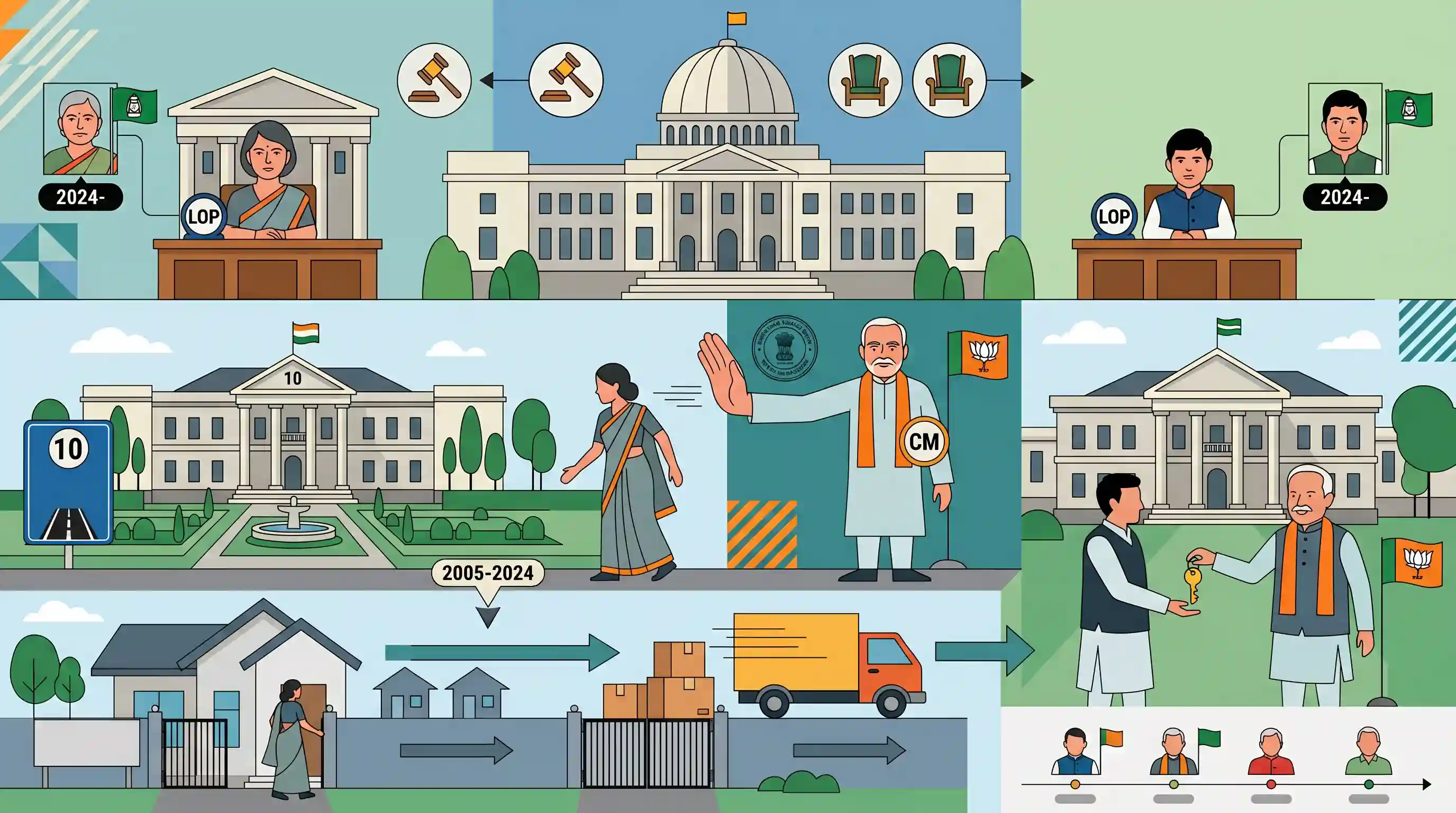
Former Bihar Chief Minister Rabri Devi vacated her official government bungalow at 10, Circular Road, Patna, and moved to her private residence in Kautilya Nagar. Having occupied the prominent bungalow since 2005, her eviction followed pressure from the BJP administration led by Chief Minister Samrat Choudhary. The bungalow has been re-allotted to BJP leader and Minister Nand Kishor Ram. Rabri Devi currently serves as the Leader of the Opposition in the Bihar Legislative Council, while her son Tejashwi Yadav remains the Leader of the Opposition in the Bihar Legislative Assembly.
Key Points
- Former Bihar Chief Minister Rabri Devi vacated her long-occupied government bungalow at 10, Circular Road, Patna, and shifted to her private house in Kautilya Nagar.
- Rabri Devi had occupied the 10, Circular Road bungalow since 2005 (nearly two decades), which also served as the camp office for the Rashtriya Janata Dal (RJD).
- The eviction came under pressure from the current BJP-led administration under Chief Minister Samrat Choudhary, and the bungalow has been allotted to BJP Minister Nand Kishor Ram.
- Rabri Devi holds the position of Leader of the Opposition in the Bihar Legislative Council, while her younger son, Tejashwi Yadav, is the Leader of the Opposition in the Bihar Legislative Assembly.
- Her elder son, Tej Pratap Yadav, who is currently estranged from the family, lives in a separate government bungalow running the Janshakti Janata Dal.
Important Terms
Bihar Legislative Council

The upper house (Vidhan Parishad) of Bihar's bicameral state legislature, established under Article 169 of the Indian Constitution, acting as a permanent, non-dissolvable advisory chamber.
UPSC context
GS Paper II (Polity). Tests understanding of state bicameralism, constitutional provisions, and the role of upper houses.
Bihar Legislative Assembly
The directly elected lower house (Vidhan Sabha) of Bihar's legislature, established under Article 170 of the Constitution, possessing primary law-making and financial powers.
UPSC context
GS Paper II (Polity). Tests knowledge of state legislative powers, democratic representation, and law-making processes.
Leader of the Opposition
A statutory position recognized under the 1977 Act, given to the leader of the largest opposition party with at least 10% seats, holding a cabinet minister rank.
UPSC context
GS Paper II (Polity). Tests knowledge of legislative accountability, statutory posts, and the functioning of parliamentary democracy.
Rashtriya Janata Dal (RJD)
A prominent regional political party in Bihar, founded in 1997, centered on social justice and secularism, with a significant support base among backward classes.
UPSC context
GS Paper II (Polity). Tests understanding of regional political parties, coalition politics, and socio-political evolution.
Bharatiya Janata Party (BJP)
A major national political party in India, advocating right-wing nationalist politics, and a key player in central governance and various state coalitions.
UPSC context
GS Paper II (Polity). Tests knowledge of national party dynamics, political ideologies, and federal alliances.
Janata Dal (United) [JD(U)]
A regional socialist political party in Bihar led by Nitish Kumar, acting as a crucial pivot in state-level alliance and coalition governance.
UPSC context
GS Paper II (Polity). Tests knowledge of coalition federalism and the role of regional parties.
Prelims Trap
The 10% seat requirement for the Leader of the Opposition is explicitly defined in the Salary and Allowances of Leaders of Opposition Act, 1977.
This 10% threshold is actually based on the 'Mavalankar Rule' (Speaker's Direction 121) and parliamentary convention, not written into the text of the 1977 Act.
Static Concepts Connected
What is the legal status and threshold for the Leader of the Opposition (LoP)?
- Statutory status: The LoP post is statutory, defined under the 1977 Act, granting the holder the status of a Cabinet Minister, not a constitutional post.
- Numerical threshold: The 10% seat requirement is derived from Speaker's directions (Direction 121) and parliamentary conventions, not explicitly written in any statute.
How is a State Legislative Council created or abolished under the Constitution?
- Constitutional basis: Under Article 169, Parliament can abolish or create a Legislative Council if the state Assembly passes a resolution by a special majority.
- Legislative process: The subsequent Act passed by Parliament requires only a simple majority and is not considered a constitutional amendment under Article 368.
Cross-Topic Patterns
State Bicameralism and Federalism
Asymmetric bicameralism across Indian states reflects legislative diversity, where states like Bihar retain upper houses while others seek abolition, influencing state-level check-and-balance systems.
Executive Discretion and Statutory Privileges
The allocation of official housing and state resources to political leaders highlights the boundary between administrative law, executive discretion, and statutory rights of opposition leaders.

The statutory origin of the Leader of the Opposition and the procedural 10% rule are highly likely to be tested in Polity.
Linked PYQs · 3
Linked PYQs · 3
- 2020BPSC_PRELIMSGS1
Who was the first Chief Minister of Bihar?
- 2024-IBPSC_PRELIMSGS1
Which of the following Acts converted Unicameral Legislature of Bihar into Bicameral : Bihar Legislative Assembly and Bihar Legislative Council?
- 2024-IBPSC_PRELIMSGS1
Under the Government of India Act 1935, who was the first elected Chairman of Bihar Legislative Council ?
