Public Health Response and Stray Dog Population Management Issues
Source:The Hindu ↗
Why It Matters
This issue sits at the intersection of GS2 (Public Health and Local Governance) and GS3 (Science and Technology - vaccines/immunity). Understanding the distinction between active immunity (vaccines) and passive immunity (immunoglobulins) is highly relevant for Prelims, while the failure of local bodies to implement Animal Birth Control (ABC) rules provides a practical case study for Mains GS2 governance questions.
Summary
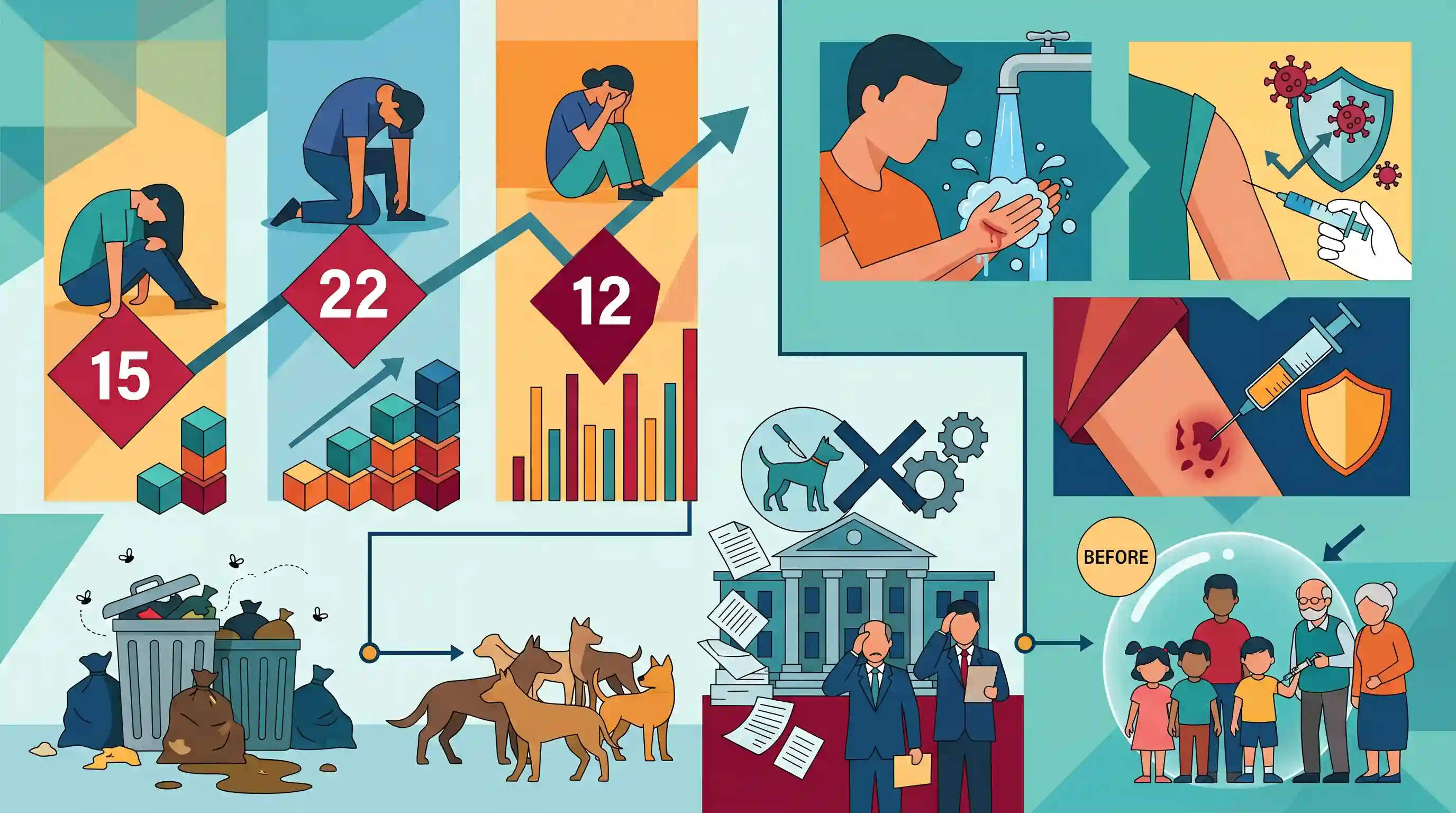
Kerala is experiencing a concerning rise in rabies deaths, with fatalities increasing from 15 in 2022 to 22 in 2024, and 12 already recorded in 2025. The crisis is fueled by a burgeoning stray dog population due to inadequate waste management and the failure of local bodies to effectively implement Animal Birth Control (ABC) rules. Public health experts stress the critical need for awareness regarding immediate post-exposure protocols—such as washing wounds with soap and administering both anti-rabies vaccines (active immunity) and immunoglobulin serum (passive immunity) for severe bites. Furthermore, experts are advocating for Pre-Exposure Prophylaxis (PrEP) vaccination for children and vulnerable populations to mitigate the rising risk of rabies infections.
Key Points
- Rabies deaths in Kerala have seen a troubling upward trend, rising from 15 in 2022 to 22 in 2024, with 12 deaths already recorded in early 2025.
- The surge is largely attributed to the exponential growth of the stray dog population, driven by ineffective waste management and poor implementation of Animal Birth Control (ABC) rules by local bodies.
- Public health experts advocate for Pre-Exposure Prophylaxis (PrEP) vaccination, especially for children, to prevent fatalities given the ubiquity of stray dogs.
- Immediate post-exposure treatment requires thorough wound washing with soap and water, followed by anti-rabies vaccination (active immunity) and Immunoglobulin serum (passive immunity) for WHO Category III bites.
- Many recent fatalities occurred because victims were unaware of the severe risks of dog bites and failed to seek timely post-exposure prophylaxis.
Important Terms
Animal Birth Control (ABC) Rules 2023

Regulatory framework under the Prevention of Cruelty to Animals Act, 1960, mandating a 'Catch-Neuter-Vaccinate-Return' (CNVR) approach by local bodies to manage stray animal populations humanely.
UPSC context
GS Paper II (Governance/Local Bodies) and GS Paper III (Animal Husbandry/Ethics). Tests knowledge of administrative responsibilities in human-wildlife conflict.
Zoonotic Diseases
Infectious diseases that jump from non-human animals (vertebrates) to humans, such as Rabies, Nipah, and COVID-19, often linked to environmental degradation and poor waste management.
UPSC context
GS Paper III (Science & Technology/Environment). Central to the 'One Health' approach and pandemic preparedness discussions.
Passive Immunity
Immediate, temporary protection provided by administering ready-made antibodies (Immunoglobulin) to neutralize pathogens directly at the infection site before the body's immune system responds.
UPSC context
GS Paper III (Science & Technology). Essential for understanding medical interventions for severe (Category III) animal bites.
Active Immunity
Long-term protection developed when a vaccine stimulates the body’s own immune system to produce antibodies and memory cells; in rabies, it requires a multi-dose schedule.
UPSC context
GS Paper III (Science & Technology). Tests conceptual clarity between different immunization strategies and public health protocols.
Pre-Exposure Prophylaxis (PrEP)
Preventative vaccination administered to high-risk individuals (e.g., veterinarians, children in endemic areas) before any exposure to provide baseline protection and simplify future treatment.
UPSC context
GS Paper II (Social Justice/Health). Relevant for public health policy interventions and preventive healthcare strategies.
Post-Exposure Prophylaxis (PEP)
The emergency medical response following a potential rabies exposure, including thorough wound washing, a course of vaccines, and potentially immunoglobulin serum for severe cases.
UPSC context
GS Paper II (Public Health). Tests awareness of life-saving medical protocols in zoonotic disease management.
Prelims Trap
"Anti-rabies vaccines provide immediate passive immunity to neutralize the rabies virus post-exposure."
Vaccines trigger active immunity, which takes time. Readymade Immunoglobulin (or monoclonal antibodies) provides immediate passive immunity. UPSC frequently reverses these mechanisms in S&T statements.
Static Concepts Connected
What is the difference between active and passive immunity?
- Active Immunity: The body's own immune system produces antibodies in response to a pathogen or vaccine. It is delayed but offers long-lasting immune memory.
- Passive Immunity: Ready-made antibodies (like immunoglobulins or monoclonal antibodies) are directly administered for immediate, albeit temporary, protection against the virus.
What are the core mandates of the Animal Birth Control (ABC) Rules, 2023?
- Statutory Origin: Notified by the Centre under the Prevention of Cruelty to Animals (PCA) Act, 1960 to humanely manage stray dog populations.
- No Relocation: Strictly mandates that dogs must be captured, sterilized, vaccinated, and returned to the exact same locality. Permanent relocation or culling is prohibited.
- Local Body Responsibility: Municipalities and Panchayats are legally bound to establish ABC monitoring committees and execute anti-rabies programs.
Cross-Topic Patterns
Solid Waste Rules + Urban Zoonoses
Poor municipal waste management provides food that sustains stray populations. This links urban governance (Solid Waste Management Rules) directly to the epidemiology of zoonotic diseases.
Biotech + Passive Immunity
Modern passive immunity for severe bites relies on Rabies Monoclonal Antibodies. This connects a local public health crisis to UPSC's recurrent focus on applied biotechnology and engineered proteins.

Expect a 2026 prelims S&T question combining rabies (RNA virus), active vs passive immunity, and the ABC Rules 2023 provisions.
Linked PYQs · 3
Linked PYQs · 3
- 2024PrelimsGS1
With reference to monoclonal antibodies, often mentioned in news, consider the following statements : I. They are man-made proteins. II. They stimulate immunological function due to their ability to bind to specific antigens. III. They are used in treating viral infections like that of Nipah virus. Which of the statements given above are correct?
- 2025PrelimsGS1
With reference to monoclonal antibodies, often mentioned in news, consider the following statements : I. They are man-made proteins. II. They stimulate immunological function due to their ability to bind to specific antigens. III. They are used in treating viral infections like that of Nipah virus. Which of the statements given above are correct?
- 2024MainsGS2
Analyse the role of local bodies in providing good governance at local level and bring out the pros and cons merging the rural local bodies with the urban local bodies.
